
Article
Chiller Plant Architecture
Nov 2026
1. Engineering Overview
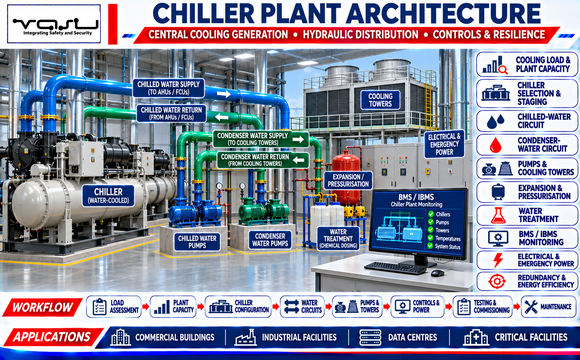
Chiller Plant Architecture establishes the central cooling-generation and distribution infrastructure required to serve the building HVAC load. The architecture should coordinate chillers, chilled-water and condenser-water systems, pumps, cooling towers where applicable, controls, electrical power, water treatment, redundancy, energy efficiency, monitoring and maintainability.
2. Complete Chiller Plant Architecture
Cooling Load Assessment → Plant Capacity → Chiller Selection → Chiller Arrangement → Chilled Water Circuit → Condenser Water Circuit → Pumps → Cooling Towers → Headers → Expansion / Pressurisation → Water Treatment → Controls → BMS / IBMS → Electrical Power → Emergency Power → Testing & Commissioning → Maintenance
3. Design Philosophy
The chiller plant should be configured to meet peak and diversified cooling requirements while maintaining efficient part-load operation, resilience and maintainability. Plant arrangement should be based on building criticality, operating profile, available space and future expansion requirements.
4. Cooling Load Assessment
The plant capacity should be established from the approved cooling-load assessment, considering envelope loads, occupancy, lighting, equipment, ventilation, process loads and applicable diversity factors.
5. Chiller Capacity & Quantity
The number and capacity of chillers should be selected to satisfy required load conditions while providing suitable staging and redundancy. Oversizing and excessive cycling should be avoided.
6. Chiller Type Selection
Chiller type should be selected according to required capacity, efficiency, water availability, ambient conditions, refrigerant requirements, maintenance strategy, acoustic constraints and project operating requirements.
7. Chiller Arrangement
Chillers should be arranged with suitable isolation, headers, flow measurement, strainers, control valves and access for maintenance. The arrangement should support independent operation and required plant sequencing.
8. Chilled Water Circuit
The chilled-water circuit should include chillers, pumps, headers, distribution piping, valves, expansion / pressurisation equipment, air and dirt separation and connections to AHUs / FCUs.
9. Condenser Water Circuit
For water-cooled chillers, the condenser-water circuit should include condenser-water pumps, cooling towers, piping, isolation valves, strainers, water-treatment provisions and controls.
10. Primary Pumping
Where primary pumping is adopted, pumps should maintain the required evaporator flow through each operating chiller under all approved conditions.
11. Secondary Pumping
Where secondary pumping is adopted, pumps should deliver variable building flow according to terminal demand while maintaining required differential pressure.
12. Primary-Secondary Configuration
Where primary-secondary pumping is used, the hydraulic interface should maintain stable chiller flow while accommodating variable secondary demand.
13. Variable Primary Flow
Where variable-primary-flow operation is adopted, minimum chiller flow, pump control, bypass arrangements and control-valve operation should be coordinated.
14. Pump Selection
Chilled-water and condenser-water pumps should be selected for required flow, head, efficiency, operating range and redundancy. Variable-speed drives should be considered for variable-flow systems.
15. Cooling Tower Interface
Cooling towers should reject condenser heat under design and part-load conditions. Tower staging, fan control and condenser-water temperature should be integrated with chiller operation.
16. Chilled Water Temperature Management
Supply and return chilled-water temperatures should be controlled to meet connected cooling loads while supporting chiller efficiency and stable plant operation.
17. Condenser Water Temperature Management
Condenser-water temperature should be controlled within the chiller manufacturer’s and approved design operating range to optimise performance and prevent unstable operation.
18. Hydraulic Headers
Common supply and return headers should be sized for required flow and configured with suitable isolation and balancing arrangements to support plant operation and maintenance.
19. Expansion & Pressurisation
Suitable expansion vessels, pressurisation equipment, safety devices and make-up arrangements should maintain stable system pressure across the operating temperature range.
20. Air & Dirt Separation
Air separators, automatic vents, strainers and dirt separators should be provided as required to protect chillers, pumps, control valves and heat-transfer surfaces.
21. Water Treatment
Chilled-water and condenser-water systems should have appropriate water-treatment arrangements to control corrosion, scaling, fouling and biological growth.
22. Chemical Dosing
Chemical-dosing systems should be sized and controlled according to the water-treatment strategy. Storage, injection and monitoring arrangements should be safe and maintainable.
23. Electrical Power Supply
Chillers, pumps, cooling towers, controls and associated equipment should be coordinated with electrical distribution, motor protection, variable-frequency drives and plant power-quality requirements.
24. Emergency Power
Where required for critical facilities, designated cooling equipment and associated controls should be connected to emergency or standby power in accordance with the approved resilience strategy.
25. Redundancy & Resilience
Critical chiller plants should be assessed for N+1, duty / standby or other redundancy arrangements for chillers, pumps, cooling towers, power supplies and control systems.
26. Plant Room Planning
The chiller plant room should provide adequate equipment clearances, maintenance access, lifting / replacement routes, ventilation, drainage, acoustic treatment and safe operating space.
27. Controls & Automation
Plant controls should coordinate chiller staging, pump sequencing, cooling-tower operation, temperature reset, differential-pressure control, bypass arrangements and system safeties.
28. BMS / IBMS Integration
Chiller status, temperatures, pressures, flows, alarms, energy data, pump status, tower operation and other plant parameters should be integrated with BMS / IBMS where required.
29. Energy Efficiency
Plant design should consider high-efficiency chillers, variable-speed pumping, cooling-tower optimisation, chilled-water temperature reset, condenser-water reset, free cooling where applicable and efficient plant sequencing.
30. Installation Requirements
Chiller plant installation should verify:
- Correct chiller capacity
- Correct chiller quantity
- Correct chiller arrangement
- Correct chilled-water pumps
- Correct condenser-water pumps
- Correct cooling towers
- Correct headers
- Correct piping sizes
- Correct valves
- Correct strainers / separators
- Correct expansion / pressurisation
- Correct water treatment
- Correct electrical supply
- Correct controls
- Correct BMS / IBMS interface
- Correct emergency-power provisions
- Correct access and maintenance clearances
- Correct drainage and housekeeping
31. Testing & Commissioning
Chiller plant commissioning should verify:
- Chiller operation
- Chiller staging
- Chilled-water flow
- Condenser-water flow
- Supply / return temperatures
- Temperature differential
- Pump operation
- Cooling-tower operation
- Control-valve operation
- Differential-pressure control
- Water quality
- Plant controls
- BMS / IBMS monitoring
- Emergency-power operation where applicable
32. Hydraulic Balancing
Chilled-water and condenser-water circuits should be balanced to achieve approved design flow and pressure conditions. Final TAB records should document measured values.
33. Chiller Performance Testing
Chiller performance should be assessed under representative operating and part-load conditions. Capacity, temperatures, flow, power consumption and operating stability should be recorded as required.
34. Integrated Plant Testing
The complete plant should be tested with AHUs / FCUs, pumps, cooling towers, controls, BMS / IBMS, electrical systems and relevant emergency-power arrangements.
35. Maintenance
Preventive maintenance should include chiller servicing, pump inspection, cooling-tower cleaning, heat-exchanger checks, strainer cleaning, water-treatment monitoring, valve inspection, sensor calibration and control-system checks.
36. Impairment Management
Any impairment affecting chiller capacity, pumps, cooling towers, power, controls or distribution should be formally controlled. Available standby capacity and temporary cooling arrangements should be assessed.
37. Failure & Recovery
The plant should address chiller failure, pump failure, tower failure, power loss, control failure, high / low temperature conditions and communication loss. Automatic or manual recovery should restore required cooling capacity.
38. Design Change Control
Changes to cooling loads, occupancy, chiller capacity, AHU connections, plant layout, operating schedules or resilience requirements should trigger a review of plant capacity and hydraulic / control arrangements.
39. Documentation
Chiller plant documentation should include, as applicable:
- Chiller plant design basis
- Cooling-load calculations
- Chiller schedule
- Pump schedules
- Cooling-tower schedule
- Chilled-water schematic
- Condenser-water schematic
- Piping layouts
- Hydraulic calculations
- Pipe-sizing calculations
- Pressure-drop calculations
- Valve schedule
- Expansion / pressurisation details
- Water-treatment philosophy
- Chemical-dosing details
- Controls philosophy
- BMS / IBMS interface
- Electrical interface
- Emergency-power arrangement
- Equipment datasheets
- Installation records
- Flushing and water-quality records
- TAB reports
- Chiller performance test reports
- Testing and commissioning records
- Integrated plant test reports
- Maintenance schedule
- Impairment records
- As-built drawings
- O&M manual
40. Engineering Objective
The engineering objective is:
Assess Cooling Loads → Establish Plant Capacity & Resilience → Select Chiller Type, Quantity & Configuration → Design Chilled-Water & Condenser-Water Circuits → Select Pumps & Cooling Towers → Provide Headers, Valves, Expansion & Water Treatment → Integrate Controls, BMS / IBMS & Electrical Power → Establish Redundancy & Emergency Power → Verify Hydraulic & Thermal Performance → Test Plant Sequencing & Part-Load Operation → Execute Integrated Commissioning → Maintain Reliable, Efficient & Maintainable Chiller Plant Operation
Frequently Asked Questions
What is covered under 1. Engineering Overview?
Chiller Plant Architecture establishes the central cooling-generation and distribution infrastructure required to serve the building HVAC load. The architecture should coordinate chillers, chilled-water and condenser-water systems, pumps, cooling towers where applicable, controls, electrical power, water treatment, redundancy, energy efficiency, monitoring and maintainability.
What is covered under 2. Complete Chiller Plant Architecture?
Cooling Load Assessment → Plant Capacity → Chiller Selection → Chiller Arrangement → Chilled Water Circuit → Condenser Water Circuit → Pumps → Cooling Towers → Headers → Expansion / Pressurisation → Water Treatment → Controls → BMS / IBMS → Electrical Power → Emergency Power → Testing & Commissioning → Maintenance
What is covered under 3. Design Philosophy?
The chiller plant should be configured to meet peak and diversified cooling requirements while maintaining efficient part-load operation, resilience and maintainability. Plant arrangement should be based on building criticality, operating profile, available space and future expansion requirements.