
Article
Clean Agent Fire Suppression: Working Principle
Oct 2026
Direct Answer
A clean agent fire suppression system detects a developing fire, evaluates the approved releasing logic, provides the specified pre-discharge warnings and releases the selected gaseous extinguishing agent into a protected enclosure. Successful operation depends on the approved design, agent quantity, distribution network, enclosure integrity, pressure management and coordinated building-system interfaces.
1. Engineering Overview
A Clean Agent Fire Suppression System is an engineered fire protection system that uses a gaseous extinguishing agent to suppress or control fire within a protected enclosure without relying primarily on water or other conventional wet extinguishing media. The system combines automatic detection, releasing logic, agent storage, distribution piping and discharge nozzles.
2. Basic System Architecture
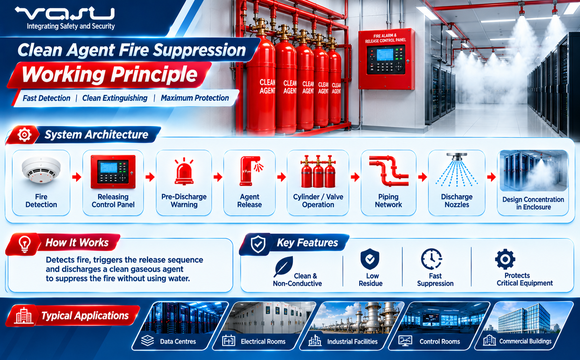
Fire Detection → Releasing Control Panel → Confirmed Alarm / Release Logic → Pre-Discharge Warning → Agent Release → Cylinder / Valve Operation → Piping Network → Discharge Nozzles → Design Concentration in Protected Enclosure
3. Working Principle
The system detects a developing fire through approved automatic detection devices. When the programmed release conditions are satisfied, the releasing control panel initiates the pre-discharge sequence and, after the configured delay and required interlocks, activates the agent release mechanism. The extinguishing agent is then discharged through the distribution network into the protected enclosure.
4. Clean Agent Concept
Clean agents are gaseous extinguishing media designed for applications where minimising residue and equipment contamination is important. Agent selection should be based on the hazard, required design concentration, enclosure characteristics, environmental conditions, applicable requirements and the approved system design.
5. Fire Detection Layer
Automatic detectors continuously monitor the protected enclosure for indications of fire. The detection arrangement may use smoke detectors, heat detectors, aspirating smoke detection or other approved technologies depending on the hazard and design philosophy.
6. Releasing Control Logic
The releasing control panel evaluates the configured detection inputs and controls the suppression sequence. The logic should provide appropriate alarm, fault, supervisory and release indications and should operate according to the approved Cause & Effect Matrix.
7. Pre-Discharge Sequence
Before agent discharge, the system may provide audible and visual warning and initiate approved interface actions. The sequence should allow occupants to respond safely and should follow the approved project design and applicable requirements.
8. Agent Storage
The clean agent is stored in approved cylinders selected for the required agent quantity, storage pressure, temperature range and installation configuration. Cylinder quantity and capacity should be determined from the approved design calculation.
9. Distribution Piping
Following release, the agent flows through the engineered piping network towards the discharge nozzles. Pipe sizing, routing, fittings and network configuration should follow the approved flow calculation and manufacturer requirements.
10. Discharge Nozzles
Discharge nozzles distribute the clean agent within the protected enclosure. Nozzle type, quantity, location and discharge characteristics should be established by the approved system design and applicable manufacturer calculations.
11. Design Concentration
The system is designed to achieve the required extinguishing or suppression concentration throughout the protected enclosure. The design concentration should be established from the selected agent, hazard and approved engineering criteria.
12. Enclosure Integrity
The protected enclosure must be sufficiently sealed to retain the discharged agent for the required hold period. Doors, penetrations, dampers, cable entries and other openings should be assessed and treated as required by the approved design.
13. Pressure Management
Agent discharge can produce a pressure change within the enclosure. Where required, pressure relief provisions should be designed to manage the pressure effect while maintaining the required enclosure integrity and suppression performance.
14. Building System Interfaces
Clean agent systems may interface with:
- HVAC equipment
- Fire / smoke dampers
- Access control
- Electrical equipment shutdown
- BMS / IBMS
- Fire alarm system
- Remote monitoring systems
The exact sequence should be defined in the approved Cause & Effect Matrix.
15. Manual Release & Abort Functions
Where specified, manual release stations provide a means of initiating the suppression sequence through deliberate human action. Abort / hold functions may be provided where required by the approved design. Their operation and limitations should be clearly defined and tested.
16. Alarm, Fault & Release Indication
The system should provide clear indication of relevant operating conditions, including fire alarm, system fault, supervisory condition and release status as supported by the selected equipment.
17. Testing & Commissioning
Testing should verify the complete clean agent suppression sequence.
Testing may include:
- Detector activation
- Releasing logic
- Pre-discharge warning
- Manual release
- Abort / hold function, where applicable
- Interface operation
- Cylinder / valve status
- Alarm indication
- Cause & Effect verification
- Reset and restoration
18. Common Engineering Considerations
Engineering review should verify:
- Correct clean agent selection
- Hazard characteristics
- Protected volume
- Design concentration
- Agent quantity
- Cylinder arrangement
- Piping network
- Nozzle arrangement
- Enclosure integrity
- Pressure relief requirements
- Releasing logic
- Building interfaces
19. Documentation
Clean agent system documentation should include, as applicable:
- System design basis
- Agent datasheet
- Agent quantity calculation
- Cylinder schedule
- Piping drawings
- Flow calculation
- Nozzle schedule
- Cause & Effect Matrix
- Enclosure integrity records
- FAT / SAT records
- Commissioning records
- As-built drawings
- O&M manual
20. Engineering Objective
The engineering objective is:
Reliable Fire Detection → Correct Release Logic → Safe Pre-Discharge Sequence → Accurate Agent Quantity → Controlled Agent Distribution → Achieved Design Concentration → Maintained Enclosure Integrity → Verified Interfaces → Complete Commissioning → Reliable Clean Agent Fire Suppression
Frequently Asked Questions
How does a clean agent fire suppression system work?
Approved detectors initiate the configured release logic. The system provides the specified pre-discharge warning and, after the programmed delay and required interlocks, releases the agent through the piping and nozzles into the protected enclosure.
Why is enclosure integrity important?
The enclosure must retain the discharged agent for the required hold period. Doors, penetrations, dampers, cable entries and other openings should be assessed against the approved design.
What determines the amount of clean agent required?
The amount depends on the selected agent, hazard, protected volume and approved engineering calculations. The quantity should not be assumed without the approved design basis.
Do all clean agent systems use the same release sequence?
No universal sequence is established by this overview. The actual sequence depends on the approved system design and Cause & Effect Matrix.
What should be tested during commissioning?
Testing may cover detector activation, releasing logic, warnings, manual release, abort/hold functions where applicable, interfaces, cylinder/valve status, indications, Cause & Effect verification and restoration.
SEO & CMS Publication Metadata
| SEO title | Clean Agent Fire Suppression System: Working Principle |
| Meta description | Learn how a clean agent fire suppression system works, from detection and releasing logic to agent discharge, enclosure integrity, interfaces and commissioning. |
| Suggested URL slug | /clean-agent-fire-suppression-working-principle/ |
| Primary keyword | clean agent fire suppression working principle |
| Related keywords | clean agent suppression system; gaseous fire suppression; clean agent release sequence; enclosure integrity; clean agent commissioning |
| Suggested internal links | Gas Suppression System: Complete Architecture; Fire Alarm System Architecture; Fire Alarm Cause & Effect Matrix; Fire Alarm FAT, SAT & Commissioning Flow |