
Article
Cooling Tower System
Nov 2026
1. Engineering Overview
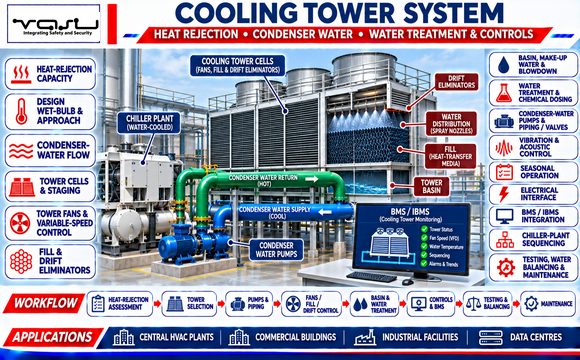
Cooling Tower System establishes the heat-rejection infrastructure required to remove condenser heat from water-cooled chiller plants. The design should address tower capacity, condenser-water flow, entering and leaving water temperatures, ambient design conditions, fans, pumps, water distribution, drift, blowdown, water treatment, controls, acoustics, redundancy, maintenance and integration with the central HVAC plant.
2. Complete Cooling Tower Architecture
Cooling Load → Chiller Plant → Condenser Water Circuit → Condenser Water Pumps → Cooling Towers → Tower Fans → Water Distribution → Fill / Heat-Transfer Media → Drift Eliminators → Basin → Make-Up Water → Blowdown → Water Treatment → Controls → BMS / IBMS → Electrical Power → Testing & Balancing → Maintenance
3. Design Philosophy
Cooling towers should be selected to reject the required condenser heat at the specified design entering and leaving water temperatures and outdoor conditions. The arrangement should provide reliable operation, efficient heat rejection, acceptable water consumption and maintainability.
4. Heat Rejection Requirement
Cooling tower capacity should be based on the total condenser heat rejection from connected chillers under the applicable operating conditions. Chiller efficiency, cooling capacity and part-load operation should be considered.
5. Design Ambient Conditions
The tower selection should consider design outdoor dry-bulb and wet-bulb conditions, seasonal variations and the required approach temperature. Extreme operating conditions should be assessed where relevant.
6. Cooling Tower Type
The selected tower type should suit the project application, available space, water quality, acoustic requirements, maintenance strategy and required heat-rejection performance. Counterflow or crossflow arrangements should be evaluated as appropriate.
7. Tower Capacity & Approach
Tower capacity should achieve the required condenser-water leaving temperature at the specified design wet-bulb condition. The approach temperature should be appropriate for the chiller plant design.
8. Condenser Water Flow
Condenser-water flow should be established from chiller requirements and tower performance. Flow distribution should remain within the approved operating range across all connected towers.
9. Cooling Tower Cells
Where multiple cells are provided, the cell arrangement should support required capacity, staging, redundancy, maintenance and low-load operation.
10. Condenser Water Pumps
Pumps should be selected for design condenser-water flow and total head, including tower, chiller condenser, piping, valves and accessories. Variable-speed operation should be considered where appropriate.
11. Pump Redundancy
Critical cooling plants should be assessed for duty / standby or other redundant pump arrangements. Pump redundancy should align with the required plant availability.
12. Tower Fans
Fans should be selected for required airflow, static pressure, motor power, efficiency, noise and operating conditions. Variable-speed drives should be considered for efficient part-load operation.
13. Fan Control
Fan speed or staging should respond to condenser-water temperature and chiller-plant demand. Control logic should prevent unstable operation and excessive cycling.
14. Fill & Heat Transfer Media
Fill material should provide the required heat-transfer performance while being suitable for water quality, operating temperature and maintenance conditions.
15. Drift Eliminators
Drift eliminators should minimise water carryover from the tower discharge. Selection and installation should support the required drift-control performance.
16. Water Distribution
Spray nozzles, distribution headers and basin arrangements should provide uniform water distribution over the heat-transfer media and maintain reliable tower performance.
17. Cooling Tower Basin
The basin should provide adequate operating volume and should include appropriate drain, overflow, make-up and water-level control arrangements.
18. Make-Up Water
Make-up water should compensate for evaporation, drift and blowdown losses. Automatic level control should maintain the required operating water level.
19. Blowdown / Bleed-Off
Blowdown should control dissolved solids and concentration cycles. Automatic or controlled blowdown should be coordinated with the water-treatment strategy.
20. Water Treatment
Cooling-tower water treatment should address scaling, corrosion, fouling and biological growth. Treatment arrangements should be appropriate to the water quality and operating conditions.
21. Chemical Dosing
Chemical dosing equipment, storage, injection points and control should be coordinated with the cooling-tower water circuit and water-treatment programme.
22. Filtration & Side-Stream Treatment
Side-stream filtration or other filtration arrangements should be considered where required to control suspended solids and maintain heat-transfer performance.
23. Piping & Valves
Condenser-water piping should be sized for required flow and acceptable velocity / pressure drop. Isolation, balancing, check, drain and control valves should be provided as required.
24. Vibration & Acoustic Control
Tower fans, motors, pumps and associated equipment should be assessed for vibration and acoustic impact. Suitable isolation and acoustic measures should be provided where required.
25. Winter / Seasonal Operation
Where seasonal conditions require it, the design should address low ambient operation, basin protection, freeze risk, fan control, water circulation and safe shutdown procedures.
26. Electrical Interface
Tower fans, pumps, chemical dosing systems, controls and accessories should be coordinated with electrical power distribution, motor protection, variable-frequency drives and emergency-power requirements where applicable.
27. Controls & Automation
Cooling-tower controls should coordinate tower fan staging / speed, condenser-water temperature, pump operation, chiller staging, bypass arrangements, basin level and water-treatment functions.
28. BMS / IBMS Integration
Tower status, fan speed, condenser-water temperatures, pump status, alarms, water level and other relevant parameters should be integrated with BMS / IBMS where required.
29. Chiller Plant Integration
Cooling towers should operate as part of the complete chiller plant. Tower, condenser-water pump and chiller sequencing should maintain required condenser-water conditions and optimise plant efficiency.
30. Installation Requirements
Cooling tower installation should verify:
- Correct tower type
- Correct capacity
- Correct design wet-bulb condition
- Correct approach temperature
- Correct condenser-water flow
- Correct fan selection
- Correct fan controls
- Correct pumps
- Correct fill
- Correct drift eliminators
- Correct water distribution
- Correct basin arrangement
- Correct make-up water
- Correct blowdown
- Correct water treatment
- Correct piping and valves
- Correct electrical supply
- Correct BMS / IBMS interface
- Correct access and maintenance clearances
31. Testing & Commissioning
Cooling-tower commissioning should verify:
- Tower operation
- Fan operation
- Fan speed / staging
- Condenser-water flow
- Entering-water temperature
- Leaving-water temperature
- Approach temperature
- Pump operation
- Basin level control
- Make-up water operation
- Blowdown operation
- Water-treatment operation
- Vibration / noise where required
- BMS / IBMS monitoring
32. Water Balancing
Condenser-water flow should be balanced across cooling towers, chillers and associated circuits. Final TAB records should document measured flow, pressure and temperature values.
33. Performance Testing
Tower performance should be assessed under representative operating conditions. Actual entering and leaving water temperatures, flow and ambient wet-bulb conditions should be recorded and compared with approved design criteria.
34. Integrated HVAC Testing
Cooling towers should be tested with chillers, condenser-water pumps, controls, BMS / IBMS and electrical systems under representative load conditions and staging sequences.
35. Maintenance
Preventive maintenance should include cleaning of fill and basins, inspection of nozzles, drift eliminators, fans, motors, gearboxes, belts, bearings, strainers, water-treatment equipment and electrical controls.
36. Impairment Management
Any impairment affecting cooling-tower capacity, condenser-water pumps, water treatment or critical controls should be formally controlled. Alternative cooling capacity should be assessed where required.
37. Failure & Recovery
The system should address fan failure, pump failure, water-level failure, high / low condenser-water temperature, water-treatment failure, power loss and control failure. Recovery should restore required heat-rejection capacity.
38. Design Change Control
Changes to chiller capacity, condenser-water flow, plant layout, ambient design conditions, water quality or operating strategy should trigger a review of cooling-tower capacity and controls.
39. Documentation
Cooling tower documentation should include, as applicable:
- Cooling-tower design basis
- Heat-rejection calculations
- Tower schedule
- Tower selection data
- Fan schedule
- Pump schedule
- Condenser-water schematic
- Piping layouts
- Pipe-sizing calculations
- Pressure-drop calculations
- Fill / drift-eliminator data
- Basin and make-up-water details
- Blowdown arrangement
- Water-treatment philosophy
- Chemical-dosing details
- Controls philosophy
- BMS / IBMS interface
- Electrical interface
- Equipment datasheets
- Installation records
- Water-balancing reports
- Performance test reports
- Testing and commissioning records
- Integrated test reports
- Maintenance schedule
- Impairment records
- As-built drawings
- O&M manual
40. Engineering Objective
The engineering objective is:
Assess Chiller Heat-Rejection Requirement → Establish Design Wet-Bulb & Approach → Select Cooling Tower Type & Capacity → Design Condenser-Water Pumps & Piping → Configure Cells, Fans, Fill & Drift Eliminators → Provide Basin, Make-Up, Blowdown & Water Treatment → Integrate Tower Controls with Chillers & BMS / IBMS → Verify Flow, Temperature & Heat-Rejection Performance → Balance & Commission the System → Execute Integrated Plant Testing → Maintain Efficient, Reliable & Maintainable Cooling-Tower Operation
Frequently Asked Questions
What is covered under 1. Engineering Overview?
Cooling Tower System establishes the heat-rejection infrastructure required to remove condenser heat from water-cooled chiller plants. The design should address tower capacity, condenser-water flow, entering and leaving water temperatures, ambient design conditions, fans, pumps, water distribution, drift, blowdown, water treatment, controls, acoustics, redundancy, maintenance and integration with the central HVAC plant.
What is covered under 2. Complete Cooling Tower Architecture?
Cooling Load → Chiller Plant → Condenser Water Circuit → Condenser Water Pumps → Cooling Towers → Tower Fans → Water Distribution → Fill / Heat-Transfer Media → Drift Eliminators → Basin → Make-Up Water → Blowdown → Water Treatment → Controls → BMS / IBMS → Electrical Power → Testing & Balancing → Maintenance
What is covered under 3. Design Philosophy?
Cooling towers should be selected to reject the required condenser heat at the specified design entering and leaving water temperatures and outdoor conditions. The arrangement should provide reliable operation, efficient heat rejection, acceptable water consumption and maintainability.