
Article
Data Centre Access Control
Nov 2026
Direct Answer
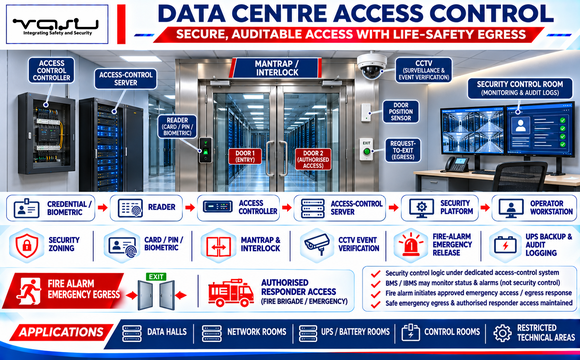
Data Centre Access Control provides controlled, auditable and resilient management of personnel and vehicle access to critical data-centre areas. The architecture should protect restricted spaces while maintaining safe emergency egress and authorised responder access. It should integrate access readers, controllers, locks, doors, mantrap systems, visitor management, CCTV, fire alarm, BMS / IBMS and the central security-control environment.
1. Engineering Overview
Data Centre Access Control provides controlled, auditable and resilient management of personnel and vehicle access to critical data-centre areas. The architecture should protect restricted spaces while maintaining safe emergency egress and authorised responder access. It should integrate access readers, controllers, locks, doors, mantrap systems, visitor management, CCTV, fire alarm, BMS / IBMS and the central security-control environment.
2. Complete Access Control Architecture
Credential / Biometric / Mobile Identity → Reader → Access Controller → Access-Control Server → Security Management Platform → Operator Workstation
Supporting Systems → Door Lock → Exit Device → Door Position Sensor → Request-to-Exit → Mantrap / Interlock → Visitor Management → CCTV → Fire Alarm → BMS / IBMS → Emergency Power → Control Room
3. Access Control Philosophy
The access-control philosophy should define security zones, user groups, credential types, authentication levels, access permissions, door configurations, mantrap operation, visitor procedures, emergency release, monitoring, event logging, redundancy and cybersecurity.
4. Security Zoning
Data-centre areas should be divided into appropriate security zones according to asset criticality and operational requirements. Typical zones may include perimeter, reception, general office, restricted technical areas, data halls, network rooms, UPS / battery rooms and control rooms.
5. Identity & Credential Management
Personnel should be assigned approved credentials based on role and authorised access. Credential lifecycle management should cover enrolment, activation, modification, suspension, revocation and periodic review.
6. Authentication Methods
Authentication may use card, PIN, biometric, mobile credential or multi-factor authentication depending on the security classification of the area. Higher-risk zones should use the authentication method defined by the approved security philosophy.
7. Access Readers
Readers should be selected and located to provide reliable credential recognition while maintaining suitable environmental protection and integration with the access controller.
8. Door Hardware
Controlled doors should use suitable electric locks, electromagnetic locks, motorised locks or other approved hardware. Door hardware should be coordinated with fire-rated construction, emergency egress and security requirements.
9. Door Position Monitoring
Door-position sensors should identify door open, closed, forced-open and held-open conditions where required. Alarm thresholds and response should be defined in the security system.
10. Request-to-Exit
Request-to-exit devices should allow authorised egress without generating false forced-door alarms. Their operation should be coordinated with the selected locking and monitoring arrangement.
11. Mantrap Architecture
Mantrap systems may be used at high-security entrances to prevent simultaneous opening of two doors. Interlocking logic, occupancy detection, emergency release and fire-alarm override should be clearly defined.
12. Anti-Passback
Where required, anti-passback logic may prevent credential sharing or repeated use without an authorised exit event. The configuration should reflect the actual access-control architecture.
13. Visitor Management
Visitor management should include registration, identity verification, authorisation, temporary credential issue, escort requirements, access limitations and credential return / deactivation.
14. Access Levels
Access permissions should be based on role, area, time schedule and operational need. Privileged access to critical technical rooms should be limited and subject to appropriate approval.
15. Fire Alarm Integration
Fire alarm conditions should initiate the approved emergency access / egress response. Access-controlled doors required for life safety should release or operate as defined by the fire and emergency strategy.
16. Emergency Egress
Emergency egress should remain available during normal operation, power failure and fire conditions as required. Security controls should not obstruct evacuation or authorised emergency response.
17. Fire Brigade Access
Emergency responder access should be coordinated with access control. Designated responder entrances, keys, credentials, override arrangements and emergency release functions should be clearly defined.
18. CCTV Integration
CCTV should be integrated with access-control events where required so that access granted, denied, forced-door and other security events can be visually verified.
19. BMS / IBMS Integration
Access-control status, alarms and selected door information may be monitored through BMS / IBMS or an integrated security platform. Security control logic should remain under the dedicated access-control system.
20. Alarm Management
Access-control alarms should include forced door, held-open, invalid credential, tamper, controller fault and communication failure conditions. Alarm priorities and operator response should be defined.
21. Event Logging & Audit Trail
All relevant access events should be logged with user identity, door, date, time, event type and system status. Records should support security investigations and audit requirements.
22. Access-Control Server
The access-control server should manage credentials, permissions, schedules, events, alarms and system configuration. Appropriate redundancy and backup should be provided according to the required availability.
23. Controller Architecture
Local controllers should retain sufficient functionality to operate authorised doors during temporary loss of central-server communication. Controller capacity and memory should support the required access points.
24. Network Architecture
Access-control networks should be appropriately segmented and secured. Critical controllers and communication paths should have suitable redundancy where required.
25. Emergency Power
Access controllers, readers, locks, security servers, network equipment and critical control-room systems should be supported by UPS / emergency power as required. Emergency operation should be coordinated with the fire strategy.
26. Cybersecurity
Authentication, role-based privileges, network segmentation, secure administration, controlled remote access, audit logging and system hardening should be applied to access-control infrastructure.
27. Control Room Monitoring
The control room should provide clear access status, alarm information, door location, event history and operator controls. Critical security alarms should be readily distinguishable.
28. Installation Requirements
Access-control installation should verify:
- Correct security zoning
- Correct reader locations
- Correct credential configuration
- Correct controller capacity
- Correct door hardware
- Correct door-position monitoring
- Correct request-to-exit devices
- Correct mantrap logic
- Correct visitor-management interface
- Correct fire alarm interface
- Correct CCTV interface
- Correct BMS / IBMS interface
- Correct emergency egress
- Correct emergency power
- Correct cybersecurity controls
29. Testing & Commissioning
Access-control commissioning should verify:
- Credential enrolment and authentication
- Access permissions
- Door lock operation
- Door-position monitoring
- Request-to-exit
- Forced-door alarms
- Door-held-open alarms
- Mantrap interlocking
- Visitor credentials
- Fire alarm emergency release
- Fire brigade access
- CCTV event integration
- BMS / IBMS monitoring
- Emergency power
- Network / controller failure response
30. Integrated Emergency Scenario Testing
Representative scenarios should verify fire alarm activation, emergency door release, loss of normal power, controller communication failure, forced-door events, authorised responder access and restoration to normal security operation.
31. Maintenance
Maintenance should include reader inspection, lock and door-hardware checks, door sensor testing, controller inspection, credential-system review, battery / UPS checks, server backup, network checks and periodic access-event review.
32. Impairment Management
Any impairment of critical access-control doors, controllers, network equipment or emergency-release functions should be formally controlled with compensatory security measures, notifications and restoration requirements.
33. Failure & Recovery
The system should be assessed for reader failure, controller failure, server failure, network failure, lock failure, power failure and communication loss. Recovery procedures should preserve both security and life-safety requirements.
34. Design Change Control
Changes to data-centre layouts, security zones, fire zones, doors, mantraps, equipment rooms or operational procedures should trigger a review of access permissions, hardware, integration and emergency-release logic.
35. Documentation
Data-centre access-control documentation should include, as applicable:
- Access-control philosophy
- Security zoning drawings
- Door schedule
- Reader schedule
- Controller schedule
- Credential / access-level matrix
- Door hardware schedule
- Mantrap logic
- Visitor-management procedure
- Fire alarm interface
- CCTV interface
- BMS / IBMS interface
- Emergency-release philosophy
- Network architecture
- Cybersecurity requirements
- Emergency-power arrangement
- Testing and commissioning records
- Integrated scenario test reports
- Maintenance schedule
- Impairment procedures
- As-built drawings
- O&M manual
36. Engineering Objective
The engineering objective is:
Assess Data Centre Security Risk → Establish Security Zones → Define Access Levels & Authentication → Design Readers, Controllers & Door Hardware → Provide Mantrap & Visitor Management → Integrate Fire Alarm, CCTV & BMS / IBMS → Maintain Emergency Egress & Fire Brigade Access → Provide UPS / Emergency Power → Validate Access, Alarm & Emergency Functions → Maintain Secure, Auditable & Resilient Access Control
Frequently Asked Questions
What is the purpose of data centre access control?
Centre Access Control provides controlled, auditable and resilient management of personnel and vehicle access to critical data-centre areas. The architecture should protect restricted spaces while maintaining safe emergency egress and authorised responder access. It should integrate access readers, controllers, locks, doors, mantrap systems, visitor management, CCTV, fire alarm, BMS / IBMS and the central security-control environment.
What should be reviewed during design and implementation?
Review the system architecture, interfaces and engineering considerations identified in the source. Verify project-specific requirements and equipment data against approved project documentation.
What should testing and commissioning verify?
Access-control commissioning should verify:
What should maintenance include?
Maintenance should include reader inspection, lock and door-hardware checks, door sensor testing, controller inspection, credential-system review, battery / UPS checks, server backup, network checks and periodic access-event review.