
Article
Data Centre Aspirating Smoke Detection
Oct 2026
Direct Answer
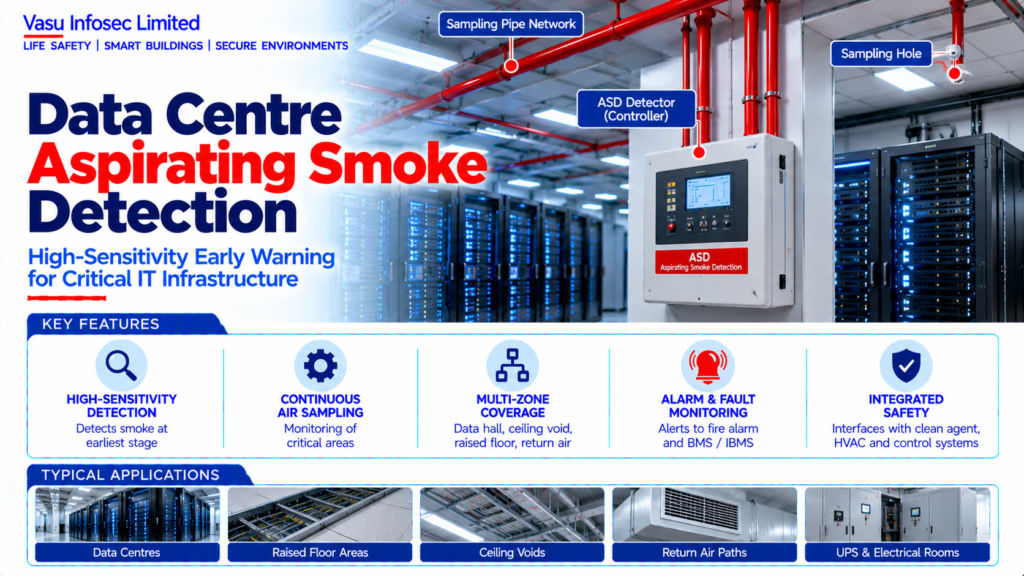
A Data Centre Aspirating Smoke Detection (ASD) System provides highly sensitive, continuous air sampling for early identification of smoke in critical IT and support spaces. The architecture uses sampling pipe networks, sampling points, an aspirator, smoke-sensing chamber, alarm thresholds, filtration, monitoring and interfaces with the fire alarm and clean-agent suppression systems.
1. Engineering Overview
A Data Centre Aspirating Smoke Detection (ASD) System provides highly sensitive, continuous air sampling for early identification of smoke in critical IT and support spaces. The architecture uses sampling pipe networks, sampling points, an aspirator, smoke-sensing chamber, alarm thresholds, filtration, monitoring and interfaces with the fire alarm and clean-agent suppression systems.
2. Complete Aspirating Detection Architecture
Protected Data-Centre Area → Sampling Holes / Points → Sampling Pipe Network → Filter → Aspirator → Detection Chamber → ASD Controller → Alarm / Fault Logic → Fire Alarm Control Panel
Supporting Systems → Raised Floor Sampling → Ceiling Void Sampling → Return-Air Sampling → BMS / IBMS → CCTV → HVAC → Clean Agent → Control Room → Emergency Power
3. ASD Philosophy
The ASD philosophy should establish sensitivity levels, sampling zones, pipe configuration, transport time, airflow, alarm thresholds, filtration, redundancy, maintenance access, fault monitoring and integration with the overall fire-protection strategy.
4. Critical Area Application
ASD may be used in data halls, server rooms, network rooms, UPS rooms, electrical rooms, ceiling voids, raised-floor voids and other critical areas where early warning is required.
5. Air Sampling Principle
The aspirator continuously draws air from the protected space through a network of sampling pipes. The sampled air is filtered and passed through the detection chamber, where smoke concentration is evaluated against configured alarm thresholds.
6. Sampling Pipe Network
Sampling pipes should be designed to provide representative air sampling across the protected area. Pipe diameter, length, sampling-hole size, spacing and configuration should be established through the approved pipe-network design and calculation.
7. Sampling Holes
Sampling holes should be positioned to provide effective coverage while considering airflow patterns, ceiling height, equipment arrangement and potential smoke paths. Hole sizes should be determined from the approved hydraulic / airflow calculation.
8. Raised Floor Detection
Where required, sampling points may be installed beneath raised floors to detect smoke from cable spaces, electrical equipment and other concealed sources. The arrangement should account for underfloor airflow.
9. Ceiling Void Detection
Ceiling void sampling may be used where concealed services or airflow conditions create a potential fire risk. Sampling points should be coordinated with HVAC airflow and obstructions.
10. Return-Air Sampling
Sampling from HVAC return-air paths can provide early detection of smoke transported through the air-handling system. The arrangement should be designed to avoid unwanted alarms and should complement room-level detection.
11. Aspirator
The aspirator creates the airflow required to continuously draw air through the sampling network. Aspirator performance should be monitored for airflow degradation and system faults.
12. Filtration
Air filtration protects the detection chamber from dust and contaminants. Filter type, replacement interval and maintenance access should be appropriate for the data-centre environment.
13. Detection Chamber
The detection chamber analyses the sampled air and provides smoke-concentration information to the ASD controller. Sensitivity should be configured according to the protected risk and approved alarm philosophy.
14. Alarm Thresholds
Multiple alarm thresholds may be configured to provide progressive warning, investigation and confirmed-fire indications. Each threshold should have a defined response within the approved cause-and-effect matrix.
15. Early Warning Integration
ASD alert-level signals should support early investigation before a developing fire reaches a higher alarm stage. Operator response procedures should define the action required for each alarm level.
16. Fire Alarm Interface
ASD alarm, pre-alarm, airflow fault, detector fault and other supervisory conditions should be transmitted to the fire alarm system as defined by the approved interface philosophy.
17. Clean Agent Interface
Where clean-agent suppression is provided, ASD alarm levels should be coordinated with the suppression releasing sequence. The interface should ensure that the required confirmation and pre-discharge logic is achieved.
18. HVAC Interface
ASD performance depends on airflow conditions. HVAC operation, return-air paths and fire-mode shutdown should therefore be coordinated with the sampling design and fire-protection sequence.
19. BMS / IBMS Interface
ASD alarms, faults and status may be monitored through BMS / IBMS. Fire-system control and release logic should remain governed by the approved fire-protection architecture.
20. CCTV Interface
ASD alarm events may initiate automatic selection of relevant CCTV views for incident verification. Camera mapping should correspond with ASD sampling zones where integrated.
21. Network & Communication
Networked ASD controllers should provide reliable communication to fire alarm panels, monitoring systems and control-room interfaces. Network faults should be supervised where required.
22. Emergency Power
ASD aspirators, controllers and associated network / communication equipment should be supplied from reliable emergency / standby power with the required autonomy.
23. Environmental Considerations
ASD design should account for dust, humidity, temperature, airflow, contamination and other environmental factors that may affect sensitivity or generate unwanted alarms.
24. Installation Requirements
Installation should verify:
- Correct ASD coverage • Correct sampling-zone configuration • Correct pipe routing • Correct sampling-hole locations • Correct aspirator capacity • Correct filtration • Correct alarm thresholds • Correct airflow monitoring • Correct fire alarm interface • Correct clean-agent interface • Correct HVAC coordination • Correct BMS / IBMS / CCTV interfaces • Correct emergency power • Proper identification and accessibility
25. Testing & Commissioning
ASD commissioning should verify:
- Aspirator operation • Sampling airflow • Pipe integrity • Sampling-hole configuration • Filter condition • Alarm thresholds • Smoke response • Fault monitoring • Fire alarm interface • Clean-agent interface • HVAC interface • BMS / IBMS communication • Emergency power • Control-room indication
26. Transport Time Verification
Sampling transport time should be verified against the approved design requirement. The test should confirm that smoke introduced at representative sampling points reaches the detection chamber within the required response period.
27. Smoke Response Testing
Controlled smoke tests or approved equivalent test methods should verify response at representative sampling points. Testing should demonstrate alarm initiation, zone identification and interface response.
28. Maintenance
Maintenance should include filter inspection / replacement, sampling-pipe inspection, aspirator checks, airflow verification, detector chamber inspection, alarm testing and review of fault history.
29. Impairment Management
Any impairment of ASD equipment, sampling pipes, aspirators or controllers should be formally controlled with compensatory measures, responsible personnel, notifications and restoration requirements.
30. Failure & Recovery
The system should be assessed for pipe blockage, pipe breakage, aspirator failure, airflow loss, filter blockage, detector fault, controller failure, network loss and power failure. Fault indication and recovery procedures should be defined.
31. Design Change Control
Changes to data-centre layout, raised floors, ceiling voids, HVAC airflow, equipment density, partitions or clean-agent protection should trigger a review of ASD sampling coverage and performance.
32. Documentation
Data-centre ASD documentation should include, as applicable:
- ASD philosophy • Sampling-zone drawings • Pipe-network layout • Sampling-hole schedule • Pipe-network calculation • Transport-time calculation • Sensitivity / alarm-threshold schedule • Aspirator schedule • Filter schedule • Fire alarm interface • Clean-agent interface • HVAC interface • BMS / IBMS interface • CCTV interface • Emergency-power calculation • Testing and commissioning records • Transport-time test reports • Smoke-response test records • Maintenance schedule • Impairment procedures • As-built drawings • O&M manual
33. Engineering Objective
The engineering objective is:
Assess Critical Data-Centre Areas → Establish ASD Coverage Philosophy → Design Sampling Zones & Pipe Networks → Select Aspirators, Filters & Detection Chambers → Configure Progressive Alarm Thresholds → Integrate Fire Alarm & Clean Agent → Coordinate HVAC & Airflow → Provide BMS / IBMS, CCTV & Emergency Power Interfaces → Verify Transport Time & Smoke Response → Maintain Reliable Early-Warning Detection
Frequently Asked Questions
What should be considered for asd philosophy?
The ASD philosophy should establish sensitivity levels, sampling zones, pipe configuration, transport time, airflow, alarm thresholds, filtration, redundancy, maintenance access, fault monitoring and integration with the overall fire-protection strategy.
What should be considered for early warning integration?
ASD alert-level signals should support early investigation before a developing fire reaches a higher alarm stage. Operator response procedures should define the action required for each alarm level.
What should be considered for fire alarm interface?
ASD alarm, pre-alarm, airflow fault, detector fault and other supervisory conditions should be transmitted to the fire alarm system as defined by the approved interface philosophy.
What should be considered for clean agent interface?
Where clean-agent suppression is provided, ASD alarm levels should be coordinated with the suppression releasing sequence. The interface should ensure that the required confirmation and pre-discharge logic is achieved.
What should be considered for hvac interface?
ASD performance depends on airflow conditions. HVAC operation, return-air paths and fire-mode shutdown should therefore be coordinated with the sampling design and fire-protection sequence.
SEO & Publishing Details
| SEO title | Data Centre Aspirating Smoke Detection | Vasu Infosec Limited |
| Meta description | A Data Centre Aspirating Smoke Detection (ASD) System provides highly sensitive, continuous air sampling for early identification of smoke in critical IT… |
| Primary keyword | data centre aspirating smoke detection |
| Secondary keywords | data centre, aspirating smoke detection, data centre, aspirating smoke detection, fire alarm |
| Suggested URL slug | data-centre-aspirating-smoke-detection |
| Suggested image alt text | Technical architecture illustration for data centre aspirating smoke detection in data-centre engineering. |