
Article
Data Centre CCTV Architecture
Nov 2026
Direct Answer
Data Centre CCTV Architecture provides continuous visual surveillance of critical IT, electrical, fire-safety, security and operational areas. The system should support incident detection, verification, investigation, access monitoring, equipment-area visibility and coordinated response with fire alarm, access control, BMS / IBMS and the central control room.
1. Engineering Overview
Data Centre CCTV Architecture provides continuous visual surveillance of critical IT, electrical, fire-safety, security and operational areas. The system should support incident detection, verification, investigation, access monitoring, equipment-area visibility and coordinated response with fire alarm, access control, BMS / IBMS and the central control room.
2. Complete CCTV Architecture
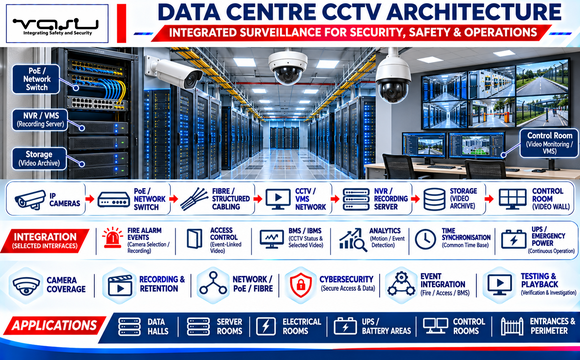
IP Camera → PoE / Network Switch → Structured Cabling / Fibre Backbone → CCTV / VMS Network → Recording Server / NVR → Storage → Operator Workstation / Video Wall
Supporting Systems → Fire Alarm Interface → Access Control → BMS / IBMS → Analytics → Time Synchronisation → UPS / Emergency Power → Control Room → Remote Monitoring where approved
3. CCTV Philosophy
The CCTV philosophy should establish surveillance objectives, camera coverage, camera types, image quality, retention period, recording modes, storage capacity, network architecture, redundancy, cybersecurity, monitoring arrangements and integration requirements.
4. Critical Area Identification
CCTV coverage should be based on the data-centre risk assessment and should consider data halls, server rooms where permitted, electrical rooms, UPS / battery areas, DG areas, control rooms, entrances, loading areas, corridors, perimeter zones and other critical locations.
5. Camera Coverage
Camera locations should provide effective visual coverage of designated areas while considering obstructions, rack layouts, doors, access routes, equipment density, lighting and maintenance requirements.
6. Camera Types
Camera selection may include fixed, dome, bullet, PTZ or specialised cameras according to the surveillance objective. Environmental conditions, mounting arrangement, required field of view and image quality should be considered.
7. Data Hall Surveillance
Data halls should be assessed for appropriate camera coverage of access points, aisles and critical operational areas. Camera placement should not interfere with equipment, airflow, maintenance access or fire-protection systems.
8. Entrance & Access Monitoring
Main entrances, security doors, mantrap areas and other controlled access points should be monitored to support identification, access verification and incident investigation.
9. Perimeter Surveillance
Where perimeter protection is required, cameras should provide suitable coverage of external boundaries, vehicle approaches, gates and other designated security zones.
10. PTZ Surveillance
PTZ cameras may be used for wider-area monitoring and incident tracking where appropriate. Preset positions, patrol sequences and operator control should be defined.
11. Low-Light & Environmental Performance
Camera selection should consider available illumination, glare, contrast, dust, temperature, humidity and other environmental conditions. Supplemental lighting should be coordinated where required.
12. Video Management System
The VMS should manage camera configuration, live viewing, recording, playback, user access, alarms, camera health and event-based video retrieval.
13. Recording Architecture
Recording may be centralised, distributed or redundant depending on availability requirements. Recording architecture should provide the required performance, retention and recovery capability.
14. Storage Capacity
Storage capacity should be calculated from camera count, resolution, frame rate, compression, recording mode, motion activity and required retention period. Capacity should include appropriate operational margin.
15. Recording Retention
Video retention should comply with project requirements, security policy and applicable contractual or statutory requirements. Critical incident footage should be protected from premature deletion.
16. Network Architecture
CCTV networks should provide adequate bandwidth, low latency, appropriate segmentation and reliable connectivity. Critical network paths should be designed with suitable redundancy where required.
17. Power Supply
Cameras, switches, servers, storage and monitoring equipment should be supplied from reliable power sources. Critical CCTV infrastructure should be supported by UPS / emergency power where required.
18. PoE Architecture
Where PoE cameras are used, PoE switch capacity, port availability, power budget, cable length and redundancy should be considered. PoE equipment should support the connected camera requirements.
19. Fibre Backbone
Fibre links may be used for inter-building, floor-to-floor or long-distance CCTV connectivity. Fibre capacity, termination, redundancy and route protection should be coordinated with the data-centre structured cabling architecture.
20. Fire Alarm Integration
Fire alarm events may trigger camera selection, recording markers or automatic display of relevant views. Camera mapping should correspond with the fire-zone architecture.
21. Access Control Integration
Access-control events such as door forced-open, access granted / denied and emergency release may be associated with relevant CCTV views for event verification.
22. BMS / IBMS Integration
CCTV status and selected video interfaces may be integrated into BMS / IBMS or an integrated security platform. Video management and recording functions should remain under the dedicated VMS.
23. Analytics
Video analytics may be used for defined security objectives such as intrusion detection, line crossing, loitering or object detection where approved. Analytics should be validated against the operational environment to manage false alarms.
24. Cybersecurity
CCTV networks and VMS infrastructure should use appropriate authentication, access privileges, network segmentation, secure configuration, controlled remote access and system hardening.
25. Time Synchronisation
CCTV equipment should use a coordinated time source so that video events can be accurately correlated with fire alarm, access control, BMS / IBMS and other system events.
26. Control Room Monitoring
The control room should provide suitable operator workstations, displays, video wall arrangements where required, incident controls and event search capability. Critical camera alarms should be clearly identified.
27. Installation Requirements
CCTV installation should verify:
- Complete approved camera coverage
- Correct camera type and location
- Correct field of view
- Adequate image quality
- Correct lighting conditions
- Correct PoE capacity
- Correct network connectivity
- Correct fibre backbone
- Adequate recording capacity
- Required video retention
- Correct UPS / emergency power
- Correct fire alarm integration
- Correct access-control integration
- Correct BMS / IBMS interface
- Correct time synchronisation
- Correct cybersecurity controls
28. Testing & Commissioning
CCTV commissioning should verify:
- Camera operation
- Field of view
- Image quality
- Day / night performance where applicable
- PTZ operation where provided
- Recording
- Playback
- Storage capacity
- Network performance
- PoE operation
- Fire alarm event integration
- Access-control event integration
- BMS / IBMS interface
- Analytics where provided
- UPS operation
- Fault monitoring
29. Camera Coverage Testing
Each camera should be tested to confirm the intended field of view, image quality, focus, identification capability, lighting performance and coverage of the designated surveillance area.
30. Recording & Playback Testing
Recording should be tested under normal and event conditions. Playback, search, export, timestamp accuracy and retention functionality should be verified.
31. Integrated Incident Scenario Testing
Representative scenarios such as fire alarm activation, unauthorised access, forced-door events and equipment-area incidents should verify automatic camera selection, recording, event correlation and control-room response.
32. Maintenance
Maintenance should include lens cleaning, camera inspection, focus verification, PTZ checks, network checks, storage health, recording verification, UPS status, firmware management and periodic review of camera coverage.
33. Impairment Management
Any impairment of critical cameras, network switches, recording servers, storage or control-room equipment should be formally controlled with compensatory surveillance measures, notifications and restoration requirements.
34. Failure & Recovery
The architecture should be assessed for camera failure, PoE failure, switch failure, fibre-link failure, recording-server failure, storage failure, network failure and power loss. Recovery procedures should prioritise critical surveillance zones.
35. Design Change Control
Changes to room layouts, rack arrangements, entrances, security zones, fire zones, lighting, network infrastructure or data-centre expansion should trigger a review of CCTV coverage and storage capacity.
36. Documentation
Data-centre CCTV documentation should include, as applicable:
- CCTV philosophy
- Camera layout drawings
- Camera schedule
- Field-of-view drawings
- Camera technical datasheets
- Network architecture
- PoE schedule
- Fibre backbone details
- VMS architecture
- Recording schedule
- Storage calculation
- Retention calculation
- Fire alarm interface
- Access-control interface
- BMS / IBMS interface
- Analytics configuration
- Cybersecurity requirements
- UPS / emergency-power arrangement
- Testing and commissioning records
- Coverage test reports
- Recording / playback test reports
- Maintenance schedule
- Impairment procedures
- As-built drawings
- O&M manual
37. Engineering Objective
The engineering objective is:
Assess Data Centre Security & Surveillance Risks → Define CCTV Coverage Philosophy → Select Camera Types & Locations → Design Network, PoE, Fibre & VMS Architecture → Establish Recording & Storage Capacity → Integrate Fire Alarm, Access Control & BMS / IBMS → Provide UPS / Emergency Power → Validate Coverage, Recording & Incident Response → Maintain Reliable Continuous Surveillance of Critical Data-Centre Areas
Frequently Asked Questions
What is the purpose of data centre cctv architecture?
Data Centre CCTV Architecture provides continuous visual surveillance of critical IT, electrical, fire-safety, security and operational areas. The system should support incident detection, verification, investigation, access monitoring, equipment-area visibility and coordinated response with fire alarm, access control, BMS / IBMS and the central control room.
What should be reviewed during design and implementation?
Review the system architecture, interfaces and engineering considerations identified in the source. Verify project-specific requirements and equipment data against approved project documentation.
What should testing and commissioning verify?
CCTV commissioning should verify:
What should maintenance include?
Camera locations should provide effective visual coverage of designated areas while considering obstructions, rack layouts, doors, access routes, equipment density, lighting and maintenance requirements.