
Article
Data Centre Environmental Monitoring
Nov 2026
Direct Answer
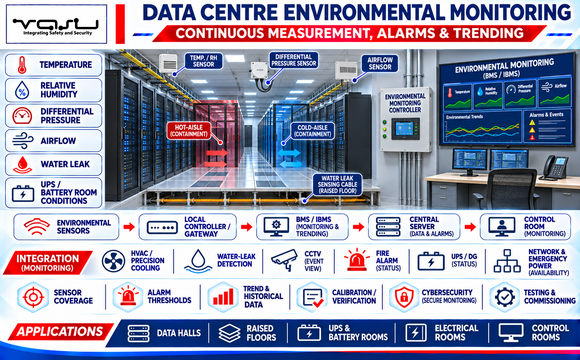
Data Centre Environmental Monitoring provides continuous measurement, alarm management and trending of critical environmental parameters that influence IT equipment performance, availability and fire-protection reliability. The architecture should monitor temperature, humidity, differential pressure, airflow, water leakage and other designated parameters across critical spaces.
1. Engineering Overview
Data Centre Environmental Monitoring provides continuous measurement, alarm management and trending of critical environmental parameters that influence IT equipment performance, availability and fire-protection reliability. The architecture should monitor temperature, humidity, differential pressure, airflow, water leakage and other designated parameters across critical spaces.
2. Complete Environmental Monitoring Architecture
Environmental Sensors → Local Monitoring Controller / Gateway → BMS / IBMS → Central Server → Operator Workstation / Control Room
Monitoring Parameters → Temperature → Relative Humidity → Differential Pressure → Airflow → Water Leak → Equipment Room Conditions → Battery / Electrical Room Conditions
Supporting Systems → HVAC → Precision Cooling → BMS / IBMS → CCTV → Fire Alarm → UPS → DG → Network → Emergency Power
3. Monitoring Philosophy
The monitoring philosophy should establish monitored parameters, sensor locations, measurement ranges, alarm thresholds, alert levels, trending requirements, data retention, communication architecture, redundancy and operator response.
4. Data Hall Monitoring
Data halls should be monitored for temperature, relative humidity, pressure and other parameters relevant to the installed IT equipment and cooling strategy. Sensor locations should represent actual operating conditions and avoid localised measurement bias.
5. Temperature Monitoring
Temperature sensors should be positioned to identify abnormal thermal conditions and support HVAC performance assessment. Thresholds should distinguish normal operating range, warning and critical conditions according to the approved environmental criteria.
6. Relative Humidity Monitoring
Relative humidity should be continuously monitored where required to identify conditions that could affect IT equipment reliability, condensation risk or electrostatic behaviour. Alarm thresholds should be established from the approved environmental strategy.
7. Differential Pressure Monitoring
Differential pressure monitoring may be used to verify pressure relationships between data halls, adjacent spaces, raised floors and other critical areas. Pressure alarms should identify deviations from the approved operating range.
8. Airflow Monitoring
Airflow monitoring may be used to assess cooling performance, fan operation and air-distribution conditions. Critical airflow parameters should be trended where required for operational analysis.
9. Hot-Aisle / Cold-Aisle Monitoring
Where hot-aisle / cold-aisle containment is implemented, environmental sensors should be coordinated with the containment arrangement to identify temperature excursions and verify cooling effectiveness.
10. Raised Floor Monitoring
Raised-floor areas should be monitored where environmental conditions, water leakage or airflow could affect critical equipment. Sensor placement should be coordinated with floor layout and cooling distribution.
11. Electrical & UPS Room Monitoring
UPS, battery and electrical rooms should be assessed for temperature, humidity and other relevant environmental conditions. Battery-room monitoring should be coordinated with the installed battery technology and safety requirements.
12. Water Leak Monitoring
Water-leak detection should be integrated with environmental monitoring where required. Leak events should identify the affected zone and support rapid operational response.
13. Sensor Selection
Sensors should be selected for appropriate accuracy, range, stability, environmental suitability and communication compatibility. Sensor calibration requirements should be established.
14. Sensor Location & Coverage
Sensor locations should be selected based on room geometry, equipment density, airflow patterns, heat sources and risk areas. Adequate coverage should be provided without unnecessary duplication.
15. Alarm Thresholds
Alarm thresholds should define warning and critical conditions for each monitored parameter. Thresholds should support early intervention while minimising nuisance alarms.
16. Alarm Management
Environmental alarms should clearly identify the parameter, location, severity, timestamp and current status. Alarm acknowledgement, escalation and return-to-normal conditions should be defined.
17. Trend Monitoring
Critical environmental parameters should be trended to identify gradual degradation, cooling imbalance, recurring excursions and capacity constraints. Historical data should support preventive maintenance and operational planning.
18. BMS / IBMS Integration
Environmental sensors and controllers should be integrated with BMS / IBMS for central monitoring, alarms and trending. Local controllers should maintain appropriate operation during temporary communication loss.
19. HVAC Integration
Environmental monitoring should support HVAC operation by providing temperature, humidity, pressure and airflow information. Approved control loops may use monitoring data to regulate cooling equipment.
20. Fire Protection Interface
Environmental monitoring should be coordinated with fire-protection systems where relevant. Fire events, clean-agent discharge and HVAC fire-mode operation may affect monitored environmental conditions and should be identifiable in the event history.
21. CCTV Integration
Environmental alarms may be associated with CCTV views of the affected area where required, supporting operator verification and incident investigation.
22. UPS / DG Integration
Environmental conditions of UPS and DG areas may be monitored alongside electrical-system status. Relevant temperature or equipment-room alarms should be correlated with power-system events.
23. Network & Communication
Monitoring networks should provide reliable communication between sensors, controllers, gateways and central servers. Communication failure should generate a clear fault indication.
24. Time Synchronisation
Environmental monitoring systems should use a coordinated time source where required so that temperature, humidity, water-leak, HVAC, power and fire events can be accurately correlated.
25. Data Storage & Retention
Historical environmental data should be stored for the period required by operational, contractual and maintenance requirements. Data should be protected from unauthorised modification or loss.
26. Emergency Power
Environmental monitoring controllers, gateways, servers and critical network equipment should be supported by UPS / emergency power where required to maintain visibility during utility failure.
27. Cybersecurity
Monitoring networks and servers should use appropriate authentication, role-based access, network segregation, secure administration and controlled remote access. Cybersecurity controls should not compromise critical monitoring availability.
28. Installation Requirements
Environmental monitoring installation should verify:
- Correct monitoring parameters
- Correct sensor type
- Correct sensor locations
- Adequate coverage
- Correct measurement range
- Correct alarm thresholds
- Correct controller / gateway configuration
- Correct BMS / IBMS integration
- Correct HVAC interface
- Correct water-leak integration
- Correct network communication
- Correct time synchronisation
- Correct data storage
- Correct emergency power
- Correct cybersecurity controls
29. Testing & Commissioning
Commissioning should verify:
- Sensor operation
- Measurement accuracy
- Temperature alarms
- Humidity alarms
- Differential-pressure alarms
- Airflow monitoring
- Water-leak alarms
- Controller operation
- Communication status
- BMS / IBMS graphics
- Alarm priorities
- Trend logging
- Time synchronisation
- Emergency-power operation
- Fault monitoring
30. Sensor Calibration & Verification
Sensors should be calibrated or verified using suitable approved methods. Measurement results should be compared against reference instruments where required, and deviations should be documented and corrected.
31. Integrated Environmental Scenario Testing
Representative scenarios should include high-temperature conditions, high / low humidity, abnormal pressure, airflow failure, water leakage, HVAC failure and utility interruption. The monitoring system should correctly alarm, trend and display each event.
32. Maintenance
Maintenance should include sensor inspection, calibration / verification, controller checks, network checks, alarm testing, trend review and replacement of damaged or degraded sensors.
33. Impairment Management
Any impairment of environmental monitoring in critical data-centre areas should be formally controlled with compensatory manual monitoring or other approved measures until the system is restored.
34. Failure & Recovery
The system should be assessed for sensor failure, controller failure, network failure, gateway failure, server failure and power loss. Faults should be clearly indicated and recovery procedures established.
35. Design Change Control
Changes to IT load, rack density, HVAC systems, room partitions, raised floors, containment, UPS / battery rooms or water systems should trigger a review of environmental-monitoring coverage and alarm thresholds.
36. Documentation
Data-centre environmental-monitoring documentation should include, as applicable:
- Environmental monitoring philosophy
- Sensor layout drawings
- Sensor schedule
- Measurement-range schedule
- Alarm-threshold matrix
- Controller / gateway schedule
- BMS / IBMS point list
- HVAC interface
- Water-leak interface
- UPS / DG room monitoring
- Network architecture
- Time-synchronisation arrangement
- Data-storage / retention requirements
- Cybersecurity requirements
- Emergency-power arrangement
- Calibration / verification records
- Testing and commissioning records
- Integrated scenario test reports
- Maintenance schedule
- Impairment procedures
- As-built drawings
- O&M manual
37. Engineering Objective
The engineering objective is:
Assess Critical Environmental Risks → Define Monitoring Parameters → Establish Sensor Coverage & Locations → Select Sensors & Controllers → Configure Alarm Thresholds → Integrate BMS / IBMS, HVAC, Water Leak & Critical Equipment Monitoring → Provide Trending & Historical Data → Maintain Reliable Communication & Emergency Power → Validate Sensor Accuracy & Alarm Response → Test Environmental Failure Scenarios → Maintain Stable & Predictable Data-Centre Operating Conditions
Frequently Asked Questions
What is the purpose of data centre environmental monitoring?
Data Centre Environmental Monitoring provides continuous measurement, alarm management and trending of critical environmental parameters that influence IT equipment performance, availability and fire-protection reliability. The architecture should monitor temperature, humidity, differential pressure, airflow, water leakage and other designated parameters across critical spaces.
What should be reviewed during design and implementation?
Review the system architecture, interfaces and engineering considerations identified in the source. Verify project-specific requirements and equipment data against approved project documentation.
What should testing and commissioning verify?
Commissioning should verify:
What should maintenance include?
Critical environmental parameters should be trended to identify gradual degradation, cooling imbalance, recurring excursions and capacity constraints. Historical data should support preventive maintenance and operational planning.