
Article
Data Centre FAT, SAT & Commissioning
Nov 2026
Direct Answer
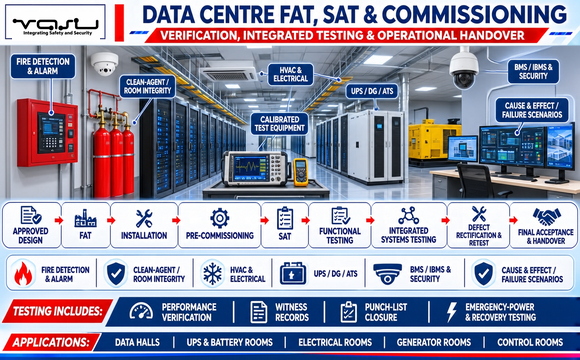
Data Centre FAT, SAT & Commissioning establishes a controlled verification process to demonstrate that critical systems, equipment, interfaces and integrated functions comply with the approved design before operational handover. Factory Acceptance Testing (FAT), Site Acceptance Testing (SAT), pre-commissioning, functional testing and integrated systems testing should provide documented evidence of performance and readiness.
1. Engineering Overview
Data Centre FAT, SAT & Commissioning establishes a controlled verification process to demonstrate that critical systems, equipment, interfaces and integrated functions comply with the approved design before operational handover. Factory Acceptance Testing (FAT), Site Acceptance Testing (SAT), pre-commissioning, functional testing and integrated systems testing should provide documented evidence of performance and readiness.
2. Complete FAT, SAT & Commissioning Architecture
Approved Design → Procurement → Factory Inspection / FAT → Delivery → Installation → Pre-Commissioning → SAT → Functional Performance Testing → Integrated Systems Testing → Defect Rectification → Re-Test → Final Acceptance → Handover
Critical Systems → Fire Detection → Fire Alarm → Clean Agent → ASD → HVAC → UPS → DG → Electrical Distribution → BMS / IBMS → CCTV → Access Control → Water Leak Detection → Emergency Communication → Emergency Lighting
3. Commissioning Philosophy
The commissioning philosophy should define responsibilities, test stages, acceptance criteria, documentation, witnessing requirements, safety controls, interface testing, defect management, retesting, handover and final acceptance. Testing should progress from individual equipment to complete integrated system operation.
4. FAT Philosophy
FAT should verify equipment construction, configuration, functionality, workmanship, documentation and selected performance parameters before dispatch. FAT should confirm that equipment is ready for installation and site integration.
5. SAT Philosophy
SAT should verify that delivered and installed equipment operates correctly under actual site conditions and communicates correctly with connected systems.
6. Pre-Commissioning
Pre-commissioning should confirm installation completeness, equipment identification, cable termination, mechanical completion, power availability, calibration, cleanliness, configuration and readiness for functional testing.
7. Commissioning Sequence
The sequence should generally progress from document review and installation verification to individual equipment testing, subsystem testing, interface testing, functional performance testing and integrated scenario testing.
8. Fire Detection Commissioning
Fire detection commissioning should verify detector installation, addressing, alarm response, fault monitoring, zoning, sensitivity where applicable and communication with the fire alarm control system.
9. Fire Alarm Commissioning
Fire alarm commissioning should verify device operation, alarm notification, zone identification, cause-and-effect logic, supervisory conditions, fault monitoring, control outputs and reset functionality.
10. ASD Commissioning
Aspirating smoke detection commissioning should verify sampling pipe installation, airflow, transport time, alarm thresholds, fault monitoring, zone identification and integration with the fire alarm / suppression sequence.
11. Clean Agent Commissioning
Clean-agent commissioning should verify cylinder and valve arrangements, pipework, nozzles, releasing controls, pre-discharge warning, manual release, abort function, HVAC shutdown, pressure-relief provisions, room integrity and release indication.
12. Room Integrity Testing
Protected clean-agent enclosures should be inspected and tested to confirm that doors, dampers, penetrations and other leakage paths are adequately controlled and that the enclosure can support the required agent retention.
13. HVAC Commissioning
HVAC commissioning should verify cooling performance, airflow, temperature control, pressure relationships, equipment sequencing, fire-mode response, damper operation and interaction with clean-agent protection.
14. UPS Commissioning
UPS commissioning should verify normal operation, load sharing, redundancy, battery operation, bypass functions, transfer performance, alarms, monitoring and compatibility with the emergency generator system.
15. DG Commissioning
DG commissioning should verify auto-start, voltage and frequency, AMF operation, ATS transfer, synchronisation where applicable, load sharing, load shedding, protection, fuel systems and return-to-normal operation.
16. Electrical Distribution Commissioning
Electrical commissioning should verify switchboards, distribution boards, breakers, protection, metering, power quality, interlocks, cable systems, earthing, emergency distribution and critical-load transfer.
17. BMS / IBMS Commissioning
BMS / IBMS commissioning should verify point-to-point communication, alarms, trends, equipment status, approved commands, gateways, graphics, event logging, time synchronisation and communication-failure indication.
18. CCTV Commissioning
CCTV commissioning should verify camera coverage, image quality, recording, playback, storage, network performance, camera health, time synchronisation and integration with fire alarm / access-control events where provided.
19. Access Control Commissioning
Access-control commissioning should verify credentials, readers, door locks, door-position monitoring, request-to-exit, mantrap logic, visitor credentials, emergency release and integration with CCTV / fire alarm.
20. Water Leak Detection Commissioning
Water-leak commissioning should verify sensing cable or point sensors, zone identification, leak simulation response, controller operation, fault monitoring and BMS / IBMS integration.
21. Emergency Communication Commissioning
Emergency communication systems should be tested for coverage, intelligibility, zone selection, alarm initiation, power backup, control-room operation and emergency-message functionality.
22. Emergency Lighting Commissioning
Emergency lighting should be tested for automatic operation, transfer response, coverage, battery duration where applicable, monitoring and emergency-route illumination.
23. FAT Test Documentation
FAT documentation should identify equipment, test procedures, acceptance criteria, test instruments, measured results, deviations, corrective actions, witness signatures and final FAT status.
24. SAT Test Documentation
SAT documentation should record site installation verification, test conditions, measured results, interfaces, deviations, corrective actions, retesting and final acceptance status.
25. Integrated Systems Testing
Integrated Systems Testing (IST) should verify interactions between critical systems under representative operating and failure scenarios. The testing should demonstrate that systems respond in the correct sequence and that no unintended common-mode failure is introduced.
26. Failure Scenario Testing
Representative failure scenarios should include utility failure, generator failure, UPS failure, fire alarm activation, clean-agent release sequence, HVAC failure, network failure, communication loss, equipment fault and recovery to normal operation.
27. Cause & Effect Verification
The approved cause-and-effect matrix should be used as the baseline for integrated testing. Every critical input and output should be verified for correct zone, priority, timing, feedback, reset and recovery.
28. Test Instruments & Calibration
Test instruments should be suitable for the parameter being measured and should have valid calibration or verification records where required. Instrument identification and calibration status should be recorded in test documentation.
29. Safety During Testing
Commissioning activities should be planned to prevent injury, equipment damage, unintended suppression discharge, electrical exposure, disruption to live IT operations and uncontrolled emergency-system activation.
30. Defect Management
All test deficiencies should be recorded in a controlled punch-list / defect register with description, responsible party, priority, target closure date, corrective action and retest status.
31. Retesting
Failed or incomplete tests should be repeated after corrective action. Final acceptance should only be established after the applicable acceptance criteria have been demonstrated and documented.
32. Witnessing & Acceptance
Client, consultant, authority or specialist witnessing should be incorporated where required. Test records should identify attendees, witness status, observations and acceptance / rejection decisions.
33. Training & Handover
Operations personnel should receive training on system operation, alarms, emergency procedures, manual controls, isolation, reset and routine maintenance before final handover.
34. Maintenance Readiness
Commissioning should confirm that spare parts, consumables, maintenance tools, software backups, passwords / credentials under controlled management, manuals and preventive-maintenance procedures are available for operations.
35. As-Built Verification
Final as-built drawings and system configurations should reflect actual installed equipment, device addresses, cable routes, interfaces, zone assignments and approved changes made during construction and commissioning.
36. Installation & Readiness Checklist
Commissioning readiness should verify:
- Approved drawings and specifications
- Equipment installation complete
- Equipment identification complete
- Cable termination complete
- Power availability
- Mechanical completion
- Calibration status
- Software / configuration status
- Fire-system readiness
- HVAC readiness
- UPS readiness
- DG readiness
- Electrical distribution readiness
- BMS / IBMS readiness
- CCTV / access-control readiness
- Emergency systems readiness
37. Final Commissioning Requirements
Final commissioning should verify:
- Equipment performance
- Subsystem performance
- Interface operation
- Cause-and-effect sequence
- Alarm and fault handling
- Redundancy performance
- Emergency-power operation
- Failure scenarios
- Recovery scenarios
- Integrated systems operation
- Operator response
- Documentation completeness
- Defect closure
38. Handover Documentation
Data-centre FAT, SAT and commissioning documentation should include, as applicable:
- Commissioning plan
- FAT procedures and reports
- SAT procedures and reports
- Pre-commissioning checklists
- Equipment test sheets
- Functional performance test records
- Integrated systems test procedures
- Cause-and-effect test records
- Fire detection / alarm test reports
- ASD test reports
- Clean-agent test reports
- Room-integrity test report
- HVAC test reports
- UPS test reports
- DG / AMF / ATS test reports
- Electrical test reports
- BMS / IBMS test records
- CCTV test records
- Access-control test records
- Water-leak test records
- Emergency communication / lighting test records
- Calibration certificates
- Defect / punch-list register
- Retest records
- Training records
- As-built drawings
- O&M manuals
- Final acceptance certificate
39. Engineering Objective
The engineering objective is:
Review Approved Design → Verify Equipment at FAT → Confirm Site Installation → Complete Pre-Commissioning → Conduct SAT → Verify Individual Systems → Verify Interfaces → Execute Functional Performance Tests → Execute Integrated Systems Testing → Test Failure & Recovery Scenarios → Close Defects → Complete Training & Documentation → Obtain Final Acceptance & Handover
Frequently Asked Questions
What is the purpose of data centre fat, sat & commissioning?
Data Centre FAT, SAT & Commissioning establishes a controlled verification process to demonstrate that critical systems, equipment, interfaces and integrated functions comply with the approved design before operational handover. Factory Acceptance Testing (FAT), Site Acceptance Testing (SAT), pre-commissioning, functional testing and integrated systems testing should provide documented evidence of performance and readiness.
What should be reviewed during design and implementation?
Review the system architecture, interfaces and engineering considerations identified in the source. Verify project-specific requirements and equipment data against approved project documentation.
What should testing and commissioning verify?
Data Centre FAT, SAT & Commissioning establishes a controlled verification process to demonstrate that critical systems, equipment, interfaces and integrated functions comply with the approved design before operational handover. Factory Acceptance Testing (FAT), Site Acceptance Testing (SAT), pre-commissioning, functional testing and integrated systems testing should provide documented evidence of performance and readiness.
What should maintenance include?
Operations personnel should receive training on system operation, alarms, emergency procedures, manual controls, isolation, reset and routine maintenance before final handover.