
Article
Data Centre Fire Protection Maintenance
Nov 2026
Direct Answer
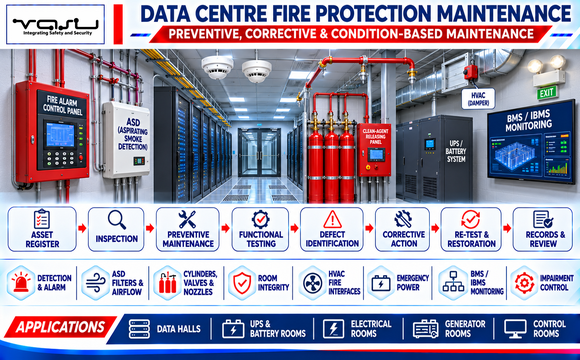
Data Centre Fire Protection Maintenance establishes a structured preventive, corrective and condition-based maintenance framework for fire detection, alarm, clean-agent suppression, aspirating smoke detection, room integrity, HVAC fire interfaces, emergency power and associated monitoring systems. The objective is to maintain continuous readiness, reliability and compliance of critical fire-protection infrastructure.
1. Engineering Overview
Data Centre Fire Protection Maintenance establishes a structured preventive, corrective and condition-based maintenance framework for fire detection, alarm, clean-agent suppression, aspirating smoke detection, room integrity, HVAC fire interfaces, emergency power and associated monitoring systems. The objective is to maintain continuous readiness, reliability and compliance of critical fire-protection infrastructure.
2. Complete Fire Protection Maintenance Architecture
Fire Protection Assets → Inspection → Preventive Maintenance → Functional Testing → Condition Assessment → Defect Identification → Corrective Action → Re-Test → Restoration → Maintenance Records → Management Review
Critical Systems → Fire Detection → Fire Alarm → ASD → Clean Agent → Room Integrity → HVAC Fire Interface → Emergency Power → BMS / IBMS → CCTV → Access Control → Emergency Communication → Emergency Lighting
3. Maintenance Philosophy
The maintenance philosophy should define inspection frequency, testing requirements, maintenance responsibilities, permitted isolation procedures, spare parts, competency requirements, documentation, impairment management, emergency response and restoration criteria.
4. Asset Register
A controlled fire-protection asset register should identify equipment, location, system, manufacturer / model where applicable, unique identification, maintenance frequency, last service date, next due date and current condition.
5. Preventive Maintenance
Preventive maintenance should be planned according to manufacturer recommendations, approved project requirements, applicable standards and the criticality of the protected data-centre environment.
6. Fire Detection Maintenance
Fire detectors should be inspected for physical condition, contamination, obstruction, correct identification, alarm operation and communication with the fire alarm control panel.
7. Fire Alarm Panel Maintenance
Fire alarm control panels should be inspected for normal status, power supplies, batteries, alarm history, fault indications, communication, device status and control functions.
8. Manual Call Point Maintenance
Manual call points should be inspected for accessibility, physical condition, identification and correct alarm initiation using approved test procedures.
9. Aspirating Smoke Detection Maintenance
ASD systems should be maintained through inspection of sampling pipes, sampling points, filters, aspirators, airflow, detector chambers, alarm thresholds and fault indications.
10. ASD Filter Maintenance
Filters should be inspected and replaced at the required interval or when contamination / airflow degradation is identified. Replacement records should be maintained.
11. Clean Agent Cylinder Maintenance
Clean-agent cylinders should be inspected for physical condition, identification, pressure / weight condition as applicable, valve condition and secure mounting. Any abnormal condition should be formally recorded.
12. Clean Agent Releasing System Maintenance
Releasing panels, actuators, solenoids, pressure switches, manual release stations, abort switches and associated circuits should be inspected and functionally tested in accordance with the approved maintenance procedure.
13. Pipework & Nozzle Maintenance
Suppression pipework should be inspected for physical damage, corrosion, obstruction, modification and support condition. Discharge nozzles should be checked for correct location, orientation and unobstructed condition.
14. Room Integrity Maintenance
Protected enclosures should be inspected for new penetrations, damaged seals, modified doors, dampers, partitions and other conditions that could compromise agent retention.
15. Room Integrity Re-Test
Where enclosure modifications or significant leakage changes occur, room-integrity testing should be considered and repeated where required by the approved suppression strategy.
16. HVAC Fire Interface Maintenance
HVAC fire-mode controls, shutdown commands, dampers, actuators and feedback signals should be periodically tested to confirm correct operation during fire and clean-agent sequences.
17. Emergency Power Maintenance
Batteries, UPS supplies, emergency power connections, chargers and designated fire-system backup supplies should be inspected and tested to confirm continued availability.
18. BMS / IBMS Interface Maintenance
Integrated fire-system points should be periodically verified for correct alarm, fault, status, timestamp and communication. Local fire-system functionality should remain independent of the supervisory platform.
19. CCTV & Access Control Interface
Where integrated, CCTV camera selection and access-control emergency functions associated with fire events should be periodically verified.
20. Emergency Communication Maintenance
Emergency communication systems should be inspected and tested for availability, intelligibility, zone operation, power backup and control-room indication.
21. Emergency Lighting Maintenance
Emergency lighting should be inspected and tested for automatic operation, illumination, battery condition, duration and monitoring where applicable.
22. Environmental Conditions
Fire-protection equipment should be maintained within suitable environmental conditions. Temperature, humidity, dust, contamination and access conditions should be monitored where they could affect system performance.
23. Maintenance Isolation & Impairment
Any isolation or impairment of fire-protection equipment should be formally authorised and controlled. The affected zone, duration, responsible person, compensatory measures and restoration status should be recorded.
24. Housekeeping & Access
Fire-protection equipment, detection devices, manual controls, cylinders, panels and emergency exits should remain accessible, identifiable and free from storage or obstruction.
25. Spare Parts & Consumables
Critical spare parts, detector heads, filters, batteries, fuses, actuators and other designated consumables should be maintained at appropriate stock levels based on equipment criticality and procurement lead time.
26. Maintenance Personnel Competency
Maintenance activities should be performed by suitably trained and competent personnel familiar with the installed fire-protection equipment, approved procedures and applicable safety requirements.
27. Installation / Maintenance Verification
Maintenance inspections should verify:
- Equipment identification
- Physical condition
- Detector condition
- Fire alarm panel status
- Battery condition
- ASD airflow and filter condition
- Clean-agent cylinder condition
- Releasing-system condition
- Pipework and nozzle condition
- Room-integrity condition
- HVAC fire interface
- Emergency power
- BMS / IBMS interface
- CCTV / access-control interface
- Emergency communication
- Emergency lighting
- Housekeeping and accessibility
28. Testing & Preventive Maintenance
Scheduled testing should verify:
- Detector alarm operation
- Fire alarm notification
- Manual call point operation
- ASD alarm thresholds
- ASD airflow / transport performance as required
- Clean-agent releasing sequence using approved test methods
- Manual release / abort functions
- HVAC shutdown / damper operation
- Room integrity where required
- Emergency power
- BMS / IBMS monitoring
- Emergency communication
- Emergency lighting
29. Corrective Maintenance
Defects identified during inspection or testing should be classified according to severity and criticality. Corrective actions should identify responsible personnel, target completion, restoration requirements and retest status.
30. Breakdown Response
Critical fire-system failures should trigger a defined emergency response, including notification, affected-zone identification, compensatory fire-watch or alternative protection where appropriate, repair and restoration.
31. Fault Trend Analysis
Recurring alarms, detector contamination, battery degradation, communication faults, airflow problems and other repeated defects should be analysed to identify systemic issues and improve preventive-maintenance intervals.
32. Integrated Maintenance Testing
Periodic integrated testing should verify interactions between fire detection, fire alarm, clean agent, HVAC, emergency power, BMS / IBMS, CCTV, access control and emergency communication systems.
33. Maintenance Records
Every inspection and maintenance activity should be documented with date, asset identification, condition, test result, defects, corrective action, technician / contractor details and next due date.
34. Compliance & Audit
Maintenance records should support internal audits, client inspections, authority requirements and contractual compliance. Records should be controlled and readily retrievable.
35. Design Change Control
Any modification to IT rooms, HVAC, electrical systems, clean-agent systems, fire alarm zoning, room construction or building services should trigger a review of the maintenance asset register and procedures.
36. Documentation
Data-centre fire-protection maintenance documentation should include, as applicable:
- Maintenance philosophy
- Fire-protection asset register
- Preventive-maintenance schedule
- Inspection checklists
- Fire detector maintenance records
- Fire alarm panel records
- ASD maintenance records
- Clean-agent cylinder records
- Releasing-system test records
- Pipework / nozzle inspection records
- Room-integrity records
- HVAC interface test records
- Emergency-power test records
- BMS / IBMS interface test records
- Emergency communication records
- Emergency lighting records
- Corrective-maintenance register
- Breakdown records
- Impairment register
- Spare-parts register
- Calibration / test certificates
- Integrated maintenance test reports
- Training / competency records
- Audit records
- As-maintained drawings
- O&M manual
37. Engineering Objective
The engineering objective is:
Establish Fire-Protection Asset Register → Define Preventive-Maintenance Strategy → Inspect Detection, Alarm, ASD & Clean Agent → Verify Room Integrity & HVAC Interfaces → Maintain Emergency Power & Integrated Monitoring → Identify & Prioritise Defects → Implement Corrective Actions → Conduct Functional & Integrated Testing → Control Impairments → Maintain Complete Records → Analyse Trends → Sustain Reliable Fire Protection Throughout the Data-Centre Lifecycle
Frequently Asked Questions
What is the purpose of data centre fire protection maintenance?
Data Centre Fire Protection Maintenance establishes a structured preventive, corrective and condition-based maintenance framework for fire detection, alarm, clean-agent suppression, aspirating smoke detection, room integrity, HVAC fire interfaces, emergency power and associated monitoring systems. The objective is to maintain continuous readiness, reliability and compliance of critical fire-protection infrastructure.
What should be reviewed during design and implementation?
Review the system architecture, interfaces and engineering considerations identified in the source. Verify project-specific requirements and equipment data against approved project documentation.
What should testing and commissioning verify?
Fire Protection Assets → Inspection → Preventive Maintenance → Functional Testing → Condition Assessment → Defect Identification → Corrective Action → Re-Test → Restoration → Maintenance Records → Management Review
What should maintenance include?
Data Centre Fire Protection Maintenance establishes a structured preventive, corrective and condition-based maintenance framework for fire detection, alarm, clean-agent suppression, aspirating smoke detection, room integrity, HVAC fire interfaces, emergency power and associated monitoring systems. The objective is to maintain continuous readiness, reliability and compliance of critical fire-protection infrastructure.