
Article
Data Centre Fire Risk Assessment
Nov 2026
Direct Answer
A Data Centre Fire Risk Assessment provides a structured evaluation of fire hazards, ignition sources, combustible loading, critical assets, detection capability, suppression provisions, evacuation arrangements, emergency response and business-continuity considerations. The assessment should establish risk controls appropriate to the facility’s operational profile and criticality.
1. Engineering Overview
A Data Centre Fire Risk Assessment provides a structured evaluation of fire hazards, ignition sources, combustible loading, critical assets, detection capability, suppression provisions, evacuation arrangements, emergency response and business-continuity considerations. The assessment should establish risk controls appropriate to the facility’s operational profile and criticality.
2. Complete Fire Risk Assessment Architecture
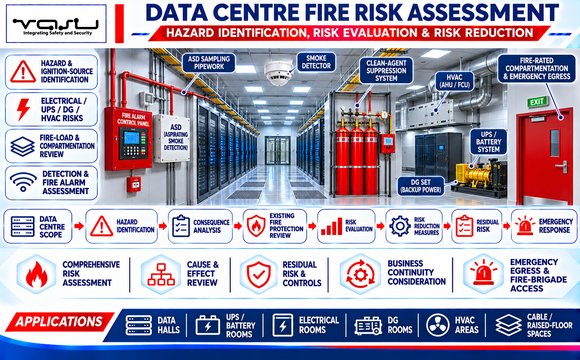
Data Centre Information → Hazard Identification → Ignition Source Assessment → Combustible / Fire Load Assessment → Consequence Analysis → Existing Fire Protection Review → Risk Evaluation → Risk Reduction Measures → Residual Risk → Emergency Response → Management & Review
3. Assessment Philosophy
The assessment should identify credible fire scenarios, evaluate likelihood and consequence, review existing safeguards, identify gaps and establish proportionate risk-reduction measures. The methodology, assumptions, acceptance criteria and responsibilities should be documented.
4. Data Centre Asset Identification
Critical assets should include IT equipment, servers, network infrastructure, storage systems, UPS equipment, batteries, electrical distribution, generators, cooling systems, fire-protection equipment, communication systems and other infrastructure essential to facility operation.
5. Fire Hazard Identification
Potential hazards should be identified across data halls, electrical rooms, UPS / battery areas, DG rooms, HVAC areas, cable spaces, storage areas, workshops, loading areas and other relevant locations.
6. Ignition Source Assessment
Potential ignition sources may include electrical faults, overloaded circuits, loose connections, overheating equipment, battery faults, mechanical equipment, hot surfaces, maintenance activities and other credible sources identified during the assessment.
7. Electrical Fire Risk
Electrical infrastructure should be assessed for short circuits, overloads, insulation failure, loose connections, arc faults, equipment overheating, cable damage and inadequate protection or maintenance.
8. UPS & Battery Fire Risk
UPS and battery systems should be assessed for thermal events, electrical faults, battery failure, charging-system faults, overheating and other hazards relevant to the installed battery technology.
9. DG Fire Risk
Generator areas should be assessed for fuel leakage, hot surfaces, electrical faults, lubrication systems, exhaust components and other combustion-related hazards.
10. HVAC Fire Risk
HVAC systems should be assessed for electrical equipment, motors, cabling, filters, ducts, airflow paths and conditions that could contribute to fire development or smoke movement.
11. Cable & Raised-Floor Risk
Cable concentrations and raised-floor spaces should be assessed for combustible materials, concealed ignition sources, overheating and potential smoke movement.
12. Fire Load Assessment
Combustible materials, packaging, plastics, cable insulation, furniture and other fire loads should be identified and assessed. Unnecessary combustible storage should be controlled.
13. Compartmentation Assessment
Walls, floors, ceilings, fire-rated doors, penetrations and other compartmentation features should be reviewed to determine whether fire and smoke can be adequately contained.
14. Fire Detection Assessment
Fire detection should be assessed for coverage, sensitivity, zoning, alarm response, early warning capability and suitability for critical data-centre environments.
15. Aspirating Smoke Detection Assessment
Where ASD is installed, sampling coverage, transport time, alarm thresholds, airflow monitoring and maintenance should be reviewed as part of the early-warning strategy.
16. Fire Alarm Assessment
The fire alarm system should be assessed for device coverage, zoning, alarm notification, fault monitoring, cause-and-effect logic and control-room indication.
17. Clean Agent Suppression Assessment
Clean-agent systems should be assessed for agent selection, design concentration, cylinder capacity, nozzle coverage, releasing logic, room integrity, pressure relief and maintenance condition.
18. Room Integrity Assessment
Protected clean-agent rooms should be reviewed for enclosure leakage, doors, dampers, cable penetrations, pipe penetrations and other openings that could compromise agent retention.
19. HVAC Fire Integration Assessment
HVAC shutdown, damper operation, smoke-control arrangements and interaction with clean-agent protection should be reviewed against the approved fire strategy.
20. Fire Water / Hydrant Assessment
Where water-based fire protection is provided, hydrants, fire pumps, water storage, distribution and access arrangements should be assessed for adequacy and availability.
21. Emergency Egress Assessment
Escape routes, exits, travel paths, emergency lighting, signage, door operation and occupant response should be assessed for safe evacuation.
22. Fire Brigade Access Assessment
Fire brigade access, appliance approach, entrances, access routes, fire-service facilities and emergency information should be reviewed.
23. Emergency Communication Assessment
Emergency communication systems should be assessed for coverage, intelligibility, power backup and coordination with the emergency-response strategy.
24. CCTV & Security Assessment
CCTV and access-control systems should be assessed for their ability to support incident verification, emergency access, evacuation and post-event investigation.
25. Emergency Power Assessment
Fire alarm, detection, suppression controls, emergency lighting, communication, security and other designated life-safety systems should have reliable emergency power.
26. Cause & Effect Assessment
The cause-and-effect matrix should be reviewed to confirm correct relationships between detection, alarm, HVAC, clean-agent release, CCTV, BMS / IBMS, access control and emergency communication.
27. Risk Ranking
Identified hazards should be evaluated using the approved risk-ranking methodology. Likelihood, consequence, existing safeguards and residual risk should be clearly documented.
28. Risk Reduction Measures
Risk-reduction measures may include improved detection, compartmentation, suppression, electrical protection, housekeeping, equipment maintenance, monitoring, emergency procedures, staff training and management controls.
29. Business Continuity Considerations
Fire-risk controls should consider potential service interruption, equipment loss, data availability, recovery time, redundancy, alternate operating arrangements and restoration priorities.
30. Installation / Physical Verification
Assessment should verify, as applicable:
- Fire-zone boundaries
- Detection coverage
- ASD coverage
- Fire alarm zoning
- Clean-agent system condition
- Room integrity
- HVAC fire response
- Electrical protection
- UPS / battery condition
- DG and fuel arrangements
- Emergency power
- Emergency lighting
- Emergency communication
- Fire brigade access
- Housekeeping and combustible storage
- CCTV / access control
- Fire-system maintenance status
31. Testing & Commissioning Review
The assessment should review available testing and commissioning records for fire detection, fire alarm, clean-agent suppression, room integrity, HVAC fire interfaces, emergency power, emergency communication and other critical systems.
32. Inspection & Evidence
Site observations, drawings, calculations, test reports, maintenance records, incident history, equipment schedules and interviews should be used as appropriate to substantiate the assessment.
33. Emergency Response Assessment
Emergency response procedures should define alarm escalation, control-room actions, evacuation, fire brigade notification, suppression-system operation, equipment isolation, emergency access and recovery responsibilities.
34. Impairment Risk
Any impairment of fire detection, suppression, emergency power, fire alarm, compartmentation or other critical protection should be assessed for increased risk and controlled through documented compensatory measures.
35. Failure & Recovery
Credible failures should be assessed, including detector failure, fire alarm failure, clean-agent impairment, room-integrity degradation, HVAC failure, UPS / DG failure and emergency-power loss.
36. Maintenance & Management
Fire-risk controls should be supported by preventive maintenance, periodic testing, inspection, housekeeping, staff training, impairment management and management review.
37. Design Change Control
Changes to IT load, room layouts, electrical systems, UPS / batteries, generators, HVAC, fire suppression, detection or occupancy should trigger a review of the fire-risk assessment.
38. Documentation
Data-centre fire-risk-assessment documentation should include, as applicable:
- Fire risk assessment methodology
- Data-centre asset schedule
- Hazard identification register
- Ignition-source assessment
- Fire-load assessment
- Risk-ranking matrix
- Existing-control assessment
- Detection assessment
- Fire alarm assessment
- ASD assessment
- Clean-agent assessment
- Room-integrity assessment
- HVAC fire-integration assessment
- Electrical / UPS / DG risk assessment
- Emergency egress assessment
- Fire brigade access assessment
- Emergency communication assessment
- Emergency-power assessment
- Cause-and-effect review
- Risk-reduction action plan
- Residual-risk register
- Business-continuity considerations
- Inspection records
- Testing / commissioning records
- Maintenance records
- Emergency-response procedures
- As-built drawings
- O&M documentation
39. Engineering Objective
The engineering objective is:
Establish Data Centre Scope → Identify Fire Hazards & Ignition Sources → Assess Critical Assets & Fire Loads → Review Compartmentation, Detection, Alarm & Suppression → Assess Electrical, UPS, DG & HVAC Risks → Evaluate Emergency Egress & Fire Brigade Response → Rank Risk → Define Risk-Reduction Measures → Establish Residual Risk & Action Plan → Integrate Business Continuity → Periodically Review & Update the Fire Risk Assessment
Frequently Asked Questions
What is the purpose of data centre fire risk assessment?
A Data Centre Fire Risk Assessment provides a structured evaluation of fire hazards, ignition sources, combustible loading, critical assets, detection capability, suppression provisions, evacuation arrangements, emergency response and business-continuity considerations. The assessment should establish risk controls appropriate to the facility’s operational profile and criticality.
What should be reviewed during design and implementation?
Review the system architecture, interfaces and engineering considerations identified in the source. Verify project-specific requirements and equipment data against approved project documentation.
What should testing and commissioning verify?
The assessment should review available testing and commissioning records for fire detection, fire alarm, clean-agent suppression, room integrity, HVAC fire interfaces, emergency power, emergency communication and other critical systems.
What should maintenance include?
Potential ignition sources may include electrical faults, overloaded circuits, loose connections, overheating equipment, battery faults, mechanical equipment, hot surfaces, maintenance activities and other credible sources identified during the assessment.