
Article
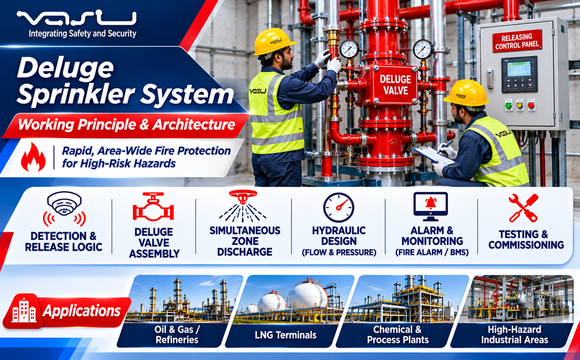
Deluge Sprinkler System
Oct 2026
Direct Answer
A deluge sprinkler system is an automatic fixed fire-protection arrangement that uses open sprinkler nozzles connected to a piping network. When the approved detection and release condition occurs, the deluge valve opens and water flows through the designated nozzle network, providing simultaneous discharge across the protected zone. System design must coordinate detection and release logic, zone configuration, hydraulic demand, water supply, alarms, interfaces and restoration.
1. Engineering Overview
A Deluge Sprinkler System is an automatic fixed fire protection arrangement in which open sprinkler nozzles are connected to a piping network and water is released to the protected zone when the associated deluge valve is activated. The system is intended for hazards where rapid, simultaneous discharge over a defined area is required.
2. System Architecture
Fire Water Storage → Fire Pump Set → Main Fire Water Header → Deluge Valve Assembly → Open Sprinkler / Nozzle Network
Detection System → Releasing / Control Panel → Deluge Valve Activation → Pump / Water Flow → Simultaneous Zone Discharge → Alarm & Interface Actions
3. Operating Principle
Under normal standby conditions, the deluge valve prevents water from entering the open-nozzle distribution network. When the approved detection and release condition occurs, the deluge valve opens and water flows through the complete designated nozzle network within the protected zone.
4. Major Components
A typical deluge system may include:
- Fire water storage tank
- Electric fire pump
- Diesel fire pump, where applicable
- Jockey pump
- Deluge valve
- Releasing / control panel
- Detection devices
- Main isolation valves
- Flow switch
- Tamper switch
- Pressure gauges
- Test and drain arrangement
- Open sprinkler / water discharge nozzles
- Distribution piping
5. Deluge Valve Assembly
The deluge valve is the principal water control device for the protected zone. Its trim, release mechanism, pressure monitoring and associated accessories should be selected and installed according to the approved system design and manufacturer requirements.
6. Detection & Release Logic
The detection system identifies the fire condition and provides the initiating signal to the releasing / control panel. The panel processes the approved Cause and Effect logic and activates the deluge valve when the specified release condition is satisfied.
7. Open Sprinkler Arrangement
Unlike wet pipe systems, the discharge devices in a deluge system are normally open. Once the deluge valve operates, water is distributed simultaneously to the designated open sprinklers or nozzles within the operating zone.
8. Zone Configuration
Deluge systems should be divided into clearly defined protection zones based on the hazard, fire scenario, hydraulic limitations and approved fire protection strategy. Each zone should have the required control, monitoring and testing arrangement.
9. Fire Pump & Water Supply
The fire pump and water storage should be capable of providing the required flow and pressure for the design deluge zone. Pump selection should be based on the approved hydraulic calculation and the hydraulically most demanding operating condition.
10. Hydraulic Design
The hydraulic calculation should establish the total water demand and pressure requirements for the operating deluge zone. Pipe friction losses, fitting losses, elevation effects, valve losses, nozzle characteristics and water supply conditions should be considered.
11. Detection Zoning
Detection zones should be coordinated with the deluge protection zones so that a fire condition activates the correct water discharge area. Detection arrangement should follow the approved fire protection strategy.
12. Alarm & Monitoring
Deluge activation should generate the appropriate fire alarm and waterflow indications. Flow switches, tamper switches, pressure monitoring and valve supervisory devices should be integrated with the approved fire alarm or monitoring system.
13. Test & Drain Arrangement
Each deluge assembly should have suitable testing and drainage provisions. The arrangement should allow controlled verification of valve operation, waterflow alarm and associated release functions.
14. Manual Release
Where included in the approved design, a manual release station may initiate deluge operation. The manual release arrangement should be clearly identified and coordinated with the approved Cause and Effect sequence.
15. Interface Integration
Deluge activation may interface with:
- Fire alarm system
- HVAC controls
- Equipment shutdown
- BMS / IBMS
- Access control
- Remote monitoring
- Emergency systems
16. Installation Requirements
Installation should verify:
- Correct deluge valve and trim
- Correct detection devices
- Correct releasing panel
- Correct open sprinkler / nozzle type
- Correct nozzle locations and orientation
- Correct piping and supports
- Correct flow and tamper switches
- Accessible test and drain connections
- Correct equipment identification
17. Testing & Commissioning
Commissioning should verify:
- Detection operation
- Cause and Effect sequence
- Deluge valve operation
- Pump start
- Waterflow alarm
- Pressure / flow performance
- Tamper supervision
- Manual release, where applicable
- Interface signals
- Test and drain operation
18. System Restoration
Following testing or system operation, the deluge system should be drained, inspected, reset and restored according to the approved procedure. All valves, controls, detection devices and monitoring functions should be returned to their normal standby condition.
19. Inspection & Maintenance
Periodic inspection should cover the deluge valve, trim, detection system, pump set, water supply, piping, open nozzles, monitoring devices and test arrangements. Corrosion, leakage, obstruction, physical damage and abnormal conditions should be identified and rectified.
20. Design Change Control
Changes to protected hazards, zone boundaries, nozzle arrangement, detection layout, piping configuration, valve arrangement or pump duty should be reviewed against the approved hydraulic and Cause and Effect design before implementation.
21. Documentation
Deluge system documentation should include, as applicable:
- Design basis
- Hydraulic calculation
- Deluge valve datasheet
- Valve trim details
- Detection layout
- Cause and Effect Matrix
- Open nozzle schedule
- Piping drawings / isometrics
- Pump datasheets
- Testing and commissioning records
- As-built drawings
- O&M manual
22. Engineering Objective
The engineering objective is:
Reliable Detection → Correct Release Decision → Rapid Deluge Valve Operation → Adequate Pump Response → Simultaneous Zone Discharge → Verified Pressure & Flow → Alarm & Interface Confirmation → Complete Restoration → Reliable Deluge Fire Protection
Frequently Asked Questions
What is a deluge sprinkler system?
It is a fixed fire-protection arrangement using open sprinkler heads or nozzles, with water admitted when the associated deluge valve is activated.
How is a deluge system activated?
The detection system sends an initiating signal to the releasing/control panel, which processes the approved Cause and Effect logic and activates the deluge valve when the specified condition is satisfied.
How does discharge differ from a typical closed-sprinkler arrangement?
In a deluge system, the discharge devices are normally open, so valve operation distributes water simultaneously to the designated open sprinklers or nozzles in the operating zone.
Why are protection zones important?
Zones should be defined according to the hazard, fire scenario, hydraulic limitations and approved fire-protection strategy, with suitable control, monitoring and testing arrangements.
What should be verified during commissioning?
The source lists detection operation, Cause and Effect sequence, deluge valve operation, pump start, waterflow alarm, pressure/flow performance, tamper supervision, manual release where applicable, interface signals and test/drain operation.
What records should be maintained?
As applicable, the source lists design basis, hydraulic calculation, deluge valve datasheet and trim details, detection layout, Cause and Effect Matrix, open nozzle schedule, piping drawings, pump datasheets, commissioning records, as-built drawings and O&M manual.
SEO and Website Publishing Details
| Field | Suggested content |
| SEO title | Deluge Sprinkler System: Operation, Components and Design |
| Meta description | Explore deluge sprinkler system operation, open nozzles, detection and release logic, zone configuration, hydraulic design, commissioning and maintenance. |
| Suggested URL slug | /deluge-sprinkler-system/ |
| Primary keyword | deluge sprinkler system |
| Secondary keywords | deluge valve; open sprinkler nozzles; deluge fire protection; Cause and Effect Matrix; deluge system hydraulic design |
| Suggested internal links | Wet Pipe Sprinkler System; Dry Pipe Sprinkler System; Pre-Action Sprinkler System; Sprinkler Head Types and Selection |