
Article
Door Access Control: Working Principle
Oct 2026
Direct Answer
Door access control is an electronic security arrangement that regulates entry and exit through a controlled door using an authorised credential, reader, controller, locking device and door-status monitoring. The system records access transactions and can generate alarms for defined abnormal conditions.
1. Engineering Overview
Door access control is an electronic security arrangement that regulates entry and exit through a controlled door using an authorised credential, reader, controller, locking device and door-status monitoring. The system records access transactions and can generate alarms for defined abnormal conditions.
2. Complete Door Access Control Architecture
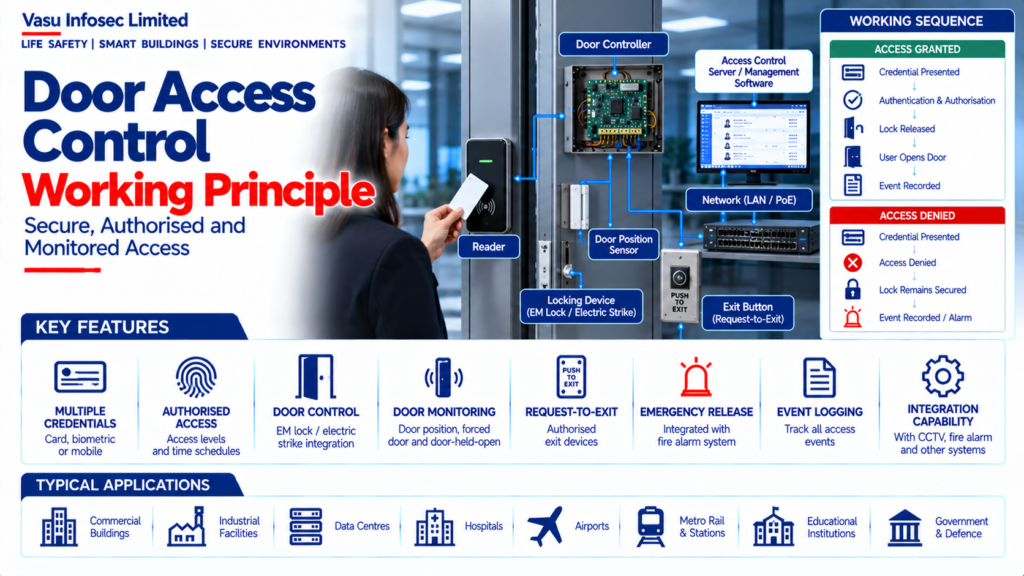
Credential → Card / Biometric / Mobile Credential → Reader → Door Controller → Locking Device
Door Position Sensor + Request-to-Exit → Door Controller
Access Control Network → ACS Server / Management Software → Operator Workstation
Supporting Infrastructure → Power Supply / UPS → Network → Time Synchronisation → Cybersecurity
3. Basic Working Principle
The user presents an authorised credential to the reader. The reader captures the credential information and sends the access request to the door controller. The controller evaluates the request using local or central access permissions and either grants or denies access.
4. Access Granted Sequence
Credential Presented → Credential Read → Access Authorisation → Access Granted → Lock Released → User Opens Door → Door Position Changes → Door Closes → Lock Secures → Event Recorded.
5. Access Denied Sequence
Credential Presented → Credential Read → Access Authorisation → Access Denied → Lock Remains Secured → Denied Event Recorded → Alarm / Notification, where configured.
6. Reader Function
The reader detects and reads the presented credential using the approved technology. Reader selection depends on credential type, security level, communication interface, environmental conditions and installation arrangement.
7. Credential Authentication
Credentials may include proximity cards, smart cards, biometric identifiers, mobile credentials or other approved technologies. The system should authenticate the credential against the configured access permissions.
8. Door Controller Function
The door controller receives the access request, applies the authorised access logic and controls the locking device. It also receives inputs from the door position sensor, request-to-exit device and emergency release interface.
9. Locking Device Function
The locking device physically controls access through the door. Electromagnetic locks, electric strikes and other approved locking arrangements may be used depending on door type, security requirements and life-safety provisions.
10. Door Position Monitoring
A door position sensor provides feedback on the physical state of the door. The system can use this status to identify normal access, forced opening or a door that remains open beyond the configured period.
11. Request-to-Exit Function
A request-to-exit device provides an authorised exit signal to the controller. This allows the system to distinguish an authorised exit from an unexpected door opening and supports correct event logging.
12. Door Held Open
If a controlled door remains open beyond the configured time, the system may generate a door-held-open alarm. The threshold should be configured according to the operational requirements of the facility.
13. Forced Door Condition
A forced-door condition may be generated when the door position changes without a valid access transaction or authorised exit signal. The event can be displayed and recorded by the access control system.
14. Access Levels & Schedules
Access permissions determine which users can access which doors and during which approved periods. Time schedules, holidays and special access rules should be configured according to the approved security policy.
15. Emergency Release
Emergency door release arrangements should operate according to the approved fire and life-safety strategy. Access control locking and emergency egress provisions must be coordinated so that security functions do not compromise required emergency evacuation.
16. Fire Alarm Interface
Where required, the access control system can receive an emergency release signal from the fire alarm system. The affected doors, release logic and restoration behaviour should be defined in the approved cause-and-effect / interface matrix.
17. Network Communication
Door controllers may communicate with the central access control server through an IP or other approved communication network. Network availability, addressing, segmentation and cybersecurity controls should be established during design.
18. Local Controller Operation
Depending on the selected system, controllers may retain authorised credentials or access rules locally and continue making access decisions during temporary server communication loss. The exact offline behaviour should be verified against the selected system.
19. Event Logging
Access events may include granted access, denied access, forced door, door held open, request-to-exit, emergency release and system faults. Event records should include appropriate time and door identification information.
20. CCTV Integration
Where integrated, access transactions can be correlated with CCTV camera views to support verification and incident investigation. The event interface should follow the approved integration matrix.
21. Power Supply & UPS
Readers, controllers and locking devices require appropriate power supplies. Critical access control equipment may be connected to UPS systems. Lock power consumption and controller loads should be included in the power calculation.
22. Installation Requirements
Installation should verify:
- Correct reader type
- Correct credential technology
- Correct controller
- Correct locking device
- Correct door position sensor
- Correct request-to-exit device
- Correct emergency release arrangement
- Correct network connection
- Correct power supply
- Correct door alignment
- Proper cable routing and identification
23. Testing & Commissioning
Door access control commissioning should verify:
- Valid credential access
- Invalid credential rejection
- Lock release and securing
- Door position indication
- Request-to-exit operation
- Door-held-open alarm
- Forced-door alarm
- Emergency release
- Access schedules
- Event logging
- Server communication
- Offline controller behaviour, where supported
24. Maintenance
Maintenance should include reader inspection, lock operation, door alignment, door sensor testing, request-to-exit testing, emergency release verification, controller health checks, power-supply checks, event-log review and configuration backup.
25. Design Change Control
Changes to door hardware, reader type, controller, locking device, access schedules, emergency release logic or system integration should be reviewed against the approved door access control design.
26. Documentation
Door access control documentation should include, as applicable:
- Door schedule
- Reader schedule
- Controller schedule
- Lock schedule
- Door hardware details
- Access level matrix
- Door logic / cause-and-effect matrix
- Network / IP details
- Power / UPS details
- Testing and commissioning records
- As-built drawings
- O&M manual
27. Engineering Objective
The engineering objective is:
Define Door Security Requirement → Select Credential & Reader → Select Controller & Lock → Integrate Door Monitoring & Exit Devices → Configure Access Rules → Verify Emergency Release → Test Access & Alarm Functions → Establish Secure & Reliable Door Access Control
Frequently Asked Questions
What is the main purpose of door access control: working principle?
Door access control is an electronic security arrangement that regulates entry and exit through a controlled door using an authorised credential, reader, controller, locking device and door-status monitoring. The system records access transactions and can generate alarms for defined abnormal conditions.
What should be checked before selection or installation?
Verify compatibility with the approved system architecture, door hardware and connected devices, power requirements, network or communication interface, environmental conditions and applicable emergency-release requirements.
What should be tested during commissioning?
Test the functions identified in the source technical content and approved project documents, including normal operation, access granted/denied behaviour, monitoring inputs, alarms, emergency release where applicable, power and communication behaviour.
What documentation should be retained?
Maintain applicable schedules, wiring and interface details, configuration records, power calculations, test and commissioning records, as-built drawings and the O&M manual as required by the project.
SEO & Publishing Details
| SEO Title | Door Access Control: Working Principle | Technical Guide | Vasu Infosec Limited |
| Meta Description | Door access control is an electronic security arrangement that regulates entry and exit through a controlled door using an authorised credential, |
| Primary Keyword | Door Access Control: Working Principle |
| Secondary Keywords | Door Access Control: Working Principle; access control system; electronic security; system architecture; installation and commissioning |
| Suggested URL Slug | door-access-control-working-principle |
| Suggested Image Alt Text | Technical architecture and key components of door access control: working principle |