
Article
Door Controller Architecture
Oct 2026
Direct Answer
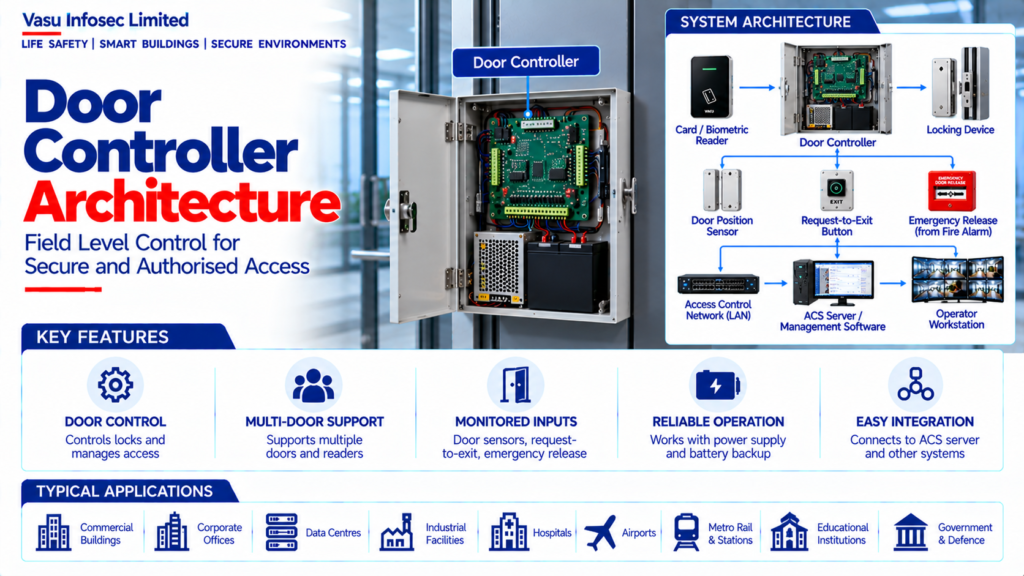
A Door Controller is the field-level control device responsible for managing one or more access-controlled doors. It interfaces with readers, locking devices, door position sensors, request-to-exit devices and emergency-release inputs while communicating with the central access control system.
1. Engineering Overview
A Door Controller is the field-level control device responsible for managing one or more access-controlled doors. It interfaces with readers, locking devices, door position sensors, request-to-exit devices and emergency-release inputs while communicating with the central access control system.
2. Complete Door Controller Architecture
Access Credential → Reader → Door Controller → Locking Device
Door Position Sensor + Request-to-Exit + Emergency Release → Door Controller
Door Controller → Access Control Network → ACS Server / Management Software → Operator Workstation
Power Supply / Battery / UPS → Door Controller → Field Devices
3. Controller Core Functions
The door controller processes access requests, controls locking devices, monitors door status, records events and communicates with the central access control platform. Depending on the system, it may also retain local access rules for continued operation during communication loss.
4. Door Capacity
Controller capacity is defined by the number of doors, readers, inputs and outputs supported. The selected controller should accommodate the required door configuration and approved future expansion.
5. Reader Interface
The controller receives credential information from connected readers through the approved interface. Reader communication type, power requirements, cable distance and security features should be compatible with the selected controller.
6. Lock Control
The controller operates the connected locking device according to the access decision and configured door logic. Output type, contact rating, current requirement and fail-safe / fail-secure behaviour should be coordinated with the approved door hardware.
7. Door Position Input
The door position sensor provides feedback to the controller regarding whether the door is open or closed. This input supports forced-door detection, door-held-open monitoring and access-event verification.
8. Request-to-Exit Input
The request-to-exit input allows the controller to recognise an authorised exit. This helps prevent a normal exit from being incorrectly reported as a forced-door event.
9. Emergency Release Input
Emergency release inputs allow the controller to respond to approved emergency commands. Fire alarm and emergency egress interfaces should be defined through the approved cause-and-effect matrix.
10. Local Access Decision
Depending on the system architecture, the controller may make access decisions locally using stored credentials / access rules or may obtain authorisation from the central server. Offline operation requirements should be established and tested.
11. Local Memory & Event Storage
Controllers may store access permissions, configuration and event records locally. Memory capacity should be adequate for the required offline period and event volume.
12. Network Communication
The controller communicates with the access control server using the approved network. IP addressing, communication protocol, VLAN, routing, bandwidth and cybersecurity requirements should be established during design.
13. Controller Power Architecture
Controller power should be sized for the controller itself and connected field devices where applicable. Reader, lock, auxiliary and communication loads should be included in the power calculation.
14. Battery Backup
Where local battery backup is provided, battery capacity should be calculated for the controller and connected loads based on the required autonomy. Battery supervision should be provided where supported.
15. UPS Integration
Critical door controllers may be connected to a UPS-supported supply. The power architecture should define the required continuity for controllers, readers and locking devices.
16. Controller Enclosure
The controller enclosure should provide suitable physical protection, cable entry, component arrangement, maintenance access and environmental protection. Tamper monitoring should be provided where required.
17. Communication Redundancy
Critical access control systems may use redundant network paths or controller arrangements. The selected architecture should be aligned with the required availability and tested during commissioning.
18. Fire Alarm Integration
Where required, the controller should interface with the fire alarm system to release designated doors during an emergency. The release logic, affected doors and restoration behaviour should be documented.
19. CCTV Integration
Access events generated by the controller may be passed to the CCTV / VMS platform for event correlation. The interface should follow the approved integration matrix.
20. Installation Requirements
Installation should verify:
- Correct controller model
- Correct door capacity
- Correct reader interface
- Correct input / output capacity
- Correct lock interface
- Correct power supply
- Correct battery arrangement
- Correct network connectivity
- Correct IP / VLAN configuration
- Correct emergency release interface
- Correct enclosure / tamper protection
- Proper cable routing and identification
21. Testing & Commissioning
Door controller commissioning should verify:
- Reader communication
- Valid / invalid credential processing
- Lock operation
- Door position monitoring
- Request-to-exit
- Door-held-open alarm
- Forced-door alarm
- Emergency release
- Network communication
- Local / offline operation, where supported
- Battery / UPS operation
- Event logging
22. Failure & Recovery
Controlled tests should verify controller behaviour during network communication loss, server unavailability and power interruption. Restoration of normal communication and synchronisation should be confirmed.
23. Maintenance
Maintenance should include controller inspection, terminal checks, power and battery verification, input / output testing, network health checks, enclosure and tamper inspection, configuration backup and event-log review.
24. Capacity Verification
Final controller capacity verification should consider:
- Number of doors
- Number of readers
- Inputs
- Outputs
- Lock loads
- Auxiliary loads
- Local memory
- Network capacity
- Battery / UPS capacity
- Future expansion
25. Design Change Control
Changes to door count, reader technology, lock type, controller model, input / output requirements, network architecture or emergency release logic should trigger a controller capacity and compatibility review.
26. Documentation
Door controller documentation should include, as applicable:
- Controller schedule
- Door / reader allocation
- Input / output schedule
- Lock schedule
- Wiring diagrams
- Power and battery calculations
- Network / IP details
- Cause-and-effect matrix
- Controller configuration
- Testing and commissioning records
- As-built drawings
- O&M manual
27. Engineering Objective
The engineering objective is:
Establish Door Requirement → Select Controller Capacity → Define Reader, Lock & Monitoring Interfaces → Size Power & Backup → Establish Network Communication → Integrate Emergency Release → Verify Local & Central Operation → Complete Testing → Establish Reliable Door-Level Access Control
Frequently Asked Questions
What is the main purpose of door controller architecture?
A Door Controller is the field-level control device responsible for managing one or more access-controlled doors. It interfaces with readers, locking devices, door position sensors, request-to-exit devices and emergency-release inputs while communicating with the central access control system.
What should be checked before selection or installation?
Verify compatibility with the approved system architecture, door hardware and connected devices, power requirements, network or communication interface, environmental conditions and applicable emergency-release requirements.
What should be tested during commissioning?
Test the functions identified in the source technical content and approved project documents, including normal operation, access granted/denied behaviour, monitoring inputs, alarms, emergency release where applicable, power and communication behaviour.
What documentation should be retained?
Maintain applicable schedules, wiring and interface details, configuration records, power calculations, test and commissioning records, as-built drawings and the O&M manual as required by the project.
SEO & Publishing Details
| SEO Title | Door Controller Architecture | Technical Guide | Vasu Infosec Limited |
| Meta Description | A Door Controller is the field-level control device responsible for managing one or more access-controlled doors. It interfaces with readers, locking |
| Primary Keyword | Door Controller Architecture |
| Secondary Keywords | Door Controller Architecture; access control system; electronic security; system architecture; installation and commissioning |
| Suggested URL Slug | door-controller-architecture |
| Suggested Image Alt Text | Technical architecture and key components of door controller architecture |