
Article
Door Position Sensor
Oct 2026
Direct Answer
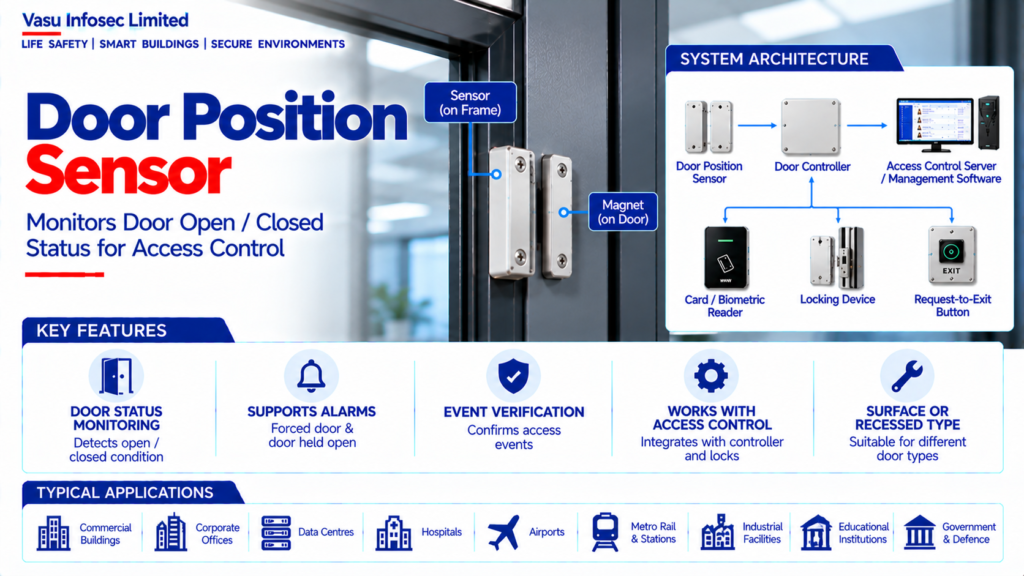
A Door Position Sensor (DPS) is a monitoring device used to detect the physical open or closed condition of an access-controlled door. The sensor provides status feedback to the access control controller and supports access-event verification, forced-door detection, door-held-open alarms and system monitoring.
1. Engineering Overview
A Door Position Sensor (DPS) is a monitoring device used to detect the physical open or closed condition of an access-controlled door. The sensor provides status feedback to the access control controller and supports access-event verification, forced-door detection, door-held-open alarms and system monitoring.
2. Complete Door Position Sensor Architecture
Door → Door Position Sensor / Magnetic Contact → Door Controller Input → Access Control Network → ACS Server / Management Software → Operator Workstation
Reader → Door Controller → Locking Device
Request-to-Exit + Emergency Release → Door Controller
Supporting Infrastructure → Power / UPS → Controller → Field Devices
3. Working Principle
A typical door position sensor consists of a sensor and corresponding magnet or sensing element. When the door is closed, the sensor remains in its normal state. Opening the door changes the sensor state, which is detected by the door controller and reported to the access control system.
4. Magnetic Contact Sensor
A magnetic contact uses a magnet and switch arrangement to detect door position. The contact changes state when the magnet moves away from the sensing element as the door opens.
5. Recessed & Surface-Mounted Types
Door position sensors may be recessed into the door / frame or mounted on the surface. Selection should consider door construction, available installation space, security requirements, environmental conditions and manufacturer recommendations.
6. Normally Closed / Normally Open Configuration
The sensor input configuration should be selected according to the controller and approved door logic. Supervised or monitored input arrangements may be used where higher fault detection is required.
7. Door Status Monitoring
The access control controller interprets the sensor signal to determine whether the door is open or closed. The status is used to correlate physical door movement with valid access transactions.
8. Access Granted Correlation
Typical sequence:
Valid Credential → Access Granted → Lock Released → Door Opens → DPS Changes State → Door Closes → DPS Returns to Normal → Event Recorded.
9. Forced Door Detection
If the door position changes without a valid access transaction, request-to-exit signal or approved emergency-release condition, the access control system may generate a forced-door alarm.
10. Door Held Open Detection
If the door remains open beyond the configured time after an authorised access event, the system may generate a door-held-open alarm. The threshold should be established according to the approved operational requirements.
11. Request-to-Exit Correlation
The DPS should be coordinated with the request-to-exit device. This allows the controller to distinguish an authorised exit from an unexpected door opening.
12. Emergency Release Correlation
During an approved emergency release condition, the door position sensor should continue to provide door status feedback where the architecture supports it. The expected status and alarm behaviour should be defined in the cause-and-effect matrix.
13. Sensor Selection
Sensor selection should consider:
- Door material
- Door construction
- Door/frame geometry
- Mounting method
- Sensing gap
- Environmental conditions
- Tamper exposure
- Required security level
- Controller input compatibility
14. Environmental Requirements
Sensors installed in outdoor, humid, dusty or industrial environments should have suitable environmental protection. Temperature, moisture, corrosion and mechanical exposure should be considered.
15. Tamper Considerations
Where required, the sensor and its wiring should be protected against tampering. Concealed or supervised arrangements may be selected for higher-security applications.
16. Cable & Wiring Architecture
The sensor should be connected to the appropriate monitored input of the door controller. Cable routing should protect the circuit from mechanical damage, interference and unauthorised access.
17. Supervised Inputs
Where the access control system supports supervised inputs, the sensor circuit can be configured to detect conditions such as open, closed, short circuit or open circuit. The selected supervision method should follow the approved system design.
18. Power Requirement
Many basic magnetic door contacts are passive devices and do not require a separate power supply. Active sensors or specialised devices may require power. The selected device characteristics should be verified against the controller design.
19. Integration with Access Control
The DPS is a fundamental input to the access control system. Its status supports door monitoring, event correlation, alarms and reporting through the central access control software.
20. CCTV Integration
Where integrated, a door status or forced-door event may trigger or correlate with a CCTV view. The interface should follow the approved access-control and CCTV integration matrix.
21. Installation Requirements
Installation should verify:
- Correct sensor type
- Correct sensor and magnet alignment
- Correct mounting method
- Correct sensing gap
- Correct controller input
- Correct circuit configuration
- Correct supervision arrangement, where applicable
- Correct environmental suitability
- Proper cable routing and protection
- Secure fixing and tamper protection
22. Testing & Commissioning
Door position sensor commissioning should verify:
- Door closed indication
- Door open indication
- Valid access correlation
- Forced-door alarm
- Door-held-open alarm
- Request-to-exit correlation
- Emergency-release behaviour
- Sensor alignment
- Input supervision, where applicable
- Event logging
23. Failure & Recovery
Controlled tests should verify sensor behaviour during cable disconnection, input fault and restoration conditions where supervision is provided. The system should correctly identify abnormal conditions and return to normal after fault clearance.
24. Maintenance
Maintenance should include sensor and magnet inspection, alignment verification, mounting checks, cable inspection, input-status verification, alarm testing and review of abnormal door events.
25. Design Change Control
Changes to door type, sensor type, mounting arrangement, controller input configuration or access-control logic should be reviewed because they may affect door monitoring and alarm functionality.
26. Documentation
Door position sensor documentation should include, as applicable:
- Door schedule
- Sensor schedule
- Sensor type
- Mounting details
- Controller input allocation
- Wiring diagram
- Input supervision details
- Door logic / cause-and-effect matrix
- Testing and commissioning records
- As-built drawings
- O&M manual
27. Engineering Objective
The engineering objective is:
Define Door Monitoring Requirement → Select Suitable Door Position Sensor → Verify Door & Frame Compatibility → Connect to Controller → Configure Normal & Alarm States → Integrate REX & Emergency Release Logic → Test Door Status & Alarms → Establish Reliable Door Monitoring
Frequently Asked Questions
What is door position sensor?
A Door Position Sensor (DPS) is a monitoring device used to detect the physical open or closed condition of an access-controlled door. The sensor provides status feedback to the access control controller and supports access-event verification, forced-door detection, door-held-open alarms and system monitoring.
What should be checked before installation?
Confirm equipment compatibility, approved interfaces, power and network requirements, installation details, emergency or fault behaviour where applicable, and manufacturer instructions.
What should be tested during commissioning?
Test functions and scenarios identified in the source content and approved project procedures, including normal operation, alarms, integrations, power or communication failures where applicable, and restoration.
What documentation should be retained?
Retain applicable schedules, wiring and interface details, configuration records, test and commissioning records, as-built drawings and O&M documentation as required by the project.
SEO & Publishing Details
| SEO Title | Door Position Sensor | Technical Guide | Vasu Infosec Limited |
| Meta Description | A Door Position Sensor (DPS) is a monitoring device used to detect the physical open or closed condition of an access-controlled door. The sensor |
| Primary Keyword | Door Position Sensor |
| Secondary Keywords | Door Position Sensor; access control system; electronic security; system architecture; installation and commissioning |
| Suggested URL Slug | door-position-sensor |
| Suggested Image Alt Text | Technical architecture and key components of door position sensor |