
Article
Dry Pipe Sprinkler System
Oct 2026
Direct Answer
A dry pipe sprinkler system is an automatic fire-protection arrangement in which the sprinkler distribution piping is normally maintained under controlled air or nitrogen pressure instead of being filled with water. When an individual sprinkler operates, the pressure condition changes, the dry pipe valve trips, and water enters the piping to discharge through the operating sprinkler. The system design must account for water-delivery time, hydraulic performance, monitoring, and the environmental conditions of the protected area.
1. Engineering Overview
A Dry Pipe Sprinkler System is an automatic sprinkler arrangement in which the distribution piping is maintained with a pressurised gas rather than water under normal standby conditions. When a sprinkler operates, the dry pipe valve releases and allows water to enter the distribution piping and discharge through the operating sprinkler heads.
2. System Architecture
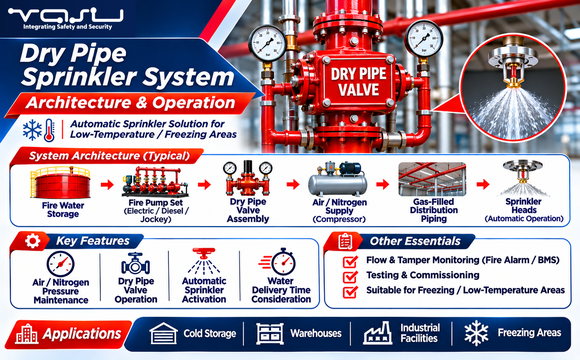
Fire Water Storage → Fire Pump Set → Dry Pipe Valve Assembly → Dry / Gas-Filled Distribution Piping → Branch Piping → Automatic Sprinkler Heads
Monitoring & Control → Air / Nitrogen Pressure Monitoring → Flow Switch → Tamper Switch → Fire Alarm / BMS Interface
3. Operating Principle
Under normal conditions, the sprinkler piping is maintained under controlled air or nitrogen pressure and the dry pipe valve prevents water from entering the distribution network. When a sprinkler operates, the pressure condition changes, the dry pipe valve trips and water flows into the piping toward the operating sprinkler.
4. Major Components
A typical dry pipe system may include:
- Fire water storage tank
- Electric fire pump
- Diesel fire pump, where applicable
- Jockey pump
- Dry pipe valve
- Air / nitrogen supply
- Air compressor, where applicable
- Air pressure maintenance equipment
- Main isolation valves
- Flow switch
- Tamper switch
- Pressure gauges
- Quick-opening device, where applicable
- Test and drain assembly
- Distribution piping
- Automatic sprinkler heads
5. Dry Pipe Valve Assembly
The dry pipe valve separates the water supply from the gas-filled distribution piping during standby conditions. The valve should be selected and installed with the approved trim and accessories required for reliable operation and testing.
6. Air / Nitrogen Pressure
Standby gas pressure should be maintained within the approved range required for the selected dry pipe valve and system design. Pressure settings should be coordinated with the water supply pressure and manufacturer requirements.
7. Air Compressor / Nitrogen Supply
Where compressed air or nitrogen is used, the supply equipment should maintain the required standby pressure. Capacity, controls, pressure settings and connection arrangement should be compatible with the approved system design.
8. Sprinkler Operation
When an individual sprinkler operates due to heat, the gas pressure in the piping decreases. The dry pipe valve then trips, permitting water to enter the distribution piping and flow toward the operating sprinkler.
9. Water Delivery Considerations
Because water must first fill the dry distribution piping after valve operation, water delivery time should be considered in the system design. The arrangement should be engineered to provide the required response for the protected hazard.
10. Hydraulic Design
The hydraulic calculation should establish the required water flow and pressure at the design sprinklers. Pipe friction losses, fitting losses, elevation, sprinkler characteristics, water supply and the dry pipe valve arrangement should be considered.
11. Quick-Opening Device
Where provided, a quick-opening device can assist in reducing the time required for dry pipe valve operation following a sprinkler activation. Its selection and operation should follow the approved manufacturer design.
12. Detection & Alarm Monitoring
Sprinkler operation and water flow should generate the appropriate alarm indication. Flow switches, valve supervisory devices and pressure monitoring should be integrated with the fire alarm or approved monitoring system.
13. Test & Drain Arrangement
The dry pipe system should have suitable test and drain facilities to verify valve operation, waterflow alarm functions and system drainage. Test arrangements should be accessible and clearly identified.
14. Low-Temperature Applications
Dry pipe systems are particularly applicable to areas where water-filled sprinkler piping may be exposed to freezing conditions. The suitability of the system should be confirmed from the actual environmental conditions and approved design.
15. Installation Requirements
Installation should verify:
- Correct dry pipe valve and trim
- Correct air / nitrogen arrangement
- Correct pipe material and size
- Correct sprinkler type and temperature rating
- Correct sprinkler spacing and orientation
- Correct flow and tamper switches
- Secure pipe supports
- Correct drain arrangement
- Correct equipment identification
16. Testing & Commissioning
Commissioning should verify:
- Air / nitrogen pressure
- Dry pipe valve operation
- Waterflow alarm
- Flow switch operation
- Tamper switch operation
- Pump operation
- Test and drain operation
- Pressure testing
- Alarm interfaces
- Water delivery response
17. Inspection & Maintenance
Periodic maintenance should include inspection of the dry pipe valve, trim, air / nitrogen pressure, compressor or nitrogen supply, sprinkler heads, piping, valves, monitoring devices and drains. Corrosion, leakage, pressure loss or abnormal conditions should be identified and rectified.
18. System Restoration
Following a system trip or test, the dry pipe system should be properly drained, inspected, reset and restored to the approved standby pressure condition. The system should not be considered available until all required valves, controls and monitoring functions are returned to normal.
19. Design Change Control
Changes to protected occupancy, environmental conditions, sprinkler locations, piping configuration, water supply, air / nitrogen pressure or dry pipe valve arrangement should be reviewed against the approved hydraulic and system design.
20. Documentation
Dry pipe system documentation should include, as applicable:
- Design basis
- Hydraulic calculation
- Dry pipe valve datasheet
- Valve trim details
- Air / nitrogen system details
- Sprinkler layout
- Piping drawings / isometrics
- Flow and tamper switch details
- Testing and commissioning records
- As-built drawings
- O&M manual
21. Engineering Objective
The engineering objective is:
Controlled Gas-Filled Standby → Reliable Sprinkler Operation → Dry Pipe Valve Trip → Rapid Water Admission → Verified Pressure & Flow → Effective Fire Control → Alarm & Monitoring → Complete Restoration → Reliable Dry Pipe Fire Protection
Frequently Asked Questions
What is a dry pipe sprinkler system?
It is an automatic sprinkler arrangement whose distribution piping is normally maintained under controlled air or nitrogen pressure rather than water.
How does a dry pipe sprinkler system operate?
When an individual sprinkler operates, gas pressure in the piping decreases. The dry pipe valve trips and permits water to enter the distribution piping toward the operating sprinkler.
Where may a dry pipe system be suitable?
It may be suitable for areas where water-filled sprinkler piping could be exposed to freezing conditions. Suitability must be confirmed against actual environmental conditions and the approved design.
Why is water-delivery time important?
Water must first enter and fill the dry distribution piping after the valve operates, so the system should be engineered to provide the required response for the protected hazard.
What should be verified during commissioning?
The source identifies air/nitrogen pressure, dry pipe valve operation, waterflow alarm, flow and tamper switches, pump operation, test and drain functions, pressure testing, alarm interfaces and water-delivery response.
What documentation should be retained?
As applicable, the source lists the design basis, hydraulic calculation, dry pipe valve datasheet and trim details, air/nitrogen system details, sprinkler layout, piping drawings, switch details, test and commissioning records, as-built drawings and O&M manual.
SEO and Website Publishing Details
| Field | Suggested content |
| SEO title | Dry Pipe Sprinkler System: Components, Operation and Design |
| Meta description | Learn how dry pipe sprinkler systems operate, including valve assemblies, air or nitrogen pressure, hydraulic design, alarms, commissioning and maintenance. |
| Suggested URL slug | /dry-pipe-sprinkler-system/ |
| Primary keyword | dry pipe sprinkler system |
| Secondary keywords | dry pipe valve; air pressure monitoring; nitrogen sprinkler system; sprinkler hydraulic design; dry pipe sprinkler commissioning |
| Suggested internal links | Wet Pipe Sprinkler System; Sprinkler Head Types and Selection; Automatic Sprinkler System Architecture; Sprinkler Inspection and Maintenance |