
Article
Electric Strike Lock: Working Principle
Oct 2026
Direct Answer
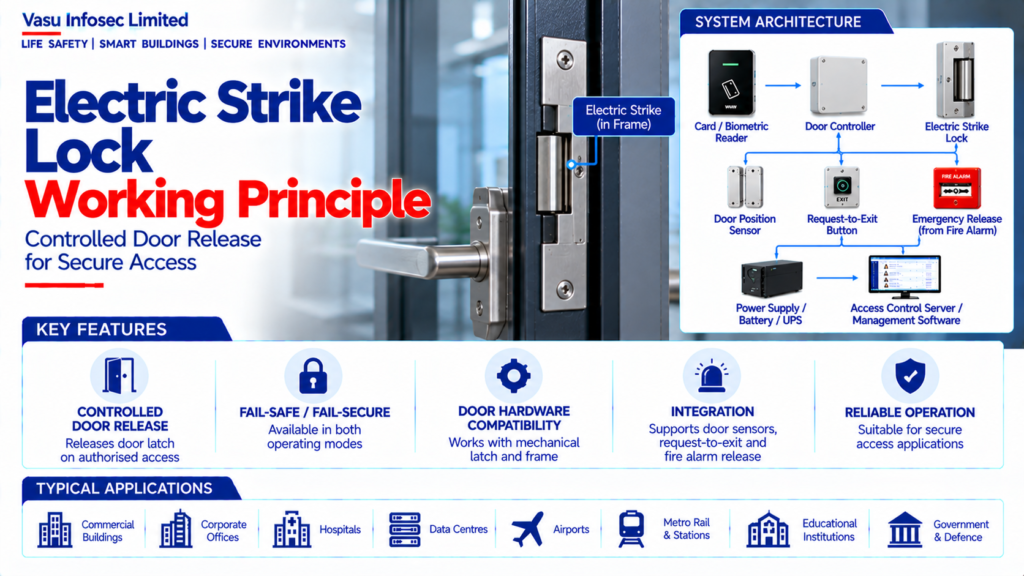
An electric strike lock is an electrically controlled door locking device installed in or in conjunction with the door frame. It permits controlled release of the door latch when an authorised access signal is received while retaining the mechanical latching function of the door.
1. Engineering Overview
An electric strike lock is an electrically controlled door locking device installed in or in conjunction with the door frame. It permits controlled release of the door latch when an authorised access signal is received while retaining the mechanical latching function of the door.
2. Complete Electric Strike Architecture
Access Credential → Reader → Door Controller → Electric Strike Control Output → Electric Strike
Door Position Sensor + Request-to-Exit → Door Controller
Fire Alarm / Emergency Release → Approved Release Interface → Electric Strike
Power Supply / Battery / UPS → Electric Strike
Access Control Network → ACS Server / Management Software → Operator Workstation
3. Working Principle
In the normal secured condition, the electric strike retains the door latch. When an authorised access request is received, the controller energises or de-energises the strike according to its operating mode, allowing the door latch to pass through the strike and the door to open.
4. Fail-Safe & Fail-Secure Types
Electric strikes may be configured as fail-safe or fail-secure depending on the selected hardware and application. The operating mode should be selected according to security requirements, emergency egress requirements and applicable fire-life-safety provisions.
5. Fail-Safe Operation
A fail-safe configuration releases the locking function when electrical power is removed. This may be considered where emergency release requirements require the door to unlock upon power loss.
6. Fail-Secure Operation
A fail-secure configuration maintains the locked condition when power is removed, subject to the specific hardware design and mechanical egress arrangement. Emergency exit requirements must still be maintained.
7. Door Latch Interface
The electric strike is designed to cooperate with the door’s mechanical latch. Correct compatibility between the strike, latch type, frame and door hardware is essential for reliable operation.
8. Access Granted Sequence
Credential Presented → Authentication → Access Granted → Controller Activates Strike → Latch Released → Door Opens → Door Position Changes → Door Closes → Strike Returns to Secured Condition → Event Recorded.
9. Access Denied Sequence
Credential Presented → Authentication → Access Denied → Strike Remains in Secured Condition → Door Remains Locked → Denied Event Recorded.
10. Request-to-Exit Integration
A request-to-exit device provides an authorised exit signal to the controller. The controller then operates the electric strike according to the configured door logic and records the exit event where applicable.
11. Door Position Monitoring
A door position sensor provides feedback on whether the door is open or closed. The access control system can use this information to detect forced opening, door-held-open conditions and confirm normal access events.
12. Emergency Release
Emergency release arrangements should provide the required door-release behaviour under emergency conditions. The electric strike type and operating mode must be coordinated with the approved life-safety strategy.
13. Fire Alarm Integration
Where required, the electric strike should interface with the fire alarm system so that designated doors achieve the approved emergency release condition. The release and restoration sequence should be defined in the approved cause-and-effect / interface matrix.
14. Power Supply
Electric strikes require a suitable power supply. Voltage, current, inrush characteristics, number of connected locks, cable length, voltage drop and required design margin should be considered during power-system design.
15. UPS & Battery Backup
The effect of UPS or battery backup on the selected fail-safe / fail-secure behaviour should be evaluated. Emergency release requirements must remain effective under the approved power architecture.
16. Door Compatibility
The electric strike should be compatible with the door frame, latch, door type, opening direction and available mounting space. Existing mechanical hardware should be checked before final selection.
17. Mechanical Alignment
Correct alignment between the door latch and electric strike is essential. Misalignment, excessive door sag, frame distortion or incorrect installation can prevent reliable release and re-latching.
18. Security Considerations
The strike should be selected according to the required security level, holding characteristics, tamper exposure, door usage, environmental conditions and approved door hardware design.
19. Environmental Selection
Outdoor or harsh-environment applications require electric strikes with suitable environmental protection. Temperature, humidity, dust, corrosion and water exposure should be considered.
20. Lock Monitoring
Where supported, lock or door monitoring can provide status information to the access control system. Monitoring functions should be integrated and tested where required.
21. Installation Requirements
Installation should verify:
- Correct electric strike model
- Correct fail-safe / fail-secure configuration
- Correct voltage and current
- Correct latch compatibility
- Correct frame and door compatibility
- Correct mechanical alignment
- Correct request-to-exit interface
- Correct door position sensor
- Correct emergency release arrangement
- Correct fire alarm interface
- Correct power supply
- Proper cable routing and protection
22. Testing & Commissioning
Electric strike commissioning should verify:
- Strike activation
- Strike release
- Valid credential operation
- Invalid credential rejection
- Request-to-exit operation
- Door position monitoring
- Door-held-open alarm
- Forced-door alarm
- Emergency release
- Fire alarm release, where applicable
- Power interruption behaviour
- Re-locking after door closure
23. Failure & Recovery
Controlled tests should verify the strike response to normal power loss, controller communication loss and emergency release conditions. Normal operation should be restored after power and communication recovery.
24. Maintenance
Maintenance should include inspection of the strike body, latch interface, mounting hardware, door alignment, electrical connections, power supply, release operation, door position sensor and emergency-release interface.
25. Design Change Control
Changes to strike type, operating mode, door hardware, frame, controller output, power supply, fire alarm interface or emergency release arrangement should be reviewed because they may affect security and life safety.
26. Documentation
Electric strike documentation should include, as applicable:
- Lock schedule
- Manufacturer datasheet
- Fail-safe / fail-secure configuration
- Electrical requirements
- Door and frame details
- Mounting details
- Wiring diagram
- Power / UPS calculation
- Fire alarm interface / cause-and-effect
- Testing and commissioning records
- As-built drawings
- O&M manual
27. Engineering Objective
The engineering objective is:
Define Door Security & Egress Requirement → Select Electric Strike → Verify Latch & Frame Compatibility → Select Fail-Safe / Fail-Secure Mode → Size Power Supply → Integrate Controller, REX & Door Monitoring → Provide Emergency / Fire Alarm Release → Test Locking & Release Functions → Establish Secure & Life-Safety-Compliant Door Access Control
Frequently Asked Questions
What is the main purpose of electric strike lock: working principle?
An electric strike lock is an electrically controlled door locking device installed in or in conjunction with the door frame. It permits controlled release of the door latch when an authorised access signal is received while retaining the mechanical latching function of the door.
What should be checked before selection or installation?
Verify compatibility with the approved system architecture, door hardware and connected devices, power requirements, network or communication interface, environmental conditions and applicable emergency-release requirements.
What should be tested during commissioning?
Test the functions identified in the source technical content and approved project documents, including normal operation, access granted/denied behaviour, monitoring inputs, alarms, emergency release where applicable, power and communication behaviour.
What documentation should be retained?
Maintain applicable schedules, wiring and interface details, configuration records, power calculations, test and commissioning records, as-built drawings and the O&M manual as required by the project.
SEO & Publishing Details
| SEO Title | Electric Strike Lock: Working Principle | Technical Guide | Vasu Infosec Limited |
| Meta Description | An electric strike lock is an electrically controlled door locking device installed in or in conjunction with the door frame. It permits controlled |
| Primary Keyword | Electric Strike Lock: Working Principle |
| Secondary Keywords | Electric Strike Lock: Working Principle; access control system; electronic security; system architecture; installation and commissioning |
| Suggested URL Slug | electric-strike-lock-working-principle |
| Suggested Image Alt Text | Technical architecture and key components of electric strike lock: working principle |