
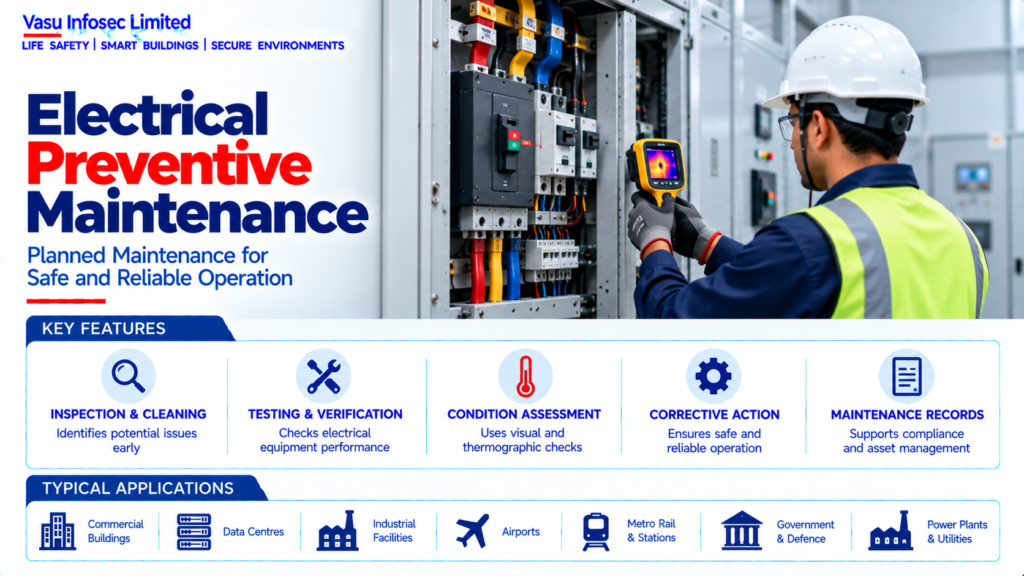
Article
Electrical Preventive Maintenance
Oct 2026
Direct Answer
Electrical preventive maintenance is a planned programme of inspection, testing, cleaning, servicing and condition assessment intended to maintain equipment in a safe, reliable and efficient operating condition and reduce unexpected failures.
1. Engineering Overview
Electrical Preventive Maintenance is a planned programme of inspection, testing, cleaning, servicing and condition assessment intended to maintain electrical equipment in a safe, reliable and efficient operating condition and reduce the probability of unexpected failures.
2. Complete Preventive Maintenance Architecture
Electrical Assets → Asset Register → Criticality Assessment → Maintenance Schedule → Visual Inspection → Cleaning / Tightening → Electrical Testing → Functional Testing → Condition Assessment → Defect Identification → Corrective Action → Retesting → Maintenance Records
3. Maintenance Philosophy
Preventive maintenance should be based on equipment criticality, manufacturer recommendations, operating environment, duty cycle, historical failures and applicable project requirements. Critical electrical systems may require more frequent inspection and condition monitoring.
4. Asset Register
The maintenance programme should maintain an asset register covering transformers, HT / LT panels, DG sets, UPS systems, batteries, cables, busbar trunking, distribution boards, protection devices, earthing systems, SPDs and associated control / monitoring equipment.
5. Criticality Assessment
Electrical assets should be classified according to their impact on safety, business continuity, critical operations and system availability. Maintenance priorities should reflect the consequences of equipment failure.
6. Preventive Maintenance Schedule
The schedule should define equipment reference, maintenance activity, frequency, responsible personnel, safety requirements, test instruments, acceptance criteria, findings and corrective-action requirements.
7. Visual Inspection
Visual inspection should identify overheating, corrosion, contamination, loose components, mechanical damage, abnormal indications, cable deterioration, water ingress, enclosure damage and unauthorised modifications.
8. Cleaning
Electrical equipment should be cleaned using methods compatible with the equipment and manufacturer requirements. Dust and contamination should be controlled because they can contribute to insulation deterioration and overheating.
9. Tightness & Termination Inspection
Accessible electrical terminations should be inspected for looseness, overheating, discolouration and mechanical condition. Torque verification should follow manufacturer requirements and approved maintenance procedures.
10. Thermographic Inspection
Thermography may be used to identify abnormal temperature patterns at switchboards, breakers, cable terminations, busbar joints, transformers and other accessible electrical connections while equipment is operating.
11. Insulation Condition
Insulation condition may be assessed through visual inspection, insulation-resistance testing and other approved diagnostic techniques. Test methods and limits should be appropriate for the specific equipment.
12. Switchgear Maintenance
HT and LT switchgear maintenance should include inspection of breakers, busbars, isolators, interlocks, auxiliary contacts, control circuits, protection devices, mechanical mechanisms and enclosure condition.
13. Circuit Breaker Maintenance
Circuit breakers should be inspected for mechanical operation, contact condition, trip mechanisms, auxiliary contacts, operating mechanisms and protection settings. Functional testing should be performed as required.
14. Transformer Maintenance
Transformer maintenance may include inspection of connections, temperature indicators, cooling equipment, protection devices, earthing, abnormal noise / vibration and insulation condition. Oil-filled transformers may require oil-quality checks according to the maintenance programme.
15. DG Set Maintenance
DG preventive maintenance should include engine condition, lubricating oil, filters, cooling system, fuel system, batteries, charger, exhaust system, alternator, control panel, protection and periodic loaded operation.
16. AMF / ATS Maintenance
AMF and ATS systems should be checked for mains sensing, DG start / stop commands, breaker operation, source interlocking, transfer delays, return-to-mains operation, alarms and control logic.
17. UPS Maintenance
UPS maintenance should include rectifier, inverter, bypass, fans, filters, terminals, alarms, control systems, batteries and monitoring interfaces. Operating history and alarm logs should be reviewed.
18. Battery Maintenance
Battery maintenance should include visual inspection, terminal condition, voltage, temperature, charger performance, interconnections, monitoring alarms and evidence of swelling, leakage or deterioration where applicable.
19. Busbar Trunking Maintenance
Busbar systems should be inspected for joint condition, tap-off units, enclosure integrity, supports, earthing continuity and signs of overheating. Thermographic inspection may be used where appropriate.
20. Cable & Termination Maintenance
Cable systems should be inspected for mechanical damage, insulation deterioration, overheating, loose terminations, gland condition, tray support and earthing continuity.
21. Earthing System Maintenance
Earthing maintenance should include inspection of earth conductors, equipment bonds, earth pits / electrodes, test links and connections. Periodic resistance / continuity testing should follow the approved maintenance programme.
22. Lightning Protection Maintenance
Lightning protection systems should be inspected for air terminals, down conductors, joints, supports, test points, earth connections and corrosion. Building or rooftop changes should be reviewed for their effect on the LPS.
23. Surge Protection Device Maintenance
SPDs should be checked for visual status, end-of-life indication, backup protection, connections and monitoring contacts. Failed or degraded modules should be replaced with approved compatible units.
24. Protection System Maintenance
Protective relays, breaker trip units, CT circuits and protection settings should be periodically reviewed and tested according to the approved maintenance and testing programme. Unauthorised setting changes should be controlled.
25. Power Quality Monitoring
Power-quality data should be reviewed periodically for abnormal voltage, current, frequency, harmonics, power factor, unbalance and event trends. Recurring abnormalities should be investigated for root cause.
26. Panel & Distribution Board Maintenance
Distribution boards should be inspected for enclosure condition, breaker operation, termination integrity, labels, spare capacity, overheating, contamination and earthing continuity.
27. Ventilation & Environmental Conditions
Electrical rooms should be maintained at suitable temperature, humidity, cleanliness and ventilation conditions. HVAC or ventilation failures affecting electrical equipment should be addressed promptly.
28. Emergency Power Maintenance
DG sets, UPS systems, batteries and associated source-transfer equipment supporting emergency and critical loads should be maintained and tested according to the approved resilience strategy.
29. Functional Testing
Preventive maintenance should include functional checks of applicable breakers, interlocks, alarms, source-transfer systems, DG start / stop, UPS operating modes, monitoring signals and emergency functions.
30. Corrective Action Management
Maintenance findings should be recorded with equipment reference, observation, severity / priority, probable cause, corrective action, responsible party, target date and closure status.
31. Maintenance Frequency
Maintenance frequency should be established according to manufacturer recommendations, equipment criticality, environmental conditions, operating hours, historical performance and applicable statutory / project requirements.
32. Safe Maintenance Practices
Maintenance activities should follow approved electrical safety procedures, isolation / lockout-tagout requirements, test-before-touch practices, suitable PPE and authorised-personnel controls. Energised work should only be undertaken where specifically permitted and controlled.
33. Failure & Recovery
The maintenance programme should identify common failure modes such as overheating, loose connections, insulation deterioration, battery degradation, breaker malfunction, protection failure and cooling-system faults. Recovery procedures should be established for critical equipment.
34. Maintenance KPIs
Useful maintenance performance indicators may include preventive-maintenance completion rate, repeat failures, equipment downtime, overdue maintenance, corrective-action closure, critical-asset availability and recurring alarm frequency.
35. Documentation
Electrical preventive-maintenance documentation should include, as applicable:
- Asset register
- Equipment criticality matrix
- Preventive-maintenance schedule
- Inspection checklists
- Thermography reports
- Electrical test reports
- Protection test records
- Battery test records
- DG / UPS maintenance records
- Earthing test records
- Lightning / SPD inspection records
- Defect and corrective-action records
- Calibration certificates
- Maintenance history
- As-maintained drawings
- O&M manual
36. Engineering Objective
The engineering objective is:
Identify Electrical Assets → Assess Criticality → Establish Maintenance Frequency → Inspect & Clean → Verify Connections & Condition → Perform Electrical / Functional Tests → Analyse Condition → Identify Defects → Implement Corrective Action → Retest → Maintain Safe, Reliable & Available Electrical Infrastructure
Frequently Asked Questions
How should maintenance frequency be established?
Use manufacturer recommendations, asset criticality, environmental conditions, operating hours, historical performance and applicable statutory/project requirements.
What should maintenance records capture?
Equipment reference, observation, severity/priority, probable cause, corrective action, responsible party, target date and closure status.
What safety practices are required?
Approved electrical safety procedures, isolation/lockout-tagout, test-before-touch, suitable PPE and authorised-personnel controls.
SEO & Publishing Details
| Field | Suggested website content |
| SEO title | Electrical Preventive Maintenance | Electrical Engineering Guide |
| Meta description | Learn about electrical preventive maintenance, including architecture, design considerations, installation, testing, maintenance and documentation. |
| Primary keyword | electrical preventive maintenance |
| Secondary keywords | electrical preventive maintenance architecture, electrical preventive maintenance design, electrical preventive maintenance testing, electrical and power systems |
| Suggested URL slug | electrical-preventive-maintenance |
| Suggested image alt text | Illustration of electrical preventive maintenance architecture and main components |