
Article
Electromagnetic Lock: Working Principle
Oct 2026
Direct Answer
An electromagnetic lock, commonly referred to as a maglock, is an electrically controlled locking device that secures a door by magnetic attraction between an electromagnet and an armature plate. The lock is operated through the access control system and must be coordinated with door hardware, emergency egress and fire-life-safety requirements.
1. Engineering Overview
An electromagnetic lock, commonly referred to as a maglock, is an electrically controlled locking device that secures a door by magnetic attraction between an electromagnet and an armature plate. The lock is operated through the access control system and must be coordinated with door hardware, emergency egress and fire-life-safety requirements.
2. Complete Electromagnetic Lock Architecture
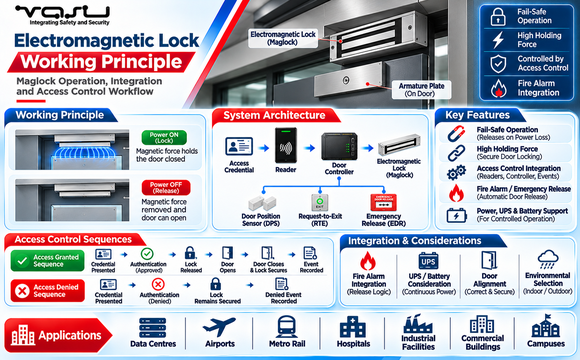
Access Credential → Reader → Door Controller → Lock Control Output → Electromagnetic Lock
Door Position Sensor + Request-to-Exit → Door Controller
Fire Alarm / Emergency Release → Approved Release Interface → Lock Power / Controller
Power Supply / Battery / UPS → Electromagnetic Lock
Access Control Network → ACS Server / Management Software → Operator Workstation
3. Working Principle
When electrical power is applied to the electromagnetic lock, the electromagnet generates a magnetic field that attracts and holds the armature plate attached to the door. When the approved release command removes power from the lock, the magnetic holding force is removed and the door can be opened.
4. Fail-Safe Operating Principle
Electromagnetic locks are generally fail-safe devices: removal of electrical power releases the lock. This characteristic must be considered in the overall security, power and life-safety design.
5. Magnetic Holding Force
The lock’s holding force depends on the electromagnet, armature contact, installation condition, alignment and manufacturer design. The selected lock should have adequate holding capacity for the intended door and security application.
6. Armature Plate
The armature plate is mounted on the moving door and forms the magnetic contact surface with the lock body. Correct alignment and installation are essential for reliable locking performance.
7. Lock Body Installation
The electromagnetic lock body is normally installed on the fixed frame or other approved structural location. Mounting arrangement should follow the manufacturer’s installation requirements and the door construction.
8. Door Alignment
Correct door and frame alignment is critical. Excessive gaps, misalignment, loose hardware, damaged surfaces or incorrect armature positioning can reduce holding performance and cause unreliable operation.
9. Access Granted Sequence
Credential Presented → Authentication → Access Granted → Controller Releases Lock → Magnetic Holding Force Removed → Door Opens → Door Position Changes → Door Closes → Lock Re-energises → Door Secured → Event Recorded.
10. Access Denied Sequence
Credential Presented → Authentication → Access Denied → Lock Remains Energised → Door Remains Secured → Denied Event Recorded.
11. Request-to-Exit Integration
A request-to-exit device provides an authorised exit signal to the access control controller. The controller then releases the electromagnetic lock according to the configured door logic.
12. Door Position Monitoring
A door position sensor confirms whether the door is open or closed. The access control system can use this information to generate forced-door or door-held-open alarms and to verify correct door operation.
13. Emergency Release
An approved emergency release arrangement should provide the required door-release behaviour during emergency conditions. Emergency egress requirements must be considered before finalising the electromagnetic lock arrangement.
14. Fire Alarm Integration
Where required, the electromagnetic lock should interface with the fire alarm system so that designated doors release during an emergency. The exact release and restoration sequence should be defined in the approved cause-and-effect / interface matrix.
15. Power Supply
Electromagnetic locks require a suitable DC power supply. The power supply should be selected based on lock voltage, current consumption, number of locks, cable length, voltage drop and required design margin.
16. UPS & Battery Backup
The impact of UPS or battery backup on lock operation must be considered carefully because continued power maintains the electromagnetic locking force. Emergency release arrangements must remain effective irrespective of normal backup-power operation.
17. Lock Monitoring
Where supported, lock monitoring may provide status information such as lock condition, door status or other diagnostic indications. Monitoring functions should be integrated with the access control system where required.
18. Security Considerations
The electromagnetic lock should be selected based on the required security level, door type, holding force, environmental conditions, tamper risks and operational requirements. The installation should prevent unauthorised access to lock wiring and release interfaces.
19. Environmental Selection
Outdoor or harsh-environment applications require locks and associated hardware with appropriate environmental protection. Temperature, humidity, dust, corrosion and weather exposure should be considered.
20. Door Compatibility
The electromagnetic lock should be compatible with the door construction, frame geometry, opening direction, available mounting space and required access-control configuration. Door hardware coordination should be completed before installation.
21. Installation Requirements
Installation should verify:
- Correct lock model
- Correct voltage
- Correct current rating
- Correct holding capacity
- Correct mounting arrangement
- Correct armature alignment
- Correct door and frame condition
- Correct request-to-exit interface
- Correct door position sensor
- Correct emergency release arrangement
- Correct fire alarm interface
- Correct power supply
- Proper cable routing and protection
22. Testing & Commissioning
Electromagnetic lock commissioning should verify:
- Lock energisation
- Lock release
- Valid credential operation
- Invalid credential rejection
- Request-to-exit operation
- Door position monitoring
- Door-held-open alarm
- Forced-door alarm
- Emergency release
- Fire alarm release, where applicable
- Power interruption behaviour
- Restoration after power recovery
23. Failure & Recovery
Controlled tests should verify lock behaviour during normal power loss, controller communication loss and emergency release conditions. The system should return to the approved normal operating state after restoration.
24. Maintenance
Maintenance should include inspection of the lock body, armature plate, mounting hardware, door alignment, electrical connections, power supply, release function, door position sensor and emergency-release interface.
25. Design Change Control
Changes to lock model, door type, power supply, controller output, fire alarm interface or emergency-release arrangement should be reviewed because they may affect security, life safety and system compatibility.
26. Documentation
Electromagnetic lock documentation should include, as applicable:
- Lock schedule
- Manufacturer datasheet
- Holding-force specification
- Power requirement
- Door hardware details
- Mounting details
- Wiring diagram
- Power / UPS calculation
- Fire alarm interface / cause-and-effect
- Testing and commissioning records
- As-built drawings
- O&M manual
27. Engineering Objective
The engineering objective is:
Define Door Security Requirement → Select Electromagnetic Lock → Verify Door & Frame Compatibility → Size Power Supply → Integrate Controller, REX & Door Monitoring → Provide Emergency / Fire Alarm Release → Test Locking & Release Functions → Establish Secure & Life-Safety-Compliant Door Access Control
Frequently Asked Questions
What is the main purpose of electromagnetic lock: working principle?
An electromagnetic lock, commonly referred to as a maglock, is an electrically controlled locking device that secures a door by magnetic attraction between an electromagnet and an armature plate. The lock is operated through the access control system and must be coordinated with door hardware, emergency egress and fire-life-safety requirements.
What should be checked before selection or installation?
Verify compatibility with the approved system architecture, door hardware and connected devices, power requirements, network or communication interface, environmental conditions and applicable emergency-release requirements.
What should be tested during commissioning?
Test the functions identified in the source technical content and approved project documents, including normal operation, access granted/denied behaviour, monitoring inputs, alarms, emergency release where applicable, power and communication behaviour.
What documentation should be retained?
Maintain applicable schedules, wiring and interface details, configuration records, power calculations, test and commissioning records, as-built drawings and the O&M manual as required by the project.
SEO & Publishing Details
| SEO Title | Electromagnetic Lock: Working Principle | Technical Guide | Vasu Infosec Limited |
| Meta Description | An electromagnetic lock, commonly referred to as a maglock, is an electrically controlled locking device that secures a door by magnetic attraction |
| Primary Keyword | Electromagnetic Lock: Working Principle |
| Secondary Keywords | Electromagnetic Lock: Working Principle; access control system; electronic security; system architecture; installation and commissioning |
| Suggested URL Slug | electromagnetic-lock-working-principle |
| Suggested Image Alt Text | Technical architecture and key components of electromagnetic lock: working principle |