
Article
Energy Management System Architecture
Oct 2026
Direct Answer
An Energy Management System (EnMS) within an Integrated Building Management System (IBMS) collects and presents energy data from approved electrical meters, utility meters and equipment interfaces. It supports centralised monitoring, historical analysis, dashboards and reporting; any optimisation or control functions must follow the approved project architecture and control philosophy.
1. Engineering Overview
An Energy Management System (EnMS) provides a structured platform for collecting, monitoring, analysing and managing energy-related information across a facility. Within an IBMS environment, the architecture integrates electrical meters, utility meters, equipment data, gateways, servers, databases, dashboards and reporting functions to support energy visibility and approved optimisation strategies.
2. Complete Architecture
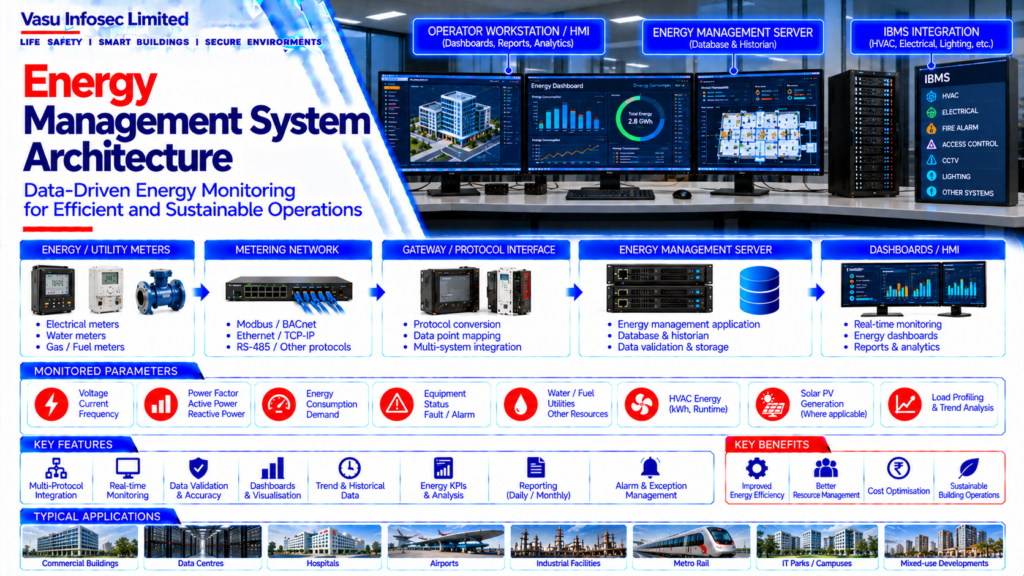
Energy Meters / Utility Meters / Equipment Data → Metering Network → Gateway / Protocol Interface → Energy Management Server / IBMS → Database / Historian → Dashboards / HMI → Reports & Analytics
Typical Data → Electricity → DG Generation → UPS Loads → HVAC Energy → Water / Fuel Utilities → Other Approved Energy Sources
3. Energy Data Acquisition
The acquisition layer collects energy and operational data from electrical meters, utility meters and approved equipment interfaces. Each source should have a defined measurement range, unit, address and communication method.
4. Electrical Energy Monitoring
Electrical energy monitoring may include active energy, reactive energy, apparent energy, demand, voltage, current, frequency and power factor. Data should be collected from appropriately selected and commissioned metering devices.
5. Utility Monitoring
Where required, the system may monitor other utility consumption such as water, fuel or other project-defined resources. Each utility should have an appropriate metering source and clearly defined measurement units.
6. Metering Architecture
Meters may communicate through Modbus, BACnet, Ethernet, RS-485 or other approved protocols. Meter addresses, registers, scaling, engineering units and communication parameters should be defined in the approved point schedule.
7. Gateway & Protocol Interface
Gateways may be used to connect meters or equipment using different communication protocols to the central energy management platform. Gateway configuration should preserve accurate values, timestamps, units and device status.
8. Data Validation
Collected energy data should be checked for communication errors, incorrect scaling, missing values, abnormal readings and inconsistent timestamps. Data validation should be completed during commissioning and periodically during operation.
9. Database & Historian
The energy management database stores measured values and historical information. Retention periods should support the approved reporting, analysis and operational requirements.
10. Energy Dashboards
Dashboards should provide clear visibility of energy consumption, demand, trends, equipment performance and relevant comparison indicators. Dashboard hierarchy may be arranged by site, building, floor, system or equipment.
11. Energy Consumption Analysis
Historical consumption data can be analysed to identify usage patterns, peak demand periods, abnormal consumption and opportunities for operational improvement. Analysis should use verified measurement data.
12. Demand Monitoring
Demand monitoring identifies periods of high electrical loading and supports operational assessment. Demand information should be presented with appropriate time intervals and measurement units.
13. Load Profiling
Load profiles provide time-based representation of energy consumption. Profiles may be used to compare operating periods, occupancy patterns, equipment schedules and other approved operational factors.
14. HVAC Energy Integration
HVAC energy information may be correlated with equipment status, operating hours, temperature and load data to support performance assessment. Control or optimisation functions should remain within the approved HVAC control philosophy.
15. Renewable Energy Integration
Where renewable generation such as solar PV is installed, generation, export, import and other approved parameters may be integrated into the energy management platform. Metering boundaries should be clearly defined.
16. Energy KPIs
Energy management may use approved KPIs such as consumption, demand, energy intensity, equipment runtime and system-level energy performance. KPI definitions should remain consistent across reporting periods.
17. Reporting Architecture
Reports may include daily, weekly, monthly or project-defined energy summaries, consumption trends, peak demand information, equipment comparisons and exception reports. Report content should be based on verified source data.
18. Alarm & Exception Management
The system may generate approved alerts for abnormal consumption, communication loss, meter faults or defined threshold exceedances. Alarm priorities and thresholds should be documented and reviewed.
19. Integration with IBMS
The Energy Management System may operate as a dedicated application or as an integrated function within IBMS. The interface should define the source of data, point ownership, communication method, data retention and authorised control functions.
20. Installation Requirements
Installation should verify:
- Correct meters
- Correct CT / PT configuration where applicable
- Correct utility meters
- Correct communication modules
- Correct addressing
- Correct register / point mapping
- Correct units and scaling
- Correct timestamps
- Correct gateway configuration
- Correct dashboards and reports
21. Testing & Commissioning
Commissioning should verify:
- Meter readings
- Communication links
- Register mapping
- Engineering units
- Scaling
- Data accuracy
- Historical logging
- Dashboard values
- Alarm / exception functions
- Reports
- Gateway communication
22. Data Accuracy & Calibration
Energy measurements displayed in the management platform should be compared with source meter readings during commissioning. Meter configuration, scaling and communication mapping should be verified. Where applicable, meter calibration should follow the approved maintenance requirements.
23. Cybersecurity & User Management
Energy management servers, gateways and network interfaces should follow the approved cybersecurity architecture. User permissions should control access to dashboards, reports, configuration and authorised control functions.
24. Maintenance & Backup
Maintenance should include meter checks, communication diagnostics, gateway inspection, database backup, server health checks, data validation and configuration backup. Missing or abnormal data should be investigated and documented.
25. Design Change Control
Changes to meters, electrical distribution, utility sources, communication protocols, gateways, point lists, dashboards or energy calculation logic should be reviewed against the approved energy management architecture before implementation.
26. Documentation
Energy Management System documentation should include, as applicable:
- Energy management architecture
- Meter schedule
- Utility meter schedule
- Point list
- Register mapping
- Communication architecture
- Gateway details
- KPI definitions
- Dashboard hierarchy
- Reporting format
- Testing and commissioning records
- As-built drawings
- O&M manual
27. Engineering Objective
The engineering objective is:
Accurate Metering → Reliable Data Acquisition → Secure Communication → Validated Energy Data → Centralised Monitoring → Meaningful Analytics → Effective Reporting → Approved Optimisation → Complete Commissioning → Reliable Energy Management
Website Publishing Metadata
SEO title: Energy Management System Architecture for IBMS | Vasu Infosec
Meta description: Learn how an Energy Management System integrates meters, utility data, gateways, historians, dashboards and reporting within an IBMS environment.
Suggested URL slug: /energy-management-system-architecture/
Primary keyword: Energy Management System architecture
Secondary keywords: IBMS energy monitoring, energy data acquisition, energy dashboards, utility metering, energy management integration, energy reporting
Suggested image alt text: Energy Management System architecture showing meters, communication gateways, IBMS server, historian, dashboards and energy reports.
Frequently Asked Questions
What is an Energy Management System (EnMS)?
An EnMS is a platform for collecting, monitoring, analysing and reporting energy-related information from meters, utilities and approved equipment interfaces.
How does an EnMS integrate with IBMS?
It can operate as a dedicated application or as an integrated IBMS function, using approved communication interfaces and a defined point schedule.
What data can an energy management platform monitor?
Depending on installed meters and approved scope, data may include electrical energy, demand, voltage, current, power factor, DG generation, UPS loads, HVAC energy and other metered utilities.
Why are data validation and scaling important?
Incorrect scaling, units, timestamps or point mapping can make displayed readings unreliable. These items should be checked during commissioning and periodically during operation.
Can the EnMS automatically control equipment to optimise energy?
The source document describes monitoring and approved optimisation strategies. Any control function must be explicitly defined in the approved project architecture and control philosophy; it should not be assumed.
What documents support EnMS commissioning and operation?
As applicable: architecture, meter and utility schedules, point list, register mapping, communication architecture, gateway details, KPI definitions, dashboard hierarchy, reporting formats, commissioning records, as-built drawings and O&M manual.