
Article
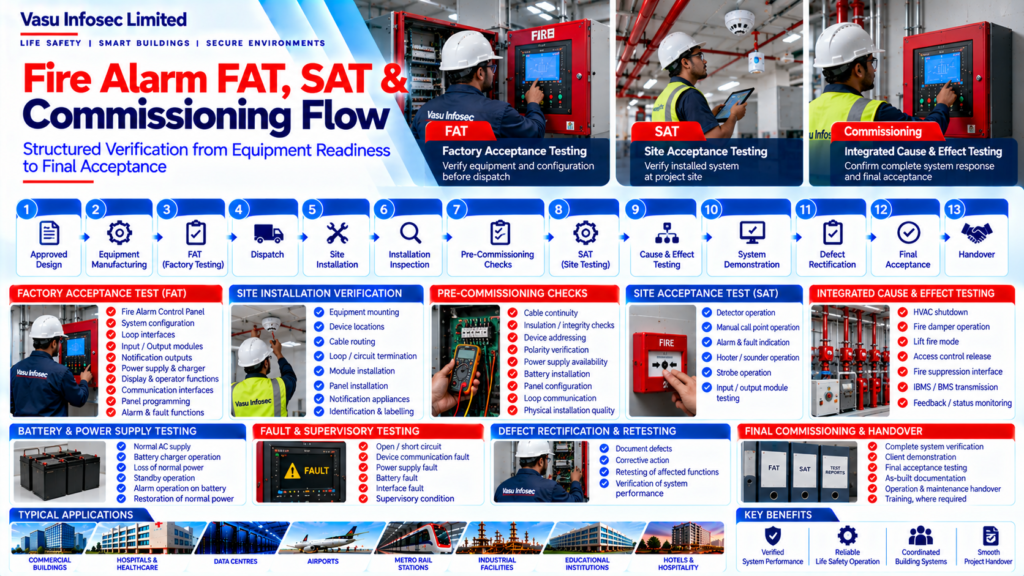
Fire Alarm FAT, SAT & Commissioning Flow
Oct 2026
Direct Answer
Fire Alarm FAT, SAT and commissioning form a staged verification process: check equipment before dispatch, verify installation and readiness at site, test device and interface functions, rectify and retest defects, and complete acceptance and handover in line with approved project documents.
1. Engineering Overview
Factory Acceptance Testing (FAT), Site Acceptance Testing (SAT) and commissioning provide a structured verification process for a Fire Alarm System from equipment readiness through site installation and integrated system performance. The activities should follow the approved inspection and test plan, project specifications, approved drawings, manufacturer requirements and applicable requirements.
2. Overall Verification Flow
Approved Design → Equipment Manufacturing → Factory Inspection / FAT → Dispatch → Site Installation → Installation Inspection → Pre-Commissioning Checks → SAT → Integrated Cause & Effect Testing → System Demonstration → Defect Rectification → Final Acceptance → Handover
3. Factory Acceptance Test (FAT)
FAT is conducted before dispatch or delivery, as applicable, to verify that the supplied equipment and configured system meet the approved technical requirements before installation at site.
4. FAT Scope
FAT may include verification of:
- Fire Alarm Control Panel
- System configuration
- Addressable loop interfaces
- Input / output modules
- Notification outputs
- Power supply
- Battery charger
- Display and operator functions
- Communication interfaces
- Panel programming
- Alarm and fault functions
5. FAT Documentation
FAT documentation may include:
- Approved FAT procedure
- Equipment datasheets
- Approved drawings
- Configuration information
- Test records
- Inspection reports
- Non-conformance / observation records, where applicable
- FAT approval / sign-off
6. Site Installation Verification
Following delivery, the installed system should be checked against approved drawings and equipment documentation.
Installation verification may include:
- Equipment mounting
- Device locations
- Cable routing
- Loop / circuit termination
- Module installation
- Panel installation
- Notification appliance installation
- Identification and labelling
7. Pre-Commissioning Checks
Before functional commissioning, the installation should be checked for readiness.
Checks may include:
- Cable continuity
- Insulation / integrity checks as applicable
- Device addressing
- Polarity verification where applicable
- Power supply availability
- Battery installation
- Panel configuration
- Loop communication
- Physical installation quality
8. Site Acceptance Test (SAT)
SAT verifies that the installed Fire Alarm System operates correctly at the project site and complies with the approved design, configuration and installation requirements.
9. SAT Functional Testing
SAT may include:
- Smoke detector operation
- Heat detector operation
- Beam detector operation
- Flame detector operation
- Manual call point operation
- Alarm indication
- Fault indication
- Hooter / sounder operation
- Strobe operation
- Input / output module testing
10. Cause & Effect Testing
The approved Cause & Effect Matrix should be tested during commissioning.
Testing may include:
- Alarm initiation
- Notification activation
- HVAC interface
- Lift fire mode
- Access control release
- Fire suppression interface
- IBMS / BMS signal transmission
- Feedback / status monitoring
11. Integrated System Testing
Integrated testing verifies the complete signal path from the initiating device through the Fire Alarm Control Panel to the final controlled equipment or monitoring system.
The objective is to confirm that the actual site response matches the approved Cause & Effect Matrix.
12. Battery & Power Supply Testing
Power supply and standby battery performance should be verified.
Testing may include:
- Normal AC supply
- Battery charger operation
- Battery fault indication
- Loss of normal power
- Standby operation
- Alarm operation on standby supply
- Restoration of normal power
13. Fault & Supervisory Testing
The system should be tested for applicable abnormal conditions.
Examples include:
- Open circuit
- Short circuit
- Device communication fault
- Power supply fault
- Battery fault
- Interface fault
- Supervisory condition
14. Defect Rectification & Retesting
Any defects or deviations identified during FAT, SAT or commissioning should be documented and rectified through the approved project process. Affected functions should be retested after corrective action to confirm satisfactory operation.
15. Final Commissioning & Acceptance
Final commissioning should confirm that the complete Fire Alarm System operates in accordance with the approved design and agreed testing requirements. Acceptance should be based on satisfactory completion of required testing and closure of applicable observations / defects.
16. Handover Documentation
Handover documentation should include, as applicable:
- Approved as-built drawings
- FAT records
- SAT records
- Commissioning reports
- Cause & Effect Matrix
- Testing certificates / records
- Device schedule
- Panel configuration / programming records
- Battery calculation
- O&M manuals
- Warranty documentation
17. Common Engineering Considerations
Engineering review should verify:
- Approved FAT / SAT procedures
- Defined responsibilities
- Test equipment availability
- Approved Cause & Effect Matrix
- Complete device testing
- Interface testing
- Power and battery testing
- Defect closure
- Final documentation
18. Engineering Objective
The engineering objective is:
Factory Verification → Site Installation Verification → Pre-Commissioning → SAT → Integrated Cause & Effect Testing → Defect Rectification → Final Acceptance → Complete Handover → Reliable Fire Alarm System Performance
Frequently Asked Questions
What is the difference between FAT and SAT?
FAT is performed before dispatch or delivery, as applicable, to check supplied equipment and configuration. SAT verifies operation of the installed system at the project site. The exact scope should follow the approved procedure and project requirements.
What is tested during Fire Alarm commissioning?
Testing may include initiating devices, alarm and fault indications, notification appliances, input/output modules, power and battery functions, and approved Cause & Effect interfaces. The actual test scope depends on the approved project documents.
Is integrated Cause & Effect testing required for every interface?
The source document states that the approved Cause & Effect Matrix should be tested during commissioning. The interfaces and acceptance process should be defined in the approved project requirements.
What happens when a defect is found?
Document the defect or deviation, rectify it through the approved project process, and retest affected functions to confirm satisfactory operation.
Which documents may be included in handover?
As applicable, handover may include as-built drawings, FAT/SAT records, commissioning reports, Cause & Effect Matrix, test records, device schedule, panel configuration/programming records, battery calculation, O&M manuals and warranty documentation.
SEO & CMS Metadata
| SEO title | Fire Alarm FAT, SAT & Commissioning: Engineering Flow |
| Meta description | Understand the Fire Alarm FAT, SAT and commissioning sequence, including installation checks, functional testing, Cause & Effect verification, defect retesting and handover records. |
| Suggested URL slug | /fire-alarm-fat-sat-commissioning-flow/ |
| Primary keyword | Fire Alarm FAT SAT commissioning |
| Related keywords | Fire Alarm FAT procedure; Fire Alarm SAT checklist; fire alarm commissioning; Cause and Effect testing; fire alarm handover documentation |
| Suggested internal links | Fire Alarm System Architecture; Fire Alarm Cause & Effect Matrix; Fire Alarm Battery Backup Calculation; Fire Alarm Interfaces with HVAC, Lift & Access Control |