
Article
Fire Detection to Alarm Sequence
Oct 2026
Direct Answer
A fire detection-to-alarm sequence is the controlled process through which a fire-related condition is detected or manually initiated, transmitted to the Fire Alarm Control Panel (FACP), processed according to approved system logic, and communicated through occupant notification and authorised interfaces. The actual sequence must follow the approved fire strategy, detection philosophy, Cause & Effect Matrix and project requirements.
1.Engineering Overview
The Fire Detection to Alarm Sequence defines the progression from identification of a fire-related condition through signal transmission, alarm processing, notification and programmed system interfaces. The sequence should be established from the approved fire strategy, detection philosophy, Cause & Effect Matrix and project requirements.
2. Complete Detection-to-Alarm Sequence
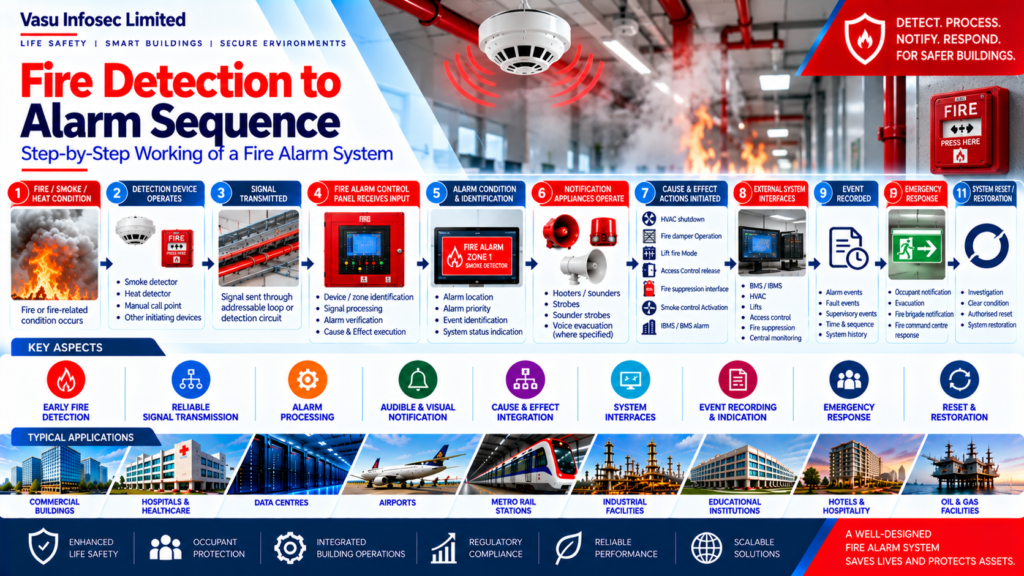
Fire / Smoke / Heat Condition → Detector or Manual Call Point Operates → Signal Transmission → Fire Alarm Control Panel Receives Input → Signal Processing → Alarm Condition → Alarm Identification → Audible / Visual Notification → Cause & Effect Actions → External System Interfaces → Event Recording → Emergency Response → Reset / Restoration
| Stage | What happens |
| 1. Initiation | A detector, manual call point or approved external input initiates a fire-related signal. |
| 2. Transmission | The signal travels through the applicable addressable loop, detection circuit or approved interface. |
| 3. Panel processing | The FACP identifies the device, zone or input and applies programmed logic and approved Cause & Effect requirements. |
| 4. Alarm and notification | The required alarm condition is established and approved audible/visual appliances operate. |
| 5. Interfaces and records | Specified Cause & Effect actions and external interfaces operate; events may be logged. |
| 6. Response and restoration | The approved emergency procedure is followed; authorised personnel reset/restoration only after investigation and safety checks. |
3. Fire Condition Initiation
The sequence begins when a fire-related condition is detected or manually initiated. Possible initiating sources include:
- Smoke detector
- Heat detector
- Beam smoke detector
- Aspirating smoke detection system
- Flame detector
- Manual call point
- Approved external fire alarm input
4. Detection Device Operation
When the selected detection device reaches its programmed operating criteria, it changes state and transmits an initiating signal to the fire alarm system.
5. Signal Transmission
The initiating signal is transmitted through the applicable addressable loop, detection circuit or approved interface to the Fire Alarm Control Panel. The transmission path should provide reliable communication, device/zone identification and appropriate fault monitoring.
6. Fire Alarm Control Panel Reception and Processing
The FACP receives the initiating signal and identifies the affected device, zone or input according to the system architecture. It processes the signal in accordance with its programmed logic and approved Cause & Effect Matrix. Once the programmed alarm criteria are satisfied, the panel establishes the required alarm condition. Processing may include device identification, zone identification, alarm priority, event logging and Cause & Effect execution.
7. Audible and Visual Notification
Following alarm processing, the approved notification appliances operate to alert occupants and relevant personnel. Depending on the project specification, notification may include hooters, sounders, strobes, sounder-strobes and voice evacuation systems.
8. Cause & Effect Actions
The alarm condition may initiate programmed actions through the approved Cause & Effect Matrix. Examples listed in the source include:
- HVAC shutdown
- Fire damper operation
- Lift fire mode
- Access control release
- Smoke control operation
- Fire suppression interface
- IBMS / BMS alarm transmission
These actions are project-dependent. Do not assume that every listed action applies to every installation; the approved project documents determine the required operation.
9. External System Interfaces
Depending on the approved project architecture, the fire alarm signal may be transmitted to connected systems, including the Building Management System (BMS), Integrated Building Management System (IBMS), fire suppression, HVAC, lift, access control and central monitoring systems.
10. Alarm Indication and Event Recording
The control panel should provide clear indication of the alarm condition and its location based on the selected system architecture. Event history may record alarm initiation, device/zone identification, time and sequence, interface activation, fault conditions and reset events.
11. Emergency Response
The alarm signal should initiate the approved emergency response procedure, which may include occupant notification, evacuation, fire brigade notification where applicable, fire command centre response and fire suppression response. The response must follow the site’s approved emergency plan and applicable project procedures.
12. Fault Condition Sequence
Fault Occurs → Panel Detects Abnormal Condition → Fault Indication → Fault Event Recorded → Responsible Personnel Notified → Fault Investigation → Corrective Action → Verification → Fault Reset
The fault sequence is distinct from the fire alarm sequence. Fault investigation and restoration should be handled by responsible personnel in accordance with approved procedures.
13. System Reset and Restoration
After the fire condition has been investigated and the area is confirmed safe, authorised personnel may restore the system according to the approved operating procedure. The reset sequence should verify that initiating conditions have cleared and that no unresolved alarm or fault remains. Reset should not be treated as a substitute for investigation or confirmation that the area is safe.
14. Sequence Testing and Commissioning
The complete detection-to-alarm sequence should be demonstrated during testing, including:
- Detector activation
- Manual call point activation
- Signal transmission
- Panel alarm indication
- Audible notification
- Visual notification
- Cause & Effect operation
- External interface operation
- Event recording
- Reset / restoration
Testing should be carried out against the approved project requirements and applicable procedures. The source does not specify test acceptance values, test frequencies or mandatory third-party testing; these must be confirmed from the contract and approved project documents.
15. Common Engineering Considerations
Engineering review should verify:
- Correct detector selection
- Appropriate detector location
- Reliable circuit transmission
- Correct panel programming
- Accurate alarm identification
- Adequate notification coverage
- Correct Cause & Effect actions
- Interface coordination
- Event recording
- Controlled reset
16. Documentation
Sequence documentation should include, as applicable:
- Detection zoning drawings
- Device schedule
- Fire Alarm Control Panel configuration
- Cause & Effect Matrix
- Input / Output schedule
- Interface schedule
- Sequence of operation
- Testing records
- Commissioning records
- As-built documentation
17. Engineering Objective
Accurate Fire Detection → Reliable Signal Transmission → Correct Panel Processing → Timely Alarm Initiation → Effective Audible / Visual Notification → Correct Cause & Effect → Coordinated External Interfaces → Documented Emergency Response → Verified Reset & Restoration
Frequently Asked Questions
What starts the fire detection-to-alarm sequence?
A fire-related condition detected by an approved detector, a manual call point operation or an approved external fire alarm input can initiate the sequence.
What is the role of the FACP?
The FACP receives the initiating signal, identifies the affected device, zone or input, processes it using programmed logic and establishes the required alarm condition.
Does every fire alarm activate HVAC, lifts and access control?
No. Such actions depend on the approved project architecture and Cause & Effect Matrix. The source lists examples, not universal requirements.
What is the difference between an alarm and a fault sequence?
An alarm sequence responds to a fire-related initiating condition. A fault sequence responds to an abnormal system condition and includes indication, investigation, corrective action and verification.
When should the system be reset?
Only after the fire condition has been investigated, the area is confirmed safe, initiating conditions have cleared and authorised personnel follow the approved operating procedure.
What should be checked during commissioning?
The source identifies detector and manual call point activation, signal transmission, panel indication, audible/visual notification, Cause & Effect, external interfaces, event recording and reset/restoration.
Project and Scope Considerations
This article describes the general engineering sequence. Actual system operation is governed by the approved fire strategy, contract documents, project specifications, approved Cause & Effect Matrix, OEM documentation and site procedures. The examples of interfaces and actions are not a commitment that all such functions are included in any particular Vasu Infosec Limited work package.
For project-specific publications, confirm the approved scope, design inputs, interface responsibilities, testing obligations and acceptance criteria before stating that a particular action or deliverable is included. Do not infer project compliance solely from the description of a sequence.
Technical Review and Publication Controls
| Item | Publication control |
| Technical reviewer | To be assigned by Vasu Infosec Limited before publication. |
| Review date | Enter the actual review date after technical approval. |
| Applicable standards | Confirm the project-applicable standards, editions and clauses from approved project documents before publication; none are specified in the source file. |
| Project evidence | Publish project-specific claims only where documented and authorised. |
| Scope and responsibility | Confirm OEM, contractor, consultant, client and system-integrator responsibilities from the approved contract and project documents. |
SEO / AEO / GEO Recommendations
| Element | Recommended content |
| SEO title | Fire Detection to Alarm Sequence: Step-by-Step Guide | Vasu Infosec |
| Meta description | Understand the fire detection-to-alarm sequence, from detector activation and FACP processing to occupant notification, Cause & Effect actions, fault handling and reset. |
| Suggested URL slug | /fire-detection-to-alarm-sequence/ |
| Primary topic | Fire detection to alarm sequence |
| Related terms | Fire Alarm Control Panel, Cause & Effect Matrix, manual call point, audible and visual notification, alarm fault sequence, fire alarm commissioning |
| Internal links | Link to the related Fire Alarm System Architecture and Fire Alarm System Working Principle articles, if published and technically reviewed. |
| Structured data | Consider Article schema for the published page only when author, publisher, dates and other required values are accurate and available in the CMS. |