
Article
Fire Hydrant & Hose Reel Integration
Oct 2026
Direct Answer
Fire hydrant and hose reel integration coordinates the water supply, pumps, distribution piping and firefighting outlets so that connected systems can meet their approved flow and pressure requirements. The design basis should identify the governing hydraulic demand, including any shared infrastructure with sprinkler systems.
1. Engineering Overview
Fire Hydrant & Hose Reel Integration establishes the coordinated arrangement between external / internal hydrant systems, hose reels, fire water storage, fire pumps and the associated distribution network. The integrated design should ensure that each connected fire protection system receives the required flow and pressure under the approved operating condition.
2. Integrated System Architecture
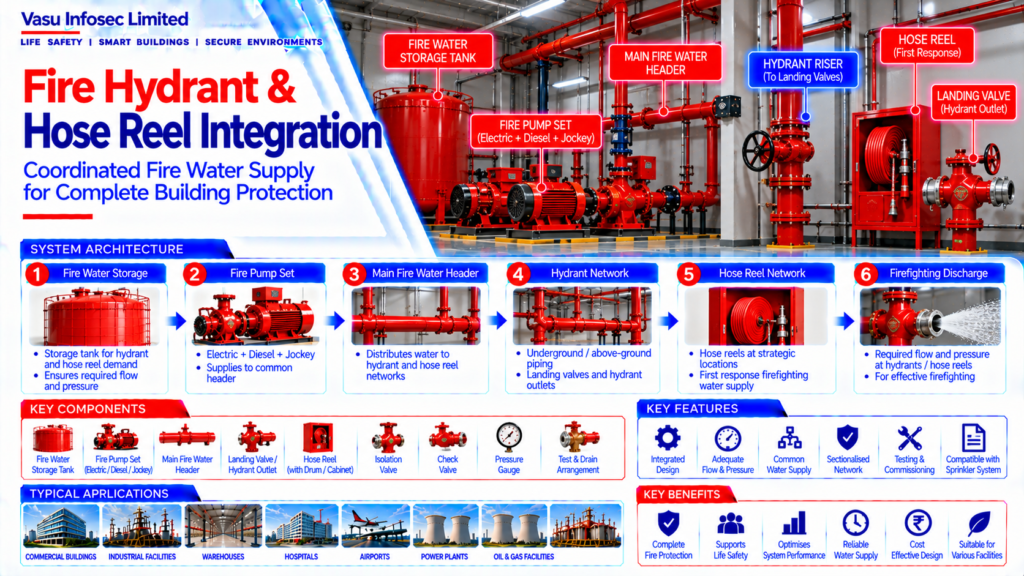
Fire Water Storage Tank → Fire Pump Set → Common Fire Water Header → Hydrant Network / Hose Reel Network → Hydrant Valves / Hose Reels → Firefighting Discharge
Monitoring & Control → Pump Controller → Flow / Pressure Monitoring → Fire Alarm / BMS Interface, where applicable
3. Major Components
An integrated arrangement may include:
- Fire water storage tank
- Electric fire pump
- Diesel fire pump, where applicable
- Jockey pump
- Main fire water header
- Underground / above-ground hydrant piping
- Landing valves
- Hydrant outlets
- Hose reels
- Hose reel drums / cabinets
- Branch connections
- Isolation valves
- Check valves
- Pressure gauges
- Test and drain arrangements
4. Hydrant System Function
The fire hydrant system provides firefighting water through designated hydrant outlets and landing valves. The network should be designed to provide the required pressure and flow at the hydraulically critical hydrant location.
5. Hose Reel Function
Hose reels provide a readily accessible first-response firefighting water supply for trained personnel. Hose reel locations, hose length, nozzle arrangement and operating pressure should comply with the approved project design.
6. Common Fire Water Supply
Where hydrants and hose reels share a common fire water supply, the tank, pumps and main distribution network should be sized for the approved combined or critical operating demand. The design basis should clearly identify the governing simultaneous demand.
7. Hydrant Piping Network
Hydrant piping should be routed to provide the required coverage throughout the protected premises. Pipe diameter, routing, fittings, elevation and pressure losses should be established through the approved hydraulic calculation.
8. Landing Valve & Hydrant Outlet
Landing valves and hydrant outlets should be positioned for safe and effective firefighting access. Connections should be compatible with the specified firefighting hose and equipment.
9. Hose Reel Arrangement
Hose reels should be located to provide the required coverage without creating inaccessible or obstructed operating positions. Hose routing, cabinet arrangement and nozzle access should be coordinated with the architectural layout.
10. Hydraulic Design
The hydraulic calculation should establish the required flow and pressure at the most demanding hydrant / hose reel condition. Pipe friction, fitting losses, elevation and equipment losses should be considered.
11. Pump Selection Coordination
Fire pump selection should consider the approved hydrant, hose reel, sprinkler and other connected fire protection demands. The pump duty point should satisfy the governing hydraulic condition.
12. Pressure Management
Pressure at hydrant outlets and hose reels should remain within the approved operating range. Where pressure regulation is required, suitable approved pressure-regulating arrangements should be incorporated.
13. Isolation & Sectionalisation
Isolation valves may be provided to sectionalise the network for maintenance while preserving the availability of other fire protection zones. Critical valves should be clearly identified and supervised where required.
14. Test & Drain Arrangement
Suitable test and drain facilities should be provided to verify pump performance, hydrant flow, hose reel operation and system pressure. Test connections should be accessible and safely discharged.
15. Installation Requirements
Installation should verify:
- Correct pipe size and material
- Correct hydrant outlet arrangement
- Correct landing valve type
- Correct hose reel location
- Correct hose reel cabinet / drum arrangement
- Correct valve orientation
- Secure pipe supports
- Adequate access and clearance
- Correct identification and labelling
16. Testing & Commissioning
Commissioning should verify:
- Fire pump operation
- Hydrant flow and pressure
- Hose reel operation
- Landing valve operation
- Isolation valve operation
- Pressure gauge indication
- Test and drain operation
- Alarm / monitoring interfaces, where applicable
17. Integration with Sprinkler System
Where hydrant, hose reel and sprinkler systems share common infrastructure, the hydraulic design should demonstrate that the water supply and pump arrangement can meet the approved governing demand. Any common header or branch arrangement should be reflected in the hydraulic calculation.
18. Inspection & Maintenance
Periodic inspection should verify hydrants, landing valves, hose reels, hoses, nozzles, cabinets, piping, valves, gauges and associated equipment. Leakage, corrosion, obstruction, damage or unauthorised modifications should be identified and rectified.
19. Design Change Control
Changes to building occupancy, hydrant locations, hose reel coverage, sprinkler demand, pump capacity, piping arrangement or water storage should be reviewed for their impact on the integrated fire water hydraulic design.
20. Documentation
Hydrant and hose reel integration documentation should include, as applicable:
- Fire water design basis
- Hydraulic calculation
- Hydrant layout
- Hose reel layout
- Piping drawings / isometrics
- Pump datasheets
- Valve schedule
- Hydrant / landing valve schedule
- Hose reel schedule
- Test and commissioning records
- Inspection records
- As-built drawings
- O&M manual
21. Engineering Objective
The engineering objective is:
Integrated Fire Water Supply → Correct Pump Duty → Coordinated Hydrant & Hose Reel Network → Adequate Pressure & Flow → Accessible Firefighting Points → Verified Hydraulic Performance → Complete Testing & Maintenance → Reliable Manual Firefighting Support
Frequently Asked Questions
What is fire hydrant and hose reel integration?
It is the coordinated arrangement of hydrants, hose reels, fire water storage, pumps and distribution piping to support the approved firefighting demand.
Can hydrants and hose reels share a common fire water supply?
They may share infrastructure where the approved design permits it. The tank, pumps and network should be checked against the governing combined or critical operating demand.
How is the required pipe size determined?
Pipe sizes and routing should be established through approved hydraulic calculations that consider flow, pressure, friction losses, fittings, elevation and equipment losses.
Why is pump selection important?
The selected fire pump duty must satisfy the governing hydraulic condition for the connected fire protection systems identified in the approved design basis.
What should commissioning verify?
Checks may include pump operation, hydrant flow and pressure, hose reel and landing valve operation, isolation valves, gauges, test/drain facilities and relevant monitoring interfaces.
When should the integrated design be reviewed?
Review is needed when occupancy, outlet locations, hose reel coverage, sprinkler demand, pump capacity, piping arrangement or water storage changes.
SEO & Publishing Details
SEO title: Fire Hydrant and Hose Reel Integration | Vasu Infosec Limited
Meta description: Learn how fire hydrant and hose reel systems are coordinated with fire pumps, water storage, piping, hydraulic calculations, commissioning and maintenance.
Primary keyword: fire hydrant and hose reel integration
Secondary keywords: fire water supply system, hydrant network, hose reel system, fire pump hydraulic design, hydrant flow and pressure
Suggested URL slug: /fire-hydrant-hose-reel-integration/
Suggested image alt text: Fire hydrant and hose reel integration showing fire water supply, pump set and distribution network