
Article
Fire Load Calculation
Nov 2026
Direct Answer
Fire Load Calculation establishes the quantity and distribution of combustible materials within a building or defined fire compartment and provides a quantitative basis for evaluating fire severity, compartmentation, suppression requirements, detection strategy and life-safety measures. The calculation should use documented inventory data, material characteristics, compartment areas and clearly stated assumptions.
1. Engineering Overview
Fire Load Calculation establishes the quantity and distribution of combustible materials within a building or defined fire compartment and provides a quantitative basis for evaluating fire severity, compartmentation, suppression requirements, detection strategy and life-safety measures. The calculation should use documented inventory data, material characteristics, compartment areas and clearly stated assumptions.
2. Complete Fire Load Calculation Architecture
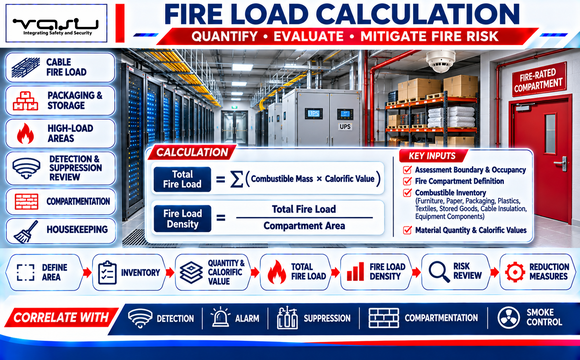
Building / Area Survey → Occupancy Identification → Compartment Definition → Combustible Inventory → Material Calorific Values → Quantity Assessment → Total Fire Load → Fire Load Density → Risk Interpretation → Fire Protection Review → Risk Reduction Measures → Documentation & Review
3. Calculation Philosophy
The calculation methodology should define the assessment boundary, combustible materials included, quantities, calorific values, calculation units, assumptions, exclusions and acceptance criteria. Fire load should be assessed for representative and worst-case compartments where appropriate.
4. Assessment Boundary
Each calculation should clearly identify the building, floor, room, fire compartment or defined area being assessed. The area used for fire-load density should correspond to the selected assessment boundary.
5. Occupancy Identification
Occupancy classification should be established before calculating fire load because combustible contents, storage arrangements and expected fire behaviour vary with building use and occupancy.
6. Combustible Inventory
The inventory should identify combustible materials such as furniture, paper products, packaging, plastics, textiles, stored goods, cable insulation, combustible equipment components and other relevant materials.
7. Fixed & Movable Combustibles
The assessment should distinguish fixed combustible elements from movable contents where appropriate. Both categories should be considered where they materially contribute to the potential fire load.
8. Material Quantity Assessment
Quantities should be established from verified inventories, drawings, storage records, equipment schedules, site measurements or reasonable documented assumptions. Units should be consistent throughout the calculation.
9. Calorific Value
Each combustible material should be assigned an appropriate calorific value based on reliable technical data. Where a composite material is used, the basis and assumed composition should be documented.
10. Total Fire Load
The total fire load is determined from the combustible mass and corresponding energy content of the materials within the defined assessment area. The calculation should retain a clear traceability between each material and its contribution.
11. Fire Load Density
Fire load density expresses the calculated combustible energy relative to the relevant floor or compartment area. It provides a comparative indicator of potential fire severity between areas.
12. Calculation Units
Units for mass, energy and area should be clearly stated and consistently applied. Conversions should be documented where data is received in different units.
13. Storage & Arrangement
Storage height, density, configuration, separation and location should be reviewed because the arrangement of combustibles can influence fire growth and spread in addition to the numerical fire load.
14. High Fire-Load Areas
Areas with comparatively high fire load should be identified for additional assessment. Examples may include storage rooms, archives, packaging areas, workshops and spaces containing substantial combustible equipment or materials.
15. Critical Facility Considerations
For critical facilities, fire load should be assessed alongside equipment criticality and business continuity. Loss of relatively small quantities of combustible material may still have significant operational consequences if located near critical infrastructure.
16. Cable Fire Load
Cable insulation and other combustible cable materials should be considered where they form a significant combustible contribution. Cable concentration and routing should be assessed by relevant compartment or zone.
17. Electrical Equipment Contribution
Combustible components within electrical, UPS, battery, control and IT equipment should be considered where appropriate. The assessment should avoid unsupported assumptions and should document the selected basis.
18. Packaging & Temporary Storage
Packaging, cartons, pallets, plastics and temporary storage can materially increase fire load. Operational controls should address accumulation and housekeeping in critical areas.
19. Fire Load Distribution
Fire load should be mapped across the building to identify concentrations and potential fire-spread pathways. Localised high-load areas should not be obscured by building-wide average values.
20. Compartment-Based Assessment
Where fire compartments are provided, fire load should preferably be evaluated for each relevant compartment. The assessment should consider whether compartmentation adequately limits the consequences of the identified fire load.
21. Fire Protection Correlation
Fire load findings should be correlated with detection, alarm, suppression, compartmentation, smoke control and means-of-egress provisions. Areas with higher fire severity potential may require enhanced protection.
22. Suppression System Correlation
The selected suppression strategy should be reviewed against the identified combustible materials. Special hazards or materials that may require specific suppression approaches should be separately identified.
23. Detection Strategy Correlation
Fire-load concentration and fire-growth potential should be considered when evaluating detector type, detector spacing, aspirating detection and alarm sensitivity.
24. Compartmentation Correlation
Fire-rated walls, floors, doors, barriers and fire stopping should be reviewed in relation to fire-load concentration and expected fire development.
25. Risk Reduction Measures
Fire-load reduction may include reducing combustible storage, controlling packaging, improving housekeeping, replacing combustible materials, segregating storage, strengthening compartmentation and improving detection / suppression.
26. Installation / Site Verification
Fire-load assessment should verify, as applicable:
- Occupancy and room use
- Compartment boundaries
- Combustible inventory
- Storage arrangements
- Material quantities
- Material types
- Cable concentration
- Equipment arrangements
- Packaging and temporary storage
- Housekeeping condition
- Fire protection provisions
- Compartmentation
- Detection and alarm coverage
- Suppression coverage
27. Calculation Verification
The calculation should be independently checked for assessment boundary, material quantities, calorific values, units, area, formulas, assumptions and final fire-load-density values.
28. Sensitivity Assessment
Where quantities or material properties are uncertain, sensitivity analysis should be considered to determine whether reasonable changes in assumptions materially affect the fire-load classification or required fire-protection measures.
29. Worst-Case Assessment
Representative worst-case conditions should be assessed where storage or operational arrangements vary. The selected worst-case scenario should be clearly justified and documented.
30. Testing & Evidence Review
Inventory records, site observations, equipment schedules, material data and other available evidence should be reviewed to substantiate the calculation. Significant assumptions should be clearly identified.
31. Management Controls
Fire-load management should include housekeeping, storage limits, combustible-material controls, waste removal, packaging controls and periodic inspection to prevent unplanned increases in fire load.
32. Monitoring & Periodic Review
Fire load should be reviewed when occupancy, storage, equipment, room layout, processes or material quantities change. Periodic review should confirm that the documented calculation remains representative.
33. Impairment / Temporary Increase
Temporary storage, construction materials, maintenance activities or other conditions that increase fire load should be identified and controlled through appropriate risk assessment and management measures.
34. Failure & Escalation Considerations
The assessment should consider how a fire involving the identified load could spread to adjacent compartments, critical equipment, escape routes or other high-consequence areas.
35. Design Change Control
Changes to occupancy, storage, IT equipment, electrical systems, cable quantities, room layouts or building use should trigger a review of the fire-load calculation.
36. Documentation
Fire-load-calculation documentation should include, as applicable:
- Calculation methodology
- Assessment boundary
- Occupancy classification
- Compartment schedule
- Combustible inventory
- Material quantity schedule
- Calorific-value schedule
- Calculation sheets
- Unit conversions
- Fire-load-density results
- Fire-load distribution drawings
- High-fire-load area register
- Assumptions and exclusions
- Sensitivity assessment
- Worst-case assessment
- Site verification records
- Fire-protection correlation
- Risk-reduction recommendations
- Management-control requirements
- Review / approval records
37. Engineering Objective
The engineering objective is:
Define Assessment Boundary → Identify Occupancy & Fire Compartments → Establish Combustible Inventory → Verify Material Quantities → Determine Appropriate Calorific Values → Calculate Total Fire Load → Calculate Fire Load Density → Map Fire-Load Concentrations → Identify High-Risk Areas → Correlate with Detection, Suppression & Compartmentation → Define Fire-Load Reduction Measures → Verify Assumptions & Evidence → Maintain an Updated Fire Load Calculation
Frequently Asked Questions
What is the purpose of Fire Load Calculation?
Fire Load Calculation establishes the quantity and distribution of combustible materials within a building or defined fire compartment and provides a quantitative basis for evaluating fire severity, compartmentation, suppression requirements, detection strategy and life-safety measures. The calculation should use documented inventory data, material characteristics, compartment areas and clearly stated assumptions.
What is the high-level process or architecture covered in Fire Load Calculation?
Building / Area Survey → Occupancy Identification → Compartment Definition → Combustible Inventory → Material Calorific Values → Quantity Assessment → Total Fire Load → Fire Load Density → Risk Interpretation → Fire Protection Review → Risk Reduction Measures → Documentation & Review