
Article
Fire Risk Assessment Methodology
Nov 2026
Direct Answer
Fire Risk Assessment Methodology provides a structured framework for identifying fire hazards, evaluating likelihood and consequences, reviewing existing safeguards, determining residual risk and establishing appropriate risk-reduction measures. The methodology should support a systematic, auditable and technically defensible assessment of fire and life-safety risks.
1. Engineering Overview
Fire Risk Assessment Methodology provides a structured framework for identifying fire hazards, evaluating likelihood and consequences, reviewing existing safeguards, determining residual risk and establishing appropriate risk-reduction measures. The methodology should support a systematic, auditable and technically defensible assessment of fire and life-safety risks.
2. Complete Risk Assessment Architecture
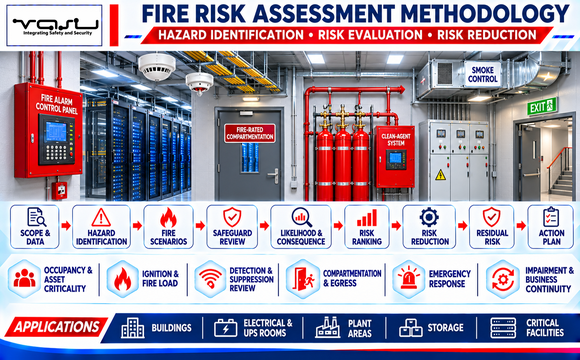
Project Scope → Data Collection → Occupancy & Asset Assessment → Hazard Identification → Ignition Source Assessment → Fire Load Assessment → Existing Fire Protection Review → Likelihood Assessment → Consequence Assessment → Risk Ranking → Risk Reduction Measures → Residual Risk Assessment → Action Plan → Management Review
3. Assessment Philosophy
The assessment should be proportionate to the building use, occupancy, fire hazards, asset criticality, construction, fire-protection systems and potential consequences. Assumptions, limitations, assessment criteria and responsibilities should be clearly documented.
4. Scope Definition
The assessment scope should identify the buildings, floors, rooms, external areas, processes, equipment, occupants and fire-protection systems included in the study. Interfaces with adjacent buildings and common services should also be considered where relevant.
5. Data Collection
Assessment inputs should include architectural drawings, occupancy information, fire-zone drawings, fire-protection layouts, electrical information, HVAC details, equipment schedules, fire-system records, maintenance records, previous incidents and relevant operational information.
6. Occupancy Assessment
Occupancy type, occupant characteristics, population, operating hours, vulnerable occupants, staff availability and familiarity with emergency procedures should be considered when evaluating life-safety risk.
7. Asset Criticality Assessment
Critical assets should be identified based on their operational, financial, safety and business-continuity importance. The consequences of fire affecting critical infrastructure should be incorporated into the risk assessment.
8. Hazard Identification
Potential fire hazards should be systematically identified, including electrical equipment, combustible materials, hot work, cooking, fuel, batteries, mechanical equipment, storage, processes and other credible ignition or fuel sources.
9. Ignition Source Assessment
Potential ignition sources should be reviewed for probability, location, operating condition, maintenance status and existing controls. Electrical faults, overheating, open flames, hot surfaces and maintenance activities should be considered where applicable.
10. Combustible / Fire Load Assessment
Combustible materials should be identified and assessed by type, quantity, location, arrangement and potential contribution to fire growth. Unnecessary combustible storage should be identified as a risk-reduction opportunity.
11. Fire Scenario Development
Credible fire scenarios should be developed for representative and high-consequence areas. Scenarios should consider ignition source, fuel, fire growth, smoke development, fire spread, occupant exposure and emergency response.
12. Fire Spread Assessment
Potential fire and smoke spread through rooms, corridors, shafts, ducts, cable routes, penetrations, façade elements and other pathways should be evaluated.
13. Compartmentation Review
Fire-rated walls, floors, doors, shafts, barriers, dampers and penetration seals should be reviewed for their effectiveness in limiting fire and smoke spread.
14. Detection & Alarm Review
Fire detection and alarm provisions should be reviewed for coverage, suitability, zoning, alarm notification, fault monitoring, early warning capability and interface with other life-safety systems.
15. Suppression System Review
Automatic and manual suppression provisions should be assessed for suitability, coverage, design basis, reliability, availability, maintenance condition and compatibility with the identified hazards.
16. Smoke Management Review
Smoke-control systems, staircase pressurisation, smoke extraction, natural ventilation and associated controls should be reviewed where applicable to determine whether smoke movement is adequately controlled.
17. Means of Egress Review
Escape routes, exit capacity, travel distance, stairs, doors, corridors, emergency lighting, signage and discharge arrangements should be assessed against the applicable design criteria.
18. Emergency Response Review
Emergency procedures, alarm escalation, evacuation arrangements, fire brigade notification, emergency access, fire command facilities and staff response should be reviewed.
19. Fire Brigade Intervention
Fire-service access, fire-fighting facilities, hydrants, fire brigade entrances, appliance access and information available to emergency responders should be considered.
20. Fire Protection System Reliability
The assessment should consider system availability, redundancy, impairment history, maintenance condition, power supply and potential single points of failure affecting critical fire protection.
21. Likelihood Assessment
Likelihood should be evaluated using the approved assessment methodology and should consider hazard frequency, exposure, existing controls, maintenance and credible initiating events.
22. Consequence Assessment
Consequences should consider life safety, property damage, business interruption, critical equipment loss, environmental impact, recovery requirements and potential fire-service exposure.
23. Risk Ranking
Likelihood and consequence should be combined using the approved risk matrix or ranking methodology. Each identified hazard should receive a documented risk classification.
24. Existing Safeguards
Existing preventive and protective controls should be documented, including passive fire protection, detection, alarm, suppression, smoke control, emergency power, emergency procedures, inspection and maintenance.
25. Risk Reduction Measures
Risk-reduction measures may include elimination or reduction of combustibles, improved housekeeping, electrical protection, compartmentation, fire stopping, detection, suppression, smoke control, emergency egress, training and management controls.
26. Residual Risk Assessment
After proposed controls are applied, residual risk should be reassessed. Remaining risks should be clearly identified, justified and assigned to responsible parties where further action is required.
27. Action Plan
Risk-reduction actions should identify the required measure, priority, responsible person / organisation, target completion, status and verification method.
28. Installation / Site Verification
Site verification should assess, as applicable:
- Occupancy and use
- Fire hazards
- Combustible storage
- Electrical installations
- Fire compartmentation
- Fire doors
- Fire stopping
- Detection systems
- Fire alarm systems
- Suppression systems
- Smoke-control systems
- Emergency exits
- Emergency lighting
- Fire brigade access
- Emergency communication
- Fire-protection equipment condition
- Housekeeping
- Maintenance and impairment controls
29. Testing & Evidence Review
Available inspection, testing and commissioning records should be reviewed to determine whether fire-protection systems are operational and maintained. Deficiencies identified through testing should be incorporated into the risk assessment.
30. Human Factors
Human behaviour, staff training, alarm recognition, evacuation response, emergency procedures, contractor activities and potential errors should be considered where they may influence fire risk.
31. Management Controls
Permit-to-work systems, hot-work controls, housekeeping, combustible-storage controls, inspection regimes, emergency drills, contractor management and impairment procedures should be assessed as organisational safeguards.
32. Fire Safety Management
The assessment should support a continuing fire-safety-management process rather than being treated as a one-time exercise. Significant changes, incidents, deficiencies or alterations should trigger review.
33. Impairment Risk
Impairment of detection, alarm, suppression, compartmentation, smoke control, emergency power or other critical protection should be evaluated for its impact on overall risk and controlled through compensatory measures.
34. Failure & Escalation
Credible failures and escalation scenarios should be considered, including detector failure, alarm failure, suppression impairment, fire-door failure, smoke-control failure and emergency-power loss.
35. Business Continuity Considerations
For critical facilities, the assessment should consider operational interruption, loss of critical assets, redundancy, recovery time, alternate facilities and restoration priorities resulting from a fire event.
36. Design Change Control
Changes to occupancy, building layout, electrical systems, HVAC, storage, processes, fire-protection systems or critical equipment should trigger a review of the fire-risk assessment.
37. Documentation
Fire-risk-assessment documentation should include, as applicable:
- Assessment scope
- Methodology statement
- Project / building information
- Occupancy assessment
- Asset criticality assessment
- Hazard register
- Ignition-source assessment
- Fire-load assessment
- Fire-scenario register
- Existing-safeguard assessment
- Likelihood criteria
- Consequence criteria
- Risk matrix
- Risk-ranking register
- Risk-reduction action plan
- Residual-risk register
- Compartmentation assessment
- Detection / alarm assessment
- Suppression assessment
- Smoke-control assessment
- Means-of-egress assessment
- Emergency-response assessment
- Fire brigade access assessment
- Management-control assessment
- Site inspection records
- Testing / maintenance evidence
- Impairment assessment
- Business-continuity considerations
- Review and approval records
38. Engineering Objective
The engineering objective is:
Define Assessment Scope → Collect Technical & Operational Data → Assess Occupancy & Critical Assets → Identify Fire Hazards & Ignition Sources → Assess Fire Loads & Credible Scenarios → Review Passive & Active Fire Protection → Evaluate Egress & Emergency Response → Determine Likelihood & Consequence → Rank Risk → Define Risk-Reduction Measures → Assess Residual Risk → Establish Action Plan → Periodically Review & Update the Fire Risk Assessment
Frequently Asked Questions
What is the purpose of Fire Risk Assessment Methodology?
Fire Risk Assessment Methodology provides a structured framework for identifying fire hazards, evaluating likelihood and consequences, reviewing existing safeguards, determining residual risk and establishing appropriate risk-reduction measures. The methodology should support a systematic, auditable and technically defensible assessment of fire and life-safety risks.
What is the high-level process or architecture covered in Fire Risk Assessment Methodology?
Project Scope → Data Collection → Occupancy & Asset Assessment → Hazard Identification → Ignition Source Assessment → Fire Load Assessment → Existing Fire Protection Review → Likelihood Assessment → Consequence Assessment → Risk Ranking → Risk Reduction Measures → Residual Risk Assessment → Action Plan → Management Review