
Article
Fire Safety Audit Methodology
Nov 2026
1. Engineering Overview
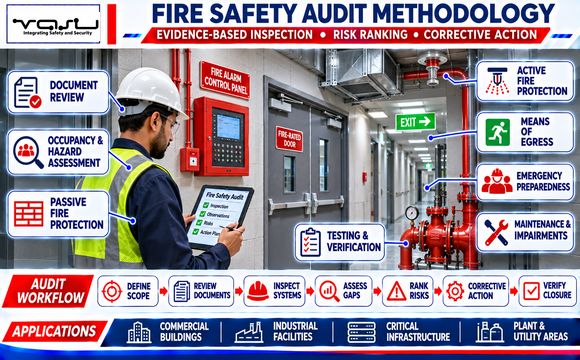
Fire Safety Audit Methodology establishes a systematic process for evaluating the adequacy, condition, functionality and management of fire and life-safety provisions within a facility. The audit should identify compliance gaps, operational deficiencies, system impairments and improvement opportunities through document review, site inspection, interviews, testing and evidence-based reporting.
2. Complete Fire Safety Audit Architecture
Audit Scope → Document Review → Occupancy & Hazard Assessment → Site Inspection → Passive Fire Protection Review → Active Fire Protection Review → Life Safety / Egress Review → Emergency Management Review → Testing & Verification → Gap Assessment → Risk Ranking → Corrective Action Plan → Audit Report → Follow-Up Verification
3. Audit Philosophy
The audit should be objective, structured, evidence-based and proportionate to the building use, occupancy, fire hazards, criticality and applicable requirements. Findings should distinguish observations, deficiencies, risks and recommended corrective actions.
4. Audit Scope Definition
The audit scope should identify buildings, floors, rooms, external areas, systems, operations, documents and time periods included. Any exclusions or limitations should be clearly documented.
5. Document Review
Available drawings, fire-system specifications, approvals, certificates, test reports, maintenance records, risk assessments, emergency plans, inspection records and previous audit reports should be reviewed as applicable.
6. Occupancy Assessment
Actual building use, occupant population, operating hours, vulnerable occupants, visitor arrangements and changes from the approved occupancy should be reviewed.
7. Fire Hazard Assessment
The auditor should identify electrical hazards, combustible storage, hot work, fuel sources, battery systems, cooking hazards, process risks, housekeeping issues and other relevant ignition or fuel sources.
8. Fire Load Review
Combustible materials, storage quantities, packaging, furniture, equipment and other fire loads should be reviewed to identify areas where fire severity may be elevated.
9. Passive Fire Protection Audit
Fire-rated walls, floors, doors, glazing, shafts, barriers, fire stopping, penetration seals, dampers and compartment boundaries should be inspected for continuity and condition.
10. Fire Door Audit
Fire doors should be checked for rating identification, condition, self-closing, latching, seals, hardware, clearances, unauthorised modifications and obstruction.
11. Fire Stopping Audit
Service penetrations and joints through fire-rated barriers should be inspected for approved fire-stopping systems, installation quality, damage, missing seals and unauthorised openings.
12. Active Fire Protection Audit
Fire detection, fire alarm, suppression, hydrant, sprinkler, clean-agent, water-mist, smoke-control and other active fire-protection systems should be reviewed for coverage, condition, functionality and maintenance.
13. Fire Detection Audit
Detectors should be checked for correct location, accessibility, physical condition, obstruction, contamination, identification and system communication.
14. Fire Alarm Audit
Fire alarm panels, manual call points, notification devices, zoning, fault indications, batteries, event history and cause-and-effect functions should be reviewed.
15. Suppression System Audit
Suppression systems should be reviewed for design coverage, equipment condition, isolation status, pressure / quantity condition as applicable, release controls, pipework, nozzles and maintenance status.
16. Clean Agent Audit
Clean-agent systems should be reviewed for cylinders, valves, releasing panels, manual release, abort functions, warning devices, pipework, nozzles, room integrity and HVAC interface.
17. Fire Water System Audit
Where applicable, hydrants, sprinklers, fire pumps, water storage, valves, pressure conditions and fire-service connections should be inspected and supported by available test records.
18. Smoke Control Audit
Smoke extraction, staircase pressurisation, lobby pressurisation, smoke dampers, fans, controls and emergency power should be reviewed against the approved fire strategy.
19. Means of Egress Audit
Exit routes, doors, stairs, corridors, travel distances, exit discharge, emergency lighting, exit signage and accessibility should be assessed for safe evacuation.
20. Emergency Communication Audit
Emergency voice evacuation, fireman’s telephone, public-address interfaces and other emergency communication systems should be reviewed for coverage, availability and functionality.
21. Fire Command Centre Audit
Where provided, the fire command centre should be reviewed for alarm monitoring, system controls, fire-service information, communication facilities, displays, emergency power and operational readiness.
22. Lift Fire Mode Audit
Lift recall, fire-mode operation, emergency / fire-service operation, fire alarm interface, emergency power and status monitoring should be reviewed where applicable.
23. Emergency Power Audit
Emergency power serving fire alarm, detection, emergency lighting, communication, smoke control, suppression controls and other critical systems should be reviewed for availability, testing and maintenance.
24. Housekeeping & Storage Audit
Combustible storage, waste accumulation, blocked exits, access to fire equipment, electrical housekeeping and general fire-safety conditions should be assessed.
25. Emergency Preparedness Audit
Emergency procedures, evacuation plans, fire warden arrangements, assembly areas, emergency contacts, fire brigade coordination and drill records should be reviewed.
26. Training & Competency Audit
Records of fire-safety training, emergency drills, fire extinguisher training, system operator training and relevant competency should be reviewed.
27. Maintenance Audit
Preventive-maintenance schedules, inspection records, testing certificates, breakdown records, defect registers and corrective actions should be evaluated.
28. Impairment Audit
Current and historical impairments of fire detection, alarm, suppression, smoke control, emergency power, compartmentation or other critical systems should be reviewed, including compensatory measures.
29. Testing & Verification
Where permitted and safe, selected systems should be functionally verified. Available FAT, SAT, commissioning, periodic testing and maintenance evidence should be reviewed to substantiate audit conclusions.
30. Site Inspection
The audit inspection should document observations through controlled checklists, photographs, drawings, equipment identification and other evidence. Findings should be traceable to specific locations.
31. Compliance Assessment
Each audited provision should be evaluated against the applicable project requirements, approved design, statutory requirements, adopted standards, manufacturer requirements and documented operational procedures.
32. Risk Ranking
Audit findings should be ranked according to severity, likelihood, life-safety impact, property / operational impact and criticality. The adopted risk-ranking methodology should be stated in the audit report.
33. Corrective Action Plan
Corrective actions should identify the finding, required action, responsible party, priority, target completion date and verification requirement. Critical life-safety deficiencies should receive immediate attention.
34. Audit Reporting
The audit report should provide an executive summary, scope, methodology, limitations, key observations, risk-ranked findings, photographs / evidence, corrective actions and overall fire-safety status.
35. Follow-Up Audit
Corrective actions should be verified through document review, site inspection or functional testing as appropriate. Closed findings should retain evidence of satisfactory resolution.
36. Installation / Site Verification
Fire safety audit should verify, as applicable:
- Occupancy and use
- Fire hazards and fire load
- Compartmentation
- Fire-rated walls and doors
- Fire stopping
- Fire and smoke dampers
- Fire detection
- Fire alarm
- Sprinkler / hydrant systems
- Clean-agent suppression
- Fire pumps and water storage
- Smoke control
- Means of egress
- Emergency lighting
- Exit signage
- Emergency communication
- Fire command centre
- Lift fire mode
- Emergency power
- Housekeeping
- Emergency procedures
- Training and drills
- Maintenance records
- Impairment controls
37. Testing & Commissioning Review
The audit should review available evidence for:
- Fire detection tests
- Fire alarm tests
- Suppression-system tests
- Fire pump tests
- Room-integrity tests
- Smoke-control tests
- Emergency-power tests
- Emergency-lighting tests
- Emergency-communication tests
- Lift fire-mode tests
- Integrated system tests
38. Documentation
Fire safety audit documentation should include, as applicable:
- Audit scope and objectives
- Audit methodology
- Applicable requirements register
- Document review checklist
- Site inspection checklist
- Occupancy assessment
- Fire hazard register
- Fire load review
- Passive fire protection checklist
- Active fire protection checklist
- Means-of-egress checklist
- Emergency management checklist
- Maintenance review
- Impairment review
- Testing / verification records
- Risk-ranking matrix
- Audit findings register
- Photographic evidence
- Corrective action plan
- Executive summary
- Follow-up verification records
- Final audit report
39. Engineering Objective
The engineering objective is:
Define Audit Scope → Review Documents & Approved Design → Assess Occupancy, Hazards & Fire Load → Inspect Passive Fire Protection → Inspect Active Fire Protection → Assess Egress & Emergency Management → Review Testing, Maintenance & Impairments → Verify Selected Systems → Identify Compliance Gaps → Rank Risks → Establish Corrective Actions → Issue Audit Report → Verify Closure & Sustain Fire Safety Performance
Frequently Asked Questions
What is the purpose of Fire Safety Audit Methodology?
Fire Safety Audit Methodology establishes a systematic process for evaluating the adequacy, condition, functionality and management of fire and life-safety provisions within a facility. The audit should identify compliance gaps, operational deficiencies, system impairments and improvement opportunities through document review, site inspection, interviews, testing and evidence-based reporting.
What is the high-level process or architecture covered in Fire Safety Audit Methodology?
Audit Scope → Document Review → Occupancy & Hazard Assessment → Site Inspection → Passive Fire Protection Review → Active Fire Protection Review → Life Safety / Egress Review → Emergency Management Review → Testing & Verification → Gap Assessment → Risk Ranking → Corrective Action Plan → Audit Report → Follow-Up Verification