
Article
Fire Safety Documentation & Handover
Nov 2026
1. Engineering Overview
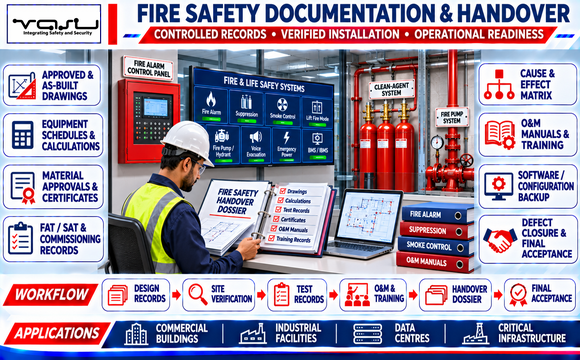
Fire Safety Documentation & Handover establishes the controlled process for compiling, verifying, reviewing and transferring all fire and life-safety engineering information required for operation, maintenance, statutory compliance, emergency response and future modification of a facility.
2. Complete Fire Safety Documentation & Handover Architecture
Design Basis → Approved Drawings → Technical Specifications → Calculations → Equipment Schedules → Material Approvals → Inspection Records → FAT / SAT → Testing & Commissioning → Integrated Testing → Certificates → As-Built Documentation → O&M Manuals → Training → Handover Dossier → Final Acceptance
3. Documentation Philosophy
Fire-safety documentation should be accurate, traceable, current and consistent with the installed system. All final records should reflect approved design changes, site conditions, test results, equipment identification and maintenance requirements.
4. Design Documentation
The final documentation set should retain the approved fire strategy, design basis, calculations, system architecture, layouts, schematics, schedules, specifications and relevant design decisions.
5. Approved Drawings
Approved fire alarm, detection, suppression, hydrant, sprinkler, clean-agent, smoke-control, emergency communication, fire command centre and other life-safety drawings should be compiled for handover.
6. As-Built Documentation
As-built drawings should reflect the actual installed configuration, including equipment locations, cable routes, pipe routes, valves, detectors, modules, panels, cylinders, dampers, fans, controls and interfaces.
7. Equipment Schedules
Final equipment schedules should identify equipment tag, description, manufacturer, model, capacity / rating, quantity, location and other information necessary for operation and maintenance.
8. Technical Specifications
Final technical specifications should document the approved equipment, materials, system performance requirements, installation criteria and relevant manufacturer requirements.
9. Calculations
Relevant final calculations should be included, such as hydraulic calculations, clean-agent quantities, room-integrity requirements, battery calculations, pump calculations, smoke-control calculations, pressure calculations and other approved engineering calculations.
10. Material Approval Records
Material approvals, technical datasheets, certificates, compliance documents and approved deviations should be retained as part of the final handover dossier.
11. Inspection Records
Inspection records should document installation quality, equipment identification, cable / pipe routing, fire stopping, fire doors, dampers, devices and other critical fire-safety installations.
12. FAT Documentation
Factory Acceptance Test records should be compiled for applicable panels, suppression equipment, control systems, pumps, valves and other factory-tested equipment.
13. SAT Documentation
Site Acceptance Test records should demonstrate that installed equipment has been inspected and tested against the approved requirements.
14. Testing & Commissioning Records
Final testing and commissioning records should document individual system tests, measured values, test conditions, deficiencies, corrective actions and final acceptance status.
15. Integrated Testing Records
Integrated fire and life-safety test records should demonstrate correct interaction between fire alarm, suppression, smoke control, emergency voice evacuation, lifts, emergency power, access control, BMS / IBMS and other interfaced systems.
16. Cause & Effect Matrix
The final approved cause-and-effect matrix should be included and should reflect the actual commissioned system sequence, including inputs, outputs, delays, priorities, alarms, controls, feedback and reset conditions.
17. Certificates & Compliance Records
Applicable statutory approvals, inspection certificates, product certifications, testing certificates, calibration certificates and other compliance records should be compiled and indexed.
18. Fire Alarm Documentation
Final fire alarm documentation should include panel configuration, loop / circuit information, device schedules, zoning, cause-and-effect, battery calculations, programming records, test results and as-built layouts.
19. Fire Suppression Documentation
Suppression-system documentation should include system design, equipment schedules, hydraulic / agent calculations where applicable, pipework drawings, nozzle layouts, release logic, test records and maintenance requirements.
20. Clean Agent Documentation
Clean-agent handover should include cylinder schedules, agent quantities, valve information, pipe-network drawings, nozzle calculations, room-integrity results, releasing logic, warning-device details and discharge / functional test records.
21. Fire Water System Documentation
Hydrant and sprinkler documentation should include pump schedules, water-storage information, valve schedules, hydraulic calculations, pipework drawings, test records and system operating procedures.
22. Smoke Control Documentation
Smoke-control documentation should include smoke-zone drawings, fan schedules, airflow / pressure calculations, damper schedules, control logic, cause-and-effect, test results and emergency-power arrangements.
23. Emergency Communication Documentation
Emergency voice evacuation and fireman’s telephone documentation should include system architecture, zone schedules, equipment schedules, communication circuits, message schedules, test records and emergency operating procedures.
24. Fire Command Centre Documentation
Fire command centre documentation should include equipment layouts, monitoring / control interfaces, fire plans, communication arrangements, alarm displays, emergency procedures and system operating instructions.
25. Emergency Power Documentation
Emergency-power documentation should identify critical fire and life-safety loads, power sources, distribution arrangements, battery capacities, generator interfaces and test results.
26. Training & Demonstration
Handover should include training for authorised operators, facilities personnel, security, fire wardens and other relevant personnel. Training should cover normal operation, alarm response, emergency procedures, system isolation, reset and basic fault identification.
27. O&M Manuals
Operation and Maintenance manuals should provide system descriptions, operating procedures, emergency procedures, maintenance schedules, inspection requirements, troubleshooting guidance, spare parts and manufacturer information.
28. Spare Parts & Special Tools
Required spare parts, consumables, special tools, programming equipment and maintenance accessories should be identified and handed over where included in the project scope.
29. Software & Configuration Backup
Where fire and life-safety systems use programmable controllers, software, configuration files, databases and authorised backup copies should be securely handed over in accordance with project and cybersecurity requirements.
30. Asset Identification
All critical fire and life-safety equipment should have traceable identification consistent with drawings, schedules, labels, control-panel displays and maintenance records.
31. Defect & Snag Closure
All outstanding fire-safety defects should be recorded in a controlled register. Handover should identify the status of each item and retain evidence of rectification and retesting.
32. Final Handover Dossier
The final dossier should be logically indexed and contain the latest approved information only. Superseded drawings and documents should be controlled to prevent accidental use.
33. Document Control
Document numbers, revision status, approval status, dates, authorship, review records and distribution should be controlled. The handover set should have a clear document index.
34. Site Verification
Fire safety handover should verify, as applicable:
- Approved fire strategy
- Design basis
- Approved drawings
- As-built drawings
- Equipment schedules
- Technical specifications
- Calculations
- Material approvals
- Certificates
- Inspection records
- FAT records
- SAT records
- Testing and commissioning records
- Integrated testing records
- Cause-and-effect matrix
- Fire alarm records
- Suppression-system records
- Clean-agent records
- Hydrant / sprinkler records
- Smoke-control records
- Emergency communication records
- Fire command centre records
- Emergency-power records
- Training records
- O&M manuals
- Spare parts
- Software / configuration backups
- Defect closure records
35. Testing & Commissioning Handover Review
Final handover should verify:
- Individual system commissioning
- Cause-and-effect testing
- Integrated fire scenarios
- Emergency-power testing
- Emergency communication testing
- Smoke-control testing
- Lift fire-mode testing
- Fire alarm testing
- Suppression-system testing
- Room-integrity testing where applicable
- Functional recovery / reset
- Final defect closure
36. Handover Acceptance
Formal acceptance should confirm that required documentation has been submitted, installed systems have been tested, critical deficiencies have been closed, operators have received required training and the final record set represents the commissioned installation.
37. Documentation Index
The handover index should include, as applicable:
- Project information
- Fire strategy
- Design basis
- Approved drawings
- As-built drawings
- Calculations
- Specifications
- Equipment schedules
- Material approvals
- Certificates
- Inspection records
- FAT records
- SAT records
- Testing & commissioning reports
- Integrated testing reports
- Cause-and-effect matrix
- Statutory approvals
- O&M manuals
- Training records
- Spare-parts schedule
- Software / configuration records
- Defect / snag closure register
- Warranty information
- Maintenance schedule
- Final acceptance records
38. Engineering Objective
The engineering objective is:
Compile Approved Design Information → Verify Installed Configuration → Update As-Built Drawings & Schedules → Consolidate Calculations, Certificates & Test Records → Confirm Individual & Integrated Commissioning → Close Fire-Safety Defects → Train Responsible Personnel → Transfer O&M Manuals, Spares & System Configuration → Establish Controlled Handover Dossier → Obtain Final Acceptance → Maintain Accurate Lifecycle Fire & Life-Safety Records
Frequently Asked Questions
What is the purpose of Fire Safety Documentation & Handover?
Fire Safety Documentation & Handover establishes the controlled process for compiling, verifying, reviewing and transferring all fire and life-safety engineering information required for operation, maintenance, statutory compliance, emergency response and future modification of a facility.
What is the high-level process or architecture covered in Fire Safety Documentation & Handover?
Design Basis → Approved Drawings → Technical Specifications → Calculations → Equipment Schedules → Material Approvals → Inspection Records → FAT / SAT → Testing & Commissioning → Integrated Testing → Certificates → As-Built Documentation → O&M Manuals → Training → Handover Dossier → Final Acceptance