
Article
Fire Water Storage Tank Design
Oct 2026
Direct Answer
The fire water storage tank provides the required reserve for a building or facility’s approved fire protection systems. Its effective capacity, configuration, connections, operating levels and refill arrangement should be established from the approved fire protection design, hydraulic calculations and applicable project requirements. Tank design must be coordinated with the fire pumps to support the required water availability and reliable pump suction under the design operating condition.
1. Engineering Overview
The Fire Water Storage Tank is a dedicated water storage facility that provides the required reserve for the fire protection system. Its capacity, configuration, connections and operating arrangement should be established from the approved fire protection design, hydraulic calculation and applicable project requirements.
2. Tank System Architecture
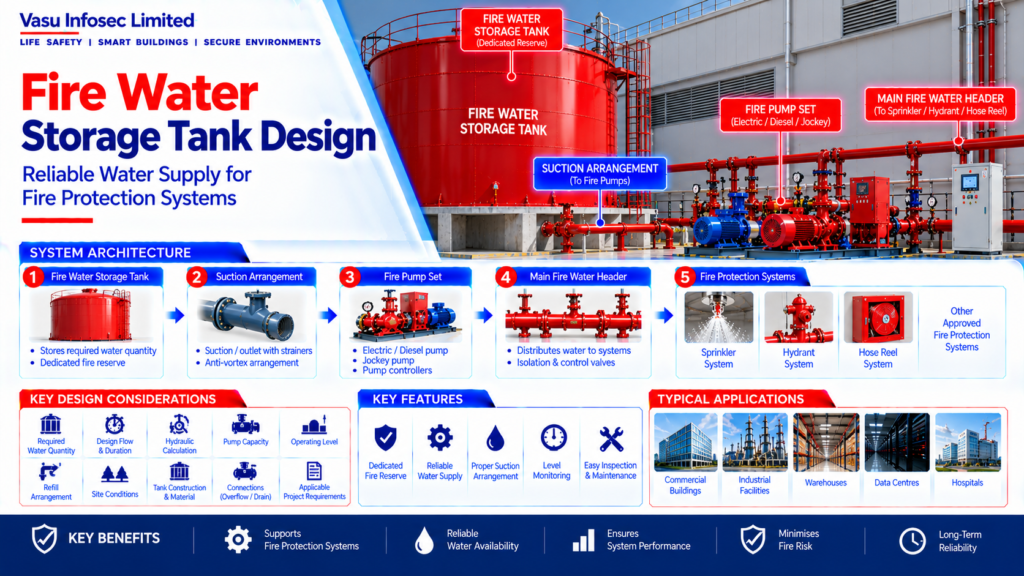
Fire Water Storage Tank → Suction / Outlet Arrangement → Fire Pump Set → Main Fire Water Header → Sprinkler / Hydrant / Hose Reel / Other Approved Fire Protection Systems
3. Design Basis
Tank design should consider:
- Protected hazard
- Fire protection systems served
- Required design flow
- Required water duration
- Hydraulic calculation
- Pump capacity
- Tank operating level
- Refill arrangement
- Site conditions
- Applicable project requirements
4. Storage Capacity
The effective fire water storage capacity should be determined from the approved fire protection demand and required duration. The usable volume should account for the operating arrangement and any volume that cannot be reliably drawn by the fire pumps.
5. Dedicated Fire Water Storage
Where required by the approved fire strategy, the tank should provide a dedicated fire water reserve. Connections and controls should prevent unauthorised consumption of the protected fire reserve.
6. Tank Configuration
The tank may be arranged as an above-ground or other approved configuration depending on project requirements. The selected construction should be suitable for the water service, environmental conditions and required operating life.
7. Tank Construction
Tank construction, material, coating and structural arrangement should be suitable for the stored water and site conditions. The final construction should follow the approved tank specification and manufacturer / specialist design.
8. Suction Arrangement
The tank outlet and suction arrangement should provide adequate water supply to the fire pump under the design operating condition. Suction connections, valves, strainers where applicable and anti-vortex provisions should follow the approved design.
9. Pump Suction Coordination
Tank geometry and connection elevations should be coordinated with the fire pump suction requirements. The design should avoid conditions that could adversely affect pump performance or water availability.
10. Refill Arrangement
Where a refill connection is provided, its capacity and control arrangement should be coordinated with the project water supply. The refill system should not compromise the required fire reserve during an emergency.
11. Water Level Monitoring
The tank may be provided with approved level monitoring equipment to indicate normal, low and other required operating conditions. Signals should be integrated with the fire protection monitoring system where specified.
12. Overflow & Drainage
Overflow and drainage arrangements should safely manage excess or drained water. Drainage provisions should be coordinated with the site drainage system and tank maintenance requirements.
13. Tank Connections
Typical tank connections may include:
- Fire pump suction
- Refill / inlet
- Overflow
- Drain
- Level monitoring
- Test / inspection connections
- Other approved fire protection connections
14. Internal Arrangement
Internal tank arrangements, where required, should support reliable water withdrawal and minimise conditions that could interfere with pump suction or water quality. Any internal components should be compatible with the approved tank design.
15. Fire Pump Coordination
The storage tank and fire pump set should be designed as an integrated system. Tank capacity, suction conditions, pump flow, pump pressure and operating levels should be verified together.
16. Installation Requirements
Installation should verify:
- Correct tank capacity
- Correct location and foundation
- Correct tank connections
- Correct suction arrangement
- Correct refill arrangement
- Correct level instruments
- Correct overflow and drain connections
- Adequate access for inspection
- Correct identification / labelling
17. Testing & Commissioning
Tank commissioning should verify:
- Structural / installation condition
- Water tightness, where applicable
- Water level indication
- Refill operation
- Suction connection condition
- Overflow and drain operation
- Pump suction performance
- Alarm / monitoring signals
18. Inspection & Maintenance
Periodic inspection should verify tank condition, water level, leakage, corrosion or coating deterioration, suction connections, valves, level devices, overflow and drain arrangements. Any condition affecting water availability should be addressed promptly.
19. Design Change Control
Changes to fire protection demand, pump capacity, connected systems, tank capacity, suction arrangement or refill source should be reviewed against the approved hydraulic design before implementation.
20. Documentation
Fire water storage tank documentation should include, as applicable:
- Tank design / datasheet
- Storage capacity calculation
- Fire protection hydraulic calculation
- Tank GA drawing
- Connection details
- Structural / installation details
- Level monitoring details
- Pump suction arrangement
- Testing records
- Inspection records
- As-built drawings
- O&M manual
21. Engineering Objective
The engineering objective is:
Accurate Fire Demand → Correct Storage Capacity → Reliable Water Availability → Proper Pump Suction → Coordinated Refill & Monitoring → Safe Installation → Verified Water Reserve → Complete Testing & Maintenance → Reliable Fire Protection Water Supply
Frequently Asked Questions
How is fire water storage tank capacity determined?
The source states that effective capacity should be determined from the approved fire protection demand and required duration, accounting for the operating arrangement and any volume that cannot be reliably drawn by the fire pumps.
Why must tank design be coordinated with fire pumps?
Tank capacity, suction conditions, pump flow, pump pressure and operating levels should be verified together to support the design operating condition.
What tank configurations may be used?
The source notes that the tank may be above-ground or another approved configuration, depending on project requirements, water service, environmental conditions and required operating life.
What are typical tank connections?
Typical connections may include fire pump suction, refill/inlet, overflow, drain, level monitoring, test/inspection connections and other approved fire protection connections.
What should be checked during commissioning?
The source lists structural/installation condition, water tightness where applicable, level indication, refill operation, suction connections, overflow and drain operation, pump suction performance, and alarm/monitoring signals.
What documents should be maintained?
As applicable, the source lists the tank design/datasheet, storage capacity and hydraulic calculations, tank GA drawing, connection and structural details, level monitoring details, pump suction arrangement, testing and inspection records, as-built drawings and O&M manual.
SEO and Website Publishing Details
| Field | Suggested content |
| SEO title | Fire Water Storage Tank Design: Capacity, Suction and Monitoring |
| Meta description | Learn key fire water storage tank design considerations, including usable capacity, pump suction, refill, level monitoring, drainage, commissioning and maintenance. |
| Suggested URL slug | /fire-water-storage-tank-design/ |
| Primary keyword | fire water storage tank design |
| Secondary keywords | fire water storage capacity; fire pump suction tank; fire water tank connections; fire reserve monitoring; fire protection water storage |
| Suggested internal links | Fire Pump System Design; Wet Pipe Sprinkler System; Deluge Sprinkler System; Fire Protection Hydraulic Design |