
Article
Fixed Dome Camera Selection
Oct 2026
Direct Answer
A fixed dome camera should be selected according to the surveillance objective, target distance, required image detail, field of view, lens, lighting, environmental conditions, mounting arrangement, network and PoE requirements, recording, analytics and cybersecurity needs. Resolution alone does not guarantee identification performance; lens selection, pixel density, lighting, focus and camera positioning must also be considered. Final selection should align with the approved CCTV design and project specification.
1. Engineering Overview
Fixed dome cameras are compact fixed-view CCTV cameras designed for controlled surveillance of defined areas. Selection should be based on surveillance objective, field of view, target distance, lighting, resolution, environmental conditions, mounting arrangement, analytics and integration requirements.
2. Fixed Dome Camera Architecture
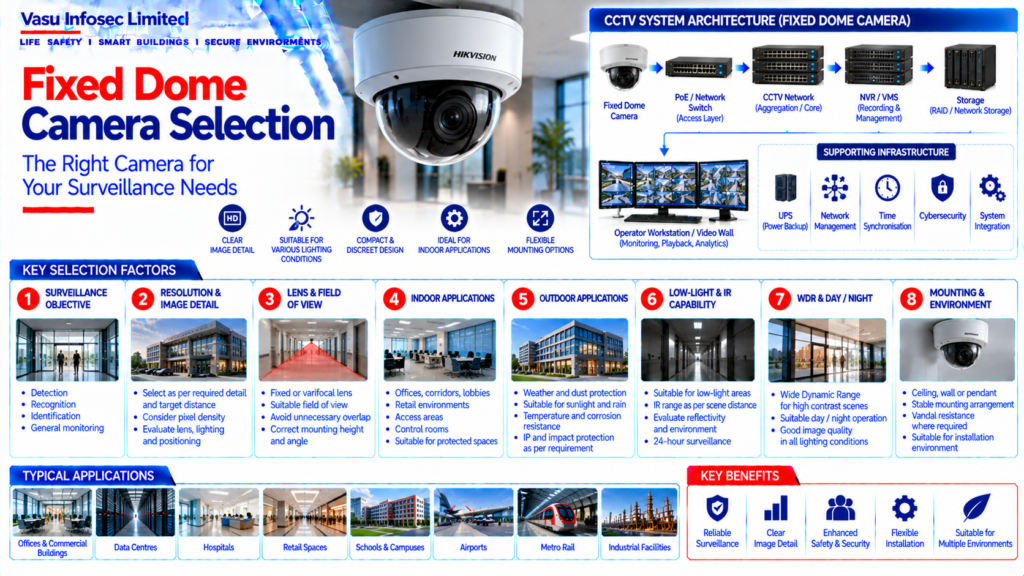
Fixed Dome Camera → PoE / Network Switch → CCTV Network → NVR / VMS → Storage → Operator Workstation / Video Wall
Supporting Infrastructure → UPS → Network Management → Time Synchronisation → Cybersecurity → Approved System Integration
3. Surveillance Objective
The first step in dome camera selection is to establish whether the camera is required for detection, recognition, identification, general monitoring or another approved surveillance objective. The objective determines the required resolution, pixel density, lens and installation geometry.
4. Camera Resolution
Resolution should be selected according to the required image detail and target distance. Higher resolution does not automatically guarantee better identification; lens selection, pixel density, lighting, focus and camera positioning must also be considered.
5. Lens Selection
The lens should provide the required horizontal and vertical field of view at the intended mounting height and target distance. Fixed focal length or varifocal configurations may be selected depending on the required coverage flexibility.
6. Field of View
The camera field of view should cover the intended surveillance zone without excessive unused area. The design should avoid obstructions, extreme viewing angles and unnecessary overlap unless overlap is required for operational resilience.
7. Pixel Density
Pixel density should be assessed at the target area to determine whether the camera can deliver the required level of detail. Camera resolution, lens focal length, sensor size and target distance jointly influence pixel density.
8. Indoor Dome Selection
Indoor dome cameras are suitable for offices, corridors, lobbies, access areas, retail environments, control areas and other protected spaces. Selection should consider ceiling height, lighting, vandal resistance and required viewing angle.
9. Outdoor Dome Selection
Outdoor dome cameras should have appropriate environmental and impact protection for the installation location. Selection should consider rain, dust, temperature, sunlight, corrosion and potential tampering.
10. Low-Light & IR Capability
Where lighting is insufficient, a dome camera with suitable low-light or infrared capability may be selected. IR range should be assessed against the actual scene distance, reflectivity and expected environmental conditions.
11. WDR Requirement
Wide Dynamic Range may be required where scenes contain strong contrasts between bright and dark areas, such as entrances, glazing interfaces and external-to-internal transitions. WDR performance should be verified against the application.
12. Day / Night Operation
For 24-hour surveillance, the camera should support appropriate day / night operation. The design should consider IR illumination, colour performance, switching behaviour and image quality under both daytime and nighttime conditions.
13. Environmental Protection
Outdoor or exposed dome cameras should be selected with an appropriate ingress protection rating and impact resistance where required. The rating should be suitable for the actual installation environment and project specification.
14. Mounting Arrangement
The mounting arrangement should provide a stable camera position, correct viewing angle and sufficient access for maintenance. Ceiling, wall, pendant or other approved mounting accessories should be compatible with the selected camera.
15. Vandal Resistance
Cameras installed in publicly accessible or security-sensitive locations may require impact-resistant housings. Vandal resistance should be selected according to the expected risk and project requirements.
16. Network & PoE Requirements
IP dome cameras require compatible network connectivity. Where PoE is used, switch port capacity, power budget, cable length and device consumption should be verified. Network bandwidth should be calculated from the camera configuration.
17. Recording Requirements
The selected dome camera should be compatible with the approved NVR / VMS and recording configuration. Resolution, frame rate, codec and recording mode should be coordinated with storage and bandwidth calculations.
18. Analytics Capability
Where analytics are required, the selected camera should support the approved functions, processing requirements and VMS compatibility. Analytics performance should be validated for the actual scene rather than assumed solely from the camera specification.
19. Cybersecurity Considerations
Network-connected dome cameras should support the approved cybersecurity requirements, including secure credentials, access control, firmware management, network segmentation and controlled remote access where applicable.
20. Installation Requirements
Installation should verify:
- Correct camera model
- Correct lens / focal length
- Correct mounting height
- Correct viewing angle
- Correct focus
- Correct environmental rating
- Correct network connection
- Correct PoE power
- Correct IP addressing
- Correct VMS / NVR compatibility
- Proper cable routing and segregation
21. Testing & Commissioning
Fixed dome camera commissioning should verify:
- Camera connectivity
- Image quality
- Field of view
- Focus
- Resolution
- Pixel density at critical targets
- Day / night operation
- IR operation, where applicable
- WDR operation, where applicable
- Recording
- Playback
- Analytics, where applicable
22. Maintenance
Maintenance should include lens and housing cleaning, image-quality verification, mounting inspection, network connectivity checks, PoE verification, firmware / configuration review and periodic confirmation of camera coverage.
23. Design Change Control
Changes to dome camera model, resolution, lens, location, mounting height, environmental rating or analytics capability should be reviewed because they may affect coverage, bandwidth, storage, integration and surveillance performance.
24. Documentation
Fixed dome camera documentation should include, as applicable:
- Camera schedule
- Camera model and type
- Resolution
- Lens / focal length
- Field of view
- Environmental rating
- Mounting details
- PoE requirements
- Network details
- Analytics capability
- Camera layout drawings
- Testing and commissioning records
- As-built drawings
- O&M manual
25. Engineering Objective
The engineering objective is:
Define Surveillance Requirement → Select Suitable Dome Camera → Validate Resolution & Lens → Confirm Coverage & Pixel Density → Verify Lighting & Environment → Confirm Network, Power & Recording → Complete Testing → Establish Reliable Fixed-View Surveillance
Frequently Asked Questions
What determines fixed dome camera selection?
The surveillance objective, target distance, field of view, required image detail, lighting, environmental conditions, mounting, analytics and integration requirements.
Does higher resolution guarantee better identification?
No. Lens selection, pixel density, lighting, focus and camera positioning also influence the delivered image detail.
When is IR or low-light capability needed?
It may be needed where lighting is insufficient. IR suitability should be assessed against actual scene distance, reflectivity and environmental conditions.
What should be checked for PoE cameras?
Verify switch port capacity, power budget, cable length, device consumption and network bandwidth.
What should commissioning verify?
Connectivity, image quality, field of view, focus, resolution, pixel density at critical targets, day/night operation, applicable IR/WDR, recording, playback and applicable analytics.
SEO & Publishing Details
| SEO title | Fixed Dome Camera Selection Guide | Vasu Infosec Limited |
| Meta description | Learn how to select fixed dome CCTV cameras using surveillance objectives, resolution, lens, field of view, pixel density, lighting, environmental protection and network requirements. |
| Primary keyword | fixed dome camera selection |
| Secondary keywords | fixed dome CCTV camera, dome camera lens selection, CCTV field of view, pixel density, IR dome camera, PoE CCTV camera, CCTV commissioning |
| Suggested URL slug | fixed-dome-camera-selection |
| Suggested image alt text | Fixed dome CCTV camera with network, lens, lighting and installation considerations |