
Article
Gas Suppression Agent Quantity Calculation
Oct 2026
Direct Answer
Gas suppression agent quantity is determined from the approved protected enclosure volume, selected agent, required design concentration and applicable design conditions. The calculation must follow the approved design methodology and manufacturer procedure; cylinder selection, piping and nozzle flow must then be checked against that calculation.
1. Engineering Overview
Gas Suppression Agent Quantity Calculation determines the quantity of extinguishing agent required to achieve the approved design concentration within the protected enclosure. The calculation should be based on the selected agent, protected volume, design conditions, applicable design methodology and approved manufacturer calculation procedure.
2. Basic Calculation Architecture
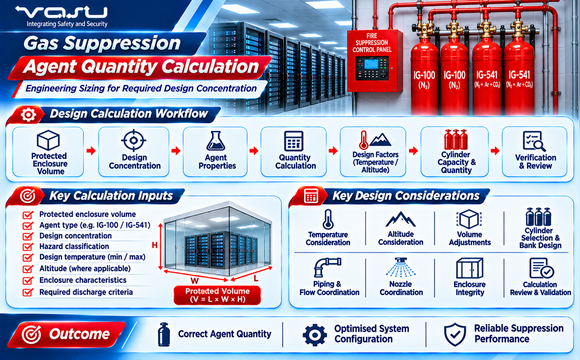
Protected Enclosure Volume → Design Conditions → Required Design Concentration → Agent Properties → Quantity Calculation → Environmental / Design Factors → Required Agent Quantity → Cylinder Capacity & Quantity → System Verification
3. Calculation Inputs
The calculation should establish the relevant design inputs before determining agent quantity.
Typical inputs include:
- Protected enclosure volume
- Agent type
- Design concentration
- Hazard classification
- Minimum / maximum design temperature
- Altitude, where applicable
- Enclosure characteristics
- Required discharge criteria
- Applicable manufacturer methodology
4. Protected Volume Determination
The protected volume should be derived from approved architectural and coordinated services information. Room dimensions, ceiling voids, raised floors, protected subspaces and other relevant volumes should be considered according to the approved system design.
5. Design Concentration
The required design concentration should be established for the selected agent and hazard using the approved design basis. The concentration should be appropriate for the identified fire risk and the applicable system design criteria.
6. Agent Properties
The agent calculation should use the relevant physical and design properties of the selected extinguishing agent. These values should be taken from approved manufacturer data and the applicable calculation methodology.
7. Basic Calculation Principle
The agent quantity is determined by relating the protected enclosure volume and required design concentration to the characteristics of the selected extinguishing agent under the specified design conditions.
The exact formula and correction factors should follow the approved manufacturer’s calculation method and applicable requirements.
8. Temperature Consideration
Temperature can affect agent density and storage / discharge characteristics. The design calculation should use the specified design temperature or the applicable temperature range required by the approved calculation methodology.
9. Altitude Consideration
Where applicable, site altitude or atmospheric conditions may influence the calculation. Any required correction should be incorporated in accordance with the approved agent calculation methodology.
10. Volume Adjustments
Where permitted by the approved design methodology, relevant equipment displacement or protected sub-volume considerations may be accounted for. The basis for any volume adjustment should be clearly documented.
11. Agent Quantity Verification
The calculated quantity should be reviewed against the required design concentration and protected volume. The final selected quantity should provide the required design basis without relying on unverified assumptions.
12. Cylinder Capacity & Quantity
Once the required agent quantity is established, the cylinder configuration should be selected.
The selection should consider:
- Required agent quantity
- Cylinder capacity
- Storage pressure
- Number of cylinders
- Bank arrangement
- Manifold configuration
- Manufacturer availability
13. Cylinder Fill & Storage Considerations
Cylinder filling and storage limits should comply with the selected manufacturer’s approved equipment data and applicable requirements. The final cylinder schedule should clearly identify the required configuration.
14. Piping & Flow Coordination
Agent quantity calculation should be coordinated with the piping and flow calculation. The selected cylinder bank, piping network and nozzle arrangement should be capable of delivering the calculated quantity within the required discharge criteria.
15. Nozzle Coordination
The calculated agent quantity should be consistent with the approved nozzle arrangement and flow calculation. Nozzle quantity, orifice configuration and location should be based on the engineered distribution system.
16. Enclosure Integrity Coordination
The calculated quantity is dependent on the protected enclosure retaining the required concentration for the specified hold period. Enclosure integrity should therefore be coordinated with the agent quantity and overall suppression design.
17. Calculation Review & Validation
The completed calculation should be technically reviewed before final equipment selection.
Review should verify:
- Correct protected volume
- Correct agent type
- Correct design concentration
- Correct design conditions
- Correct calculation methodology
- Appropriate factors / corrections
- Cylinder selection
- Piping / flow coordination
- Nozzle arrangement
18. Testing & Commissioning Coordination
Agent quantity calculations should be available for review during FAT, SAT and commissioning. The installed cylinder configuration, agent quantity and system design should correspond with the approved calculation and as-built documentation.
19. Documentation
Agent quantity calculation documentation should include, as applicable:
- Calculation sheet
- Design basis
- Protected volume details
- Agent properties
- Design concentration
- Temperature / altitude inputs
- Correction factors
- Final agent quantity
- Cylinder schedule
- Piping / flow calculation
- Nozzle schedule
- Approval / review records
20. Engineering Objective
The engineering objective is:
Accurate Protected Volume → Correct Design Concentration → Verified Agent Properties → Appropriate Design Conditions → Valid Quantity Calculation → Correct Cylinder Configuration → Coordinated Piping & Nozzle Design → Confirmed Enclosure Integrity → Complete Technical Verification → Reliable Gas Suppression System Performance
Frequently Asked Questions
What information is needed to calculate gas suppression agent quantity?
The source identifies protected enclosure volume, agent type, design concentration, hazard classification, temperature, altitude where applicable, enclosure characteristics, discharge criteria and the approved manufacturer methodology.
Can a generic formula be used for every gas suppression agent?
No generic formula is provided in the source. It states that the exact formula and correction factors must follow the approved manufacturer’s calculation method and applicable requirements.
Why does room volume matter?
The protected volume is a primary input to the calculation and should be established from approved architectural and coordinated services information, including relevant ceiling voids, raised floors and protected subspaces.
What should be checked after calculating the agent quantity?
Review the calculation against the design concentration, protected volume and design conditions, then coordinate cylinder configuration, piping/flow calculation, nozzle arrangement and enclosure integrity.
What documents should be retained?
As applicable, retain the calculation sheet, design basis, protected volume details, agent properties, concentration, temperature/altitude inputs, correction factors, final quantity, cylinder schedule, piping/flow calculation, nozzle schedule and review records.
SEO & Publication Metadata
SEO title: Gas Suppression Agent Quantity Calculation | Vasu Infosec
Meta description: Understand the inputs and verification steps for gas suppression agent quantity calculation, including protected volume, design concentration, temperature and cylinder selection.
Suggested URL slug: gas-suppression-agent-quantity-calculation
Primary keywords: gas suppression agent quantity calculation, clean agent quantity calculation, protected enclosure volume, design concentration, gas suppression cylinder calculation
Suggested internal links: Gas Suppression System Design Workflow; Gas Suppression Enclosure Integrity; Gas Suppression Nozzle Arrangement; IG-100 vs IG-541 System Comparison.