
Article
Gas Suppression Cylinder Bank Architecture
Oct 2026
Direct Answer
A gas suppression cylinder bank combines the required agent storage cylinders, valves and actuators, flexible connections, check valves where specified, a common manifold, supervision devices and distribution piping. Its configuration must be based on the approved agent quantity, selected cylinder capacity, manufacturer system architecture, and approved pressure/flow calculations.
1. Engineering Overview
A Gas Suppression Cylinder Bank Architecture defines the arrangement of multiple agent storage cylinders, valves, manifolds, actuation components and associated supervision required to deliver the calculated extinguishing agent to a protected enclosure. The bank configuration should be based on the approved agent quantity, cylinder selection, discharge requirements and manufacturer system architecture.
2. Basic Cylinder Bank Architecture
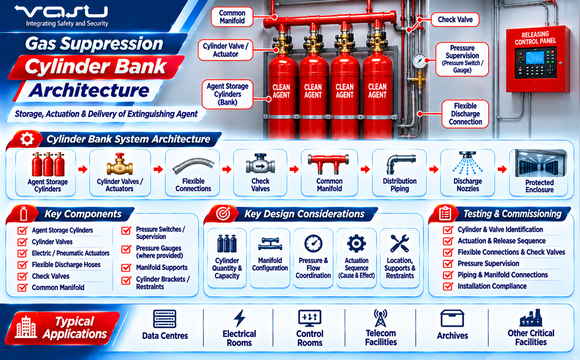
Agent Storage Cylinders → Cylinder Valves / Actuators → Flexible Connections → Check Valves → Common Manifold → Main Distribution Piping → Discharge Nozzles → Protected Enclosure
3. Purpose of Cylinder Banking
Cylinder banking allows the required agent quantity to be stored and discharged using multiple cylinders where a single cylinder cannot accommodate the calculated quantity or where the approved system requires a banked arrangement.
4. Cylinder Bank Components
A typical cylinder bank may include:
- Agent storage cylinders
- Cylinder valves
- Electric / pneumatic actuators, as applicable
- Flexible discharge hoses
- Check valves
- Common manifold
- Pressure switches / supervisory devices
- Pressure gauges, where provided
- Manifold supports
- Cylinder brackets / restraints
- Pilot / actuation piping, where applicable
5. Cylinder Quantity & Capacity
The number of cylinders should be determined from the approved agent quantity calculation and the selected cylinder capacity. The final arrangement should provide the required agent quantity within the manufacturer’s permitted cylinder fill and system configuration limits.
6. Cylinder Arrangement
Cylinders should be installed in the approved bank arrangement with suitable spacing, alignment, supports and accessibility. The arrangement should permit inspection, maintenance and safe servicing of individual cylinders and associated components.
7. Cylinder Valves & Actuation
Each cylinder should be equipped with the approved valve and actuation arrangement compatible with the selected suppression system. Actuation should be coordinated so that the required cylinders operate as intended during a release sequence.
8. Flexible Connections
Flexible discharge connections may be used between cylinder valves and the common manifold. Connections should be compatible with the system pressure, agent, cylinder valve and manifold arrangement and should be installed according to manufacturer requirements.
9. Check Valve Arrangement
Check valves may be incorporated to prevent unwanted reverse flow between cylinders and to support correct discharge behaviour in a multi-cylinder bank. Their location and configuration should follow the approved manufacturer arrangement.
10. Manifold Architecture
The common manifold collects agent flow from the connected cylinders and directs it into the main distribution piping. Manifold size, pressure rating, connections and configuration should be compatible with the approved system design and flow calculation.
11. Pressure & Flow Coordination
The cylinder bank should be coordinated with the approved piping / flow calculation. The calculation should verify that the selected cylinder configuration, manifold and piping network can deliver the required agent within the specified discharge criteria.
12. Bank Actuation Sequence
A typical sequence is:
Release Command → Actuator Operation → Cylinder Valve Opening → Agent Flow from Bank → Manifold Collection → Distribution Piping → Nozzle Discharge → Protected Enclosure
13. Pressure Supervision
Where provided, cylinder pressure supervision should monitor the condition of stored agent cylinders and provide an appropriate fault or supervisory indication when the pressure condition falls outside the permitted range.
14. Cylinder Bank Location
The cylinder bank should be installed in an approved location suitable for the selected equipment and environmental conditions. The location should provide adequate access for inspection, servicing, cylinder replacement and emergency response.
15. Supports & Restraints
Cylinders, manifolds and associated piping should be securely supported and restrained. Supports should account for the physical loads associated with the equipment and the discharge system in accordance with the approved installation details.
16. Testing & Commissioning
Cylinder bank testing should verify:
- Correct cylinder identification
- Valve condition
- Actuation arrangement
- Flexible connections
- Check valves
- Manifold connections
- Pressure supervision
- Piping connections
- Cause & Effect release sequence
- Installation compliance
17. Common Engineering Considerations
Engineering review should verify:
- Correct agent quantity
- Cylinder capacity
- Cylinder quantity
- Storage pressure
- Valve compatibility
- Actuation arrangement
- Flexible connections
- Check valve configuration
- Manifold sizing
- Supports and restraints
- Pressure supervision
- Piping / flow calculation
18. Documentation
Cylinder bank documentation should include, as applicable:
- Cylinder datasheets
- Cylinder schedule
- Cylinder bank layout
- Valve / actuator information
- Manifold datasheet
- Flexible hose details
- Check valve details
- Pressure supervision details
- Piping / flow calculation
- Installation drawings
- FAT / SAT records
- Commissioning records
- As-built documentation
19. Engineering Objective
The engineering objective is:
Accurate Agent Quantity → Correct Cylinder Selection → Optimised Bank Configuration → Reliable Valve Actuation → Controlled Manifold Flow → Verified Pressure Supervision → Secure Installation → Coordinated Piping Network → Complete Testing → Reliable Gas Suppression Cylinder Bank Performance
Frequently Asked Questions
How is the number of cylinders determined?
It is determined from the approved agent quantity calculation and selected cylinder capacity, subject to the manufacturer’s permitted fill and system configuration limits.
What is the role of the common manifold?
The manifold collects agent flow from connected cylinders and directs it into the main distribution piping.
Why may check valves be used in a cylinder bank?
They may prevent unwanted reverse flow between cylinders. Their need, location and configuration must follow the approved manufacturer arrangement.
What should be checked during cylinder bank commissioning?
Checks may include cylinder identification, valves, actuation, flexible connections, check valves, manifold connections, pressure supervision, piping connections, release sequence and installation compliance.
What documentation should be retained?
As applicable, retain cylinder datasheets and schedules, bank layout, valve/actuator and manifold details, hose/check-valve details, pressure supervision details, piping/flow calculations, installation drawings, FAT/SAT and commissioning records, and as-built documentation.
SEO & Publication Metadata
SEO title: Gas Suppression Cylinder Bank Architecture | Vasu Infosec
Meta description: Explore gas suppression cylinder bank components, manifold architecture, cylinder selection, actuation, pressure supervision, installation checks and documentation.
Suggested URL slug: gas-suppression-cylinder-bank-architecture
Primary keywords: gas suppression cylinder bank, cylinder bank architecture, gas suppression manifold, cylinder actuation, gas suppression cylinder arrangement
Suggested internal links: Gas Suppression Agent Quantity Calculation; Gas Suppression System Design Workflow; Gas Suppression System Faults and Troubleshooting; Gas Suppression Nozzle Arrangement.