
Article
Gas Suppression Cylinder Selection
Oct 2026
Direct Answer
Gas suppression cylinder selection determines the cylinder type, capacity, storage pressure, quantity and configuration needed to store and discharge the calculated extinguishing agent. Selection must follow the approved agent quantity calculation, manufacturer requirements and project criteria, with compatibility checked across valves, actuators, manifolds, piping and installation conditions.
1. Engineering Overview
Gas suppression cylinder selection is the process of determining the appropriate cylinder type, capacity, storage pressure, quantity and configuration required to store and discharge the calculated extinguishing agent. Selection should be based on the approved agent quantity calculation, system design, manufacturer requirements and applicable project criteria.
2. Cylinder Selection Architecture
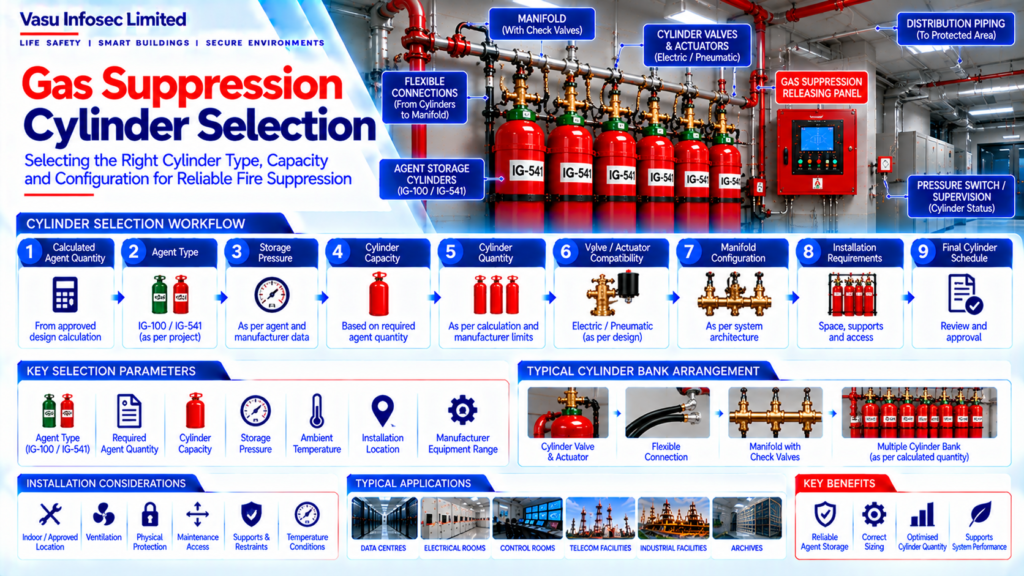
Calculated Agent Quantity → Agent Type → Required Storage Pressure → Cylinder Capacity → Cylinder Quantity → Valve / Actuator Compatibility → Manifold Configuration → Installation Requirements → Final Cylinder Schedule
3. Selection Inputs
Cylinder selection should begin with verified design inputs.
Typical inputs include:
- Extinguishing agent type
- Required agent quantity
- Storage pressure
- Protected volume
- Design concentration
- Required discharge criteria
- Ambient temperature
- Cylinder installation location
- Manufacturer equipment range
4. Agent Compatibility
The selected cylinder should be approved and compatible with the specific extinguishing agent. Cylinder material, internal finish, valve arrangement, pressure rating and filling requirements should comply with the manufacturer’s approved system configuration.
5. Cylinder Capacity
Cylinder capacity should be selected based on the required agent quantity and the manufacturer’s approved filling limits. The selected capacity should allow the required quantity to be stored without exceeding permitted fill or operating conditions.
6. Cylinder Quantity
The required number of cylinders should be determined from the calculated agent quantity and selected cylinder capacity.
The final quantity should also consider:
- Manufacturer configuration limits
- Bank arrangement
- Manifold capacity
- Available installation space
- Maintenance access
7. Storage Pressure
Storage pressure is a key cylinder selection parameter and should correspond to the selected agent and approved system design. The pressure rating of the cylinder, valve, flexible connection and manifold should be compatible with the system operating conditions.
8. Cylinder Valve Selection
The cylinder valve should be compatible with the selected cylinder, agent, storage pressure and actuation arrangement. Valve configuration should support the approved release sequence and associated supervision requirements.
9. Actuation Compatibility
Where automatic release is required, the selected cylinder and valve should be compatible with the approved electric, pneumatic or other actuation method. The actuation arrangement should be coordinated with the releasing control panel and Cause & Effect Matrix.
10. Cylinder Bank Coordination
For multiple-cylinder systems, individual cylinder selection should be coordinated with the complete bank arrangement.
Coordination should include:
- Cylinder capacity
- Quantity
- Valve arrangement
- Flexible connections
- Check valves
- Manifold configuration
- Actuation sequence
11. Temperature Considerations
Cylinder selection should account for the actual and specified operating temperature range. The selected cylinder, valve and stored agent arrangement should remain within the manufacturer’s permitted operating conditions.
12. Installation Location
The cylinder should be suitable for its proposed installation environment. Engineering review should consider:
- Indoor / approved external location
- Ambient conditions
- Accessibility
- Ventilation
- Physical protection
- Maintenance clearance
- Cylinder restraint requirements
13. Supports & Restraints
Selected cylinders should be installed using approved brackets, racks or restraints suitable for the cylinder dimensions and system arrangement. The installation should provide secure positioning and allow safe maintenance.
14. Piping & Flow Coordination
Cylinder selection should be coordinated with the approved piping / flow calculation. The selected cylinder capacity, valve, manifold and pressure characteristics should support the required discharge performance.
15. Nozzle Coordination
The cylinder configuration should be compatible with the calculated piping and nozzle arrangement. The final selection should not be isolated from the overall system flow design.
16. Selection Verification
Before final approval, the cylinder selection should be verified against:
- Agent quantity calculation
- Cylinder datasheet
- Manufacturer approval
- Storage pressure
- Fill limits
- Valve compatibility
- Actuation requirements
- Manifold arrangement
- Piping / flow calculation
- Installation conditions
17. Testing & Commissioning
Cylinder selection should be verified during inspection and commissioning.
Checks may include:
- Cylinder identification
- Capacity / rating verification
- Valve and actuator verification
- Pressure supervision
- Bank configuration
- Manifold connection
- Installation restraint
- Cause & Effect release sequence
18. Documentation
Cylinder selection documentation should include, as applicable:
- Cylinder datasheet
- Cylinder schedule
- Agent quantity calculation
- Storage pressure information
- Valve / actuator datasheet
- Manufacturer certification
- Manifold arrangement
- Installation drawing
- Piping / flow calculation
- FAT / SAT records
- Commissioning records
- As-built documentation
19. Common Engineering Considerations
Engineering review should verify:
- Correct agent
- Correct quantity
- Correct cylinder capacity
- Correct cylinder quantity
- Correct storage pressure
- Valve compatibility
- Actuation compatibility
- Temperature suitability
- Bank configuration
- Installation requirements
- Maintenance accessibility
20. Engineering Objective
The engineering objective is:
Accurate Agent Requirement → Appropriate Cylinder Capacity → Correct Cylinder Quantity → Verified Pressure Rating → Compatible Valve & Actuation → Coordinated Cylinder Bank → Validated Piping / Flow Design → Secure Installation → Complete Verification → Reliable Gas Suppression System Performance
Frequently Asked Questions
How is gas suppression cylinder capacity selected?
Capacity is selected from the required agent quantity and the manufacturer’s approved filling limits. The selection should not exceed permitted fill or operating conditions.
How is the number of cylinders determined?
The number is based on the calculated agent quantity and selected cylinder capacity, while considering manufacturer configuration limits, bank arrangement, manifold capacity, available space and maintenance access.
Why must cylinder and valve pressure ratings be checked together?
The cylinder, valve, flexible connection and manifold must be compatible with the system operating conditions and approved configuration.
What installation factors should be reviewed?
Consider the approved location, ambient conditions, accessibility, ventilation, physical protection, maintenance clearance and restraint requirements.
What documents support cylinder selection?
As applicable, retain the cylinder datasheet and schedule, agent quantity calculation, pressure details, valve/actuator datasheets, manufacturer certification, manifold and installation drawings, piping/flow calculations, FAT/SAT and commissioning records, and as-built documentation.
SEO & Publication Metadata
SEO title: Gas Suppression Cylinder Selection Guide | Vasu Infosec
Meta description: Learn how gas suppression cylinders are selected using agent quantity, capacity, storage pressure, valve compatibility, actuation, installation and flow design.
Suggested URL slug: gas-suppression-cylinder-selection
Primary keywords: gas suppression cylinder selection, gas suppression cylinder capacity, cylinder storage pressure, cylinder bank selection, gas suppression valve compatibility
Suggested internal links: Gas Suppression Agent Quantity Calculation; Gas Suppression Cylinder Bank Architecture; Gas Suppression System Design Workflow; Gas Suppression Nozzle Arrangement.