
Article
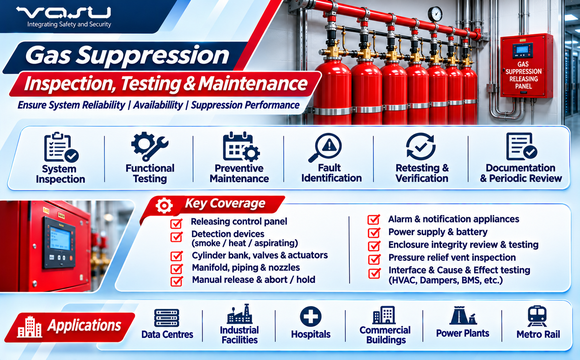
Gas Suppression Inspection, Testing & Maintenance
Oct 2026
Direct Answer
Inspection, testing and maintenance (ITM) help maintain a gas suppression system’s readiness by checking equipment condition, verifying approved functions, identifying faults, completing corrective action and keeping traceable maintenance records. The maintenance cycle should follow the approved system design, manufacturer requirements, project maintenance philosophy and applicable requirements.
1. Engineering Overview
Inspection, testing and maintenance (ITM) of a gas suppression system are essential to maintain system reliability, availability and suppression performance throughout its operational life. The maintenance cycle should be based on the approved system design, manufacturer requirements, project maintenance philosophy and applicable requirements.
2. Maintenance Cycle Architecture
Routine Inspection → Functional Testing → Preventive Maintenance → Fault Identification → Corrective Action → Retesting → Documentation → Periodic Review → Continued System Availability
3. Purpose of Inspection
Routine inspection provides a structured review of the suppression system to identify physical damage, abnormal conditions, faults, leakage paths or other issues that may affect system performance.
4. Routine System Inspection
Inspection may include:
- Releasing control panel condition
- Power supply status
- Battery condition
- Detection devices
- Manual release station
- Abort / hold station, where applicable
- Alarm notification appliances
- Cylinder bank
- Valves and actuators
- Manifold
- Piping
- Discharge nozzles
- Pressure supervision
5. Cylinder & Valve Inspection
Cylinders, valves and actuators should be inspected for physical condition, identification, accessibility and signs of damage or abnormal condition. Pressure supervision, where provided, should be checked for correct status indication.
6. Piping & Nozzle Inspection
The distribution network should be inspected for:
- Pipe damage
- Corrosion or deterioration
- Loose supports
- Damaged fittings
- Nozzle displacement
- Obstruction of discharge paths
- Incorrect or missing identification
- Unauthorised modifications
7. Detection System Testing
Automatic detection devices should be functionally tested in accordance with the approved maintenance procedure.
Testing may include:
- Smoke detection
- Heat detection
- Aspirating detection interface
- Manual release
- Alarm indication
- Fault indication
8. Releasing System Testing
The releasing system should be tested to verify correct operation without unintended agent discharge where a simulated test is permitted.
Checks may include:
- Release logic
- Pre-discharge warning
- Release output
- Manual release
- Abort / hold function
- Releasing circuit supervision
9. Alarm & Notification Testing
Audible and visual notification appliances should be checked for correct operation, visibility, audibility and identification as applicable to the installed system.
10. Power Supply & Battery Maintenance
Primary power supply and standby batteries should be inspected and tested according to the approved maintenance requirements.
Checks may include:
- AC supply
- Charger operation
- Battery voltage
- Battery condition
- Battery fault indication
- Standby operation
11. Enclosure Integrity Review
The protected enclosure should be periodically reviewed for changes that may affect agent retention.
The review may include:
- New cable penetrations
- Door changes
- HVAC modifications
- Damper changes
- Partition changes
- Construction alterations
- Other new leakage paths
12. Room Integrity Testing
Where required by the approved system maintenance philosophy, enclosure integrity should be retested to confirm that the protected room continues to provide the required agent retention characteristics.
13. Pressure Relief Vent Inspection
Pressure relief vents and associated dampers / closures should be inspected for physical damage, obstruction, correct installation and required operating condition.
14. Interface Testing
Interfaces with associated building systems should be tested as required.
Potential interfaces include:
- HVAC
- Fire / smoke dampers
- Access control
- Electrical equipment shutdown
- BMS / IBMS
- Fire alarm system
- Remote monitoring
15. Cause & Effect Verification
The approved Cause & Effect Matrix should be periodically reviewed and, where required, tested to confirm that system operation remains consistent with the approved fire strategy and current building configuration.
16. Preventive Maintenance
Preventive maintenance should identify potential failures before they affect suppression performance.
Activities may include:
- Equipment cleaning where permitted
- Battery assessment
- Detector maintenance
- Terminal inspection
- Cylinder / valve condition review
- Panel inspection
- Nozzle inspection
- Support inspection
17. Corrective Maintenance
Defects identified during inspection or testing should be documented, assessed and rectified through the approved maintenance process. Affected functions should be retested after corrective action.
18. System Impairment
Where any part of the suppression system is taken out of service, the approved impairment procedure should be followed. Appropriate coordination, notification and temporary risk controls should be implemented as required.
19. Maintenance Records
Maintenance records should provide traceability of system condition and completed activities.
Records may include:
- Inspection checklist
- Testing results
- Fault reports
- Corrective action records
- Battery test records
- Cylinder / valve inspection records
- Interface test records
- Room integrity reports
- Service reports
- Retest records
20. Documentation
ITM documentation should include, as applicable:
- Approved maintenance schedule
- Inspection checklists
- Testing procedures
- Equipment schedules
- Cylinder schedule
- Nozzle schedule
- Cause & Effect Matrix
- Test reports
- Defect / corrective action reports
- Room integrity records
- Service records
- Updated as-built documentation
21. Engineering Objective
The engineering objective is:
Routine Inspection → Reliable Functional Testing → Preventive Maintenance → Early Fault Detection → Corrective Action → Retesting → Complete Documentation → Continuous System Availability → Reliable Gas Suppression Life-Safety Performance
Frequently Asked Questions
What does ITM mean for a gas suppression system?
ITM means inspection, testing and maintenance. It covers checks of system condition, functional verification, preventive work, corrective action and recordkeeping.
What should routine inspection cover?
Depending on the installed system and approved procedure, checks may include the releasing panel, power and batteries, detectors, manual release and abort/hold stations, alarms, cylinder bank, valves, manifold, piping, nozzles and pressure supervision.
How should releasing-system testing be performed?
Testing should follow the approved maintenance procedure and should avoid unintended agent discharge; simulated testing should be used where permitted.
When should room integrity be retested?
The source document states that retesting should be performed where required by the approved system maintenance philosophy.
What should happen when a defect is found?
Document and assess the defect, rectify it through the approved maintenance process, and retest affected functions after corrective action.
What is required when the system is impaired?
Follow the approved impairment procedure, including appropriate coordination, notification and temporary risk controls as required.
SEO & Website Publishing Details
SEO title: Gas Suppression Inspection, Testing and Maintenance (ITM) Guide
Meta description: Learn the key inspection, testing and maintenance activities for gas suppression systems, including detection, releasing logic, batteries, enclosure integrity, corrective action and records.
Suggested URL slug: gas-suppression-inspection-testing-maintenance
Primary keyword: gas suppression inspection testing maintenance
Related keywords: gas suppression ITM; gas suppression preventive maintenance; releasing system testing; enclosure integrity testing; gas suppression maintenance records
Suggested internal links: Gas Suppression System Architecture; Gas Suppression FAT, SAT and Commissioning; Room Integrity / Enclosure Integrity Testing; Gas Suppression Faults and Troubleshooting; Gas Suppression Pressure Relief Venting