
Article
Gas Suppression Pressure Relief Venting
Oct 2026
Direct Answer
Pressure relief venting is an engineered provision for managing pressure changes that may occur inside a protected enclosure during gaseous extinguishing-agent discharge. Vent sizing, location and operation should follow the approved engineering calculation, manufacturer design criteria and coordinated enclosure design while preserving required suppression performance.
1. Engineering Overview
Pressure relief venting is an engineered provision used to manage pressure changes that may occur inside a protected enclosure during discharge of a gaseous extinguishing agent. The venting arrangement should limit excessive pressure effects while maintaining the required enclosure performance and suppression effectiveness.
2. Pressure Relief Architecture
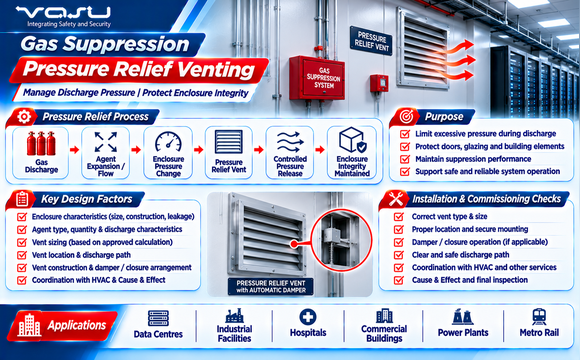
Gas Discharge → Rapid Agent Expansion / Flow → Enclosure Pressure Change → Pressure Relief Vent → Controlled Pressure Release → Protected Enclosure Integrity Maintained
3. Need for Pressure Assessment
Agent discharge can create a transient pressure condition within a protected enclosure. The pressure effect should be assessed during system design, particularly for tightly sealed rooms, large agent quantities and high-rate discharge systems.
4. Protected Enclosure Assessment
Pressure relief design should consider the actual enclosure characteristics.
Inputs may include:
- Pressure relief design should consider the actual enclosure characteristics.
5. Agent Discharge Characteristics
The pressure effect depends on the selected suppression agent, quantity, discharge characteristics and system configuration. The approved manufacturer design methodology should be used to establish the expected pressure behaviour.
6. Pressure Relief Vent Function
The pressure relief vent provides a controlled path for pressure generated during agent discharge to dissipate. The vent should be selected and positioned so that it performs its intended pressure-management function without creating an unacceptable leakage path.
7. Vent Sizing
Pressure relief vent sizing should be determined from the approved engineering calculation and manufacturer design criteria. Vent size should not be selected solely from room area; agent discharge characteristics, enclosure pressure limits and other design inputs should be considered.
8. Vent Location
Vent location should be coordinated with the protected enclosure and building services. The installation should provide a suitable discharge path and avoid interference with equipment, structural members and other services.
9. Vent Construction
Pressure relief vents should be suitable for the expected operating conditions and compatible with the enclosure construction. Construction, frame, louvre / damper arrangement and associated components should follow the approved design.
10. Vent Closure / Damper Arrangement
Where a pressure relief vent uses an approved automatic closure or damper arrangement, the device should permit the required pressure relief during discharge while returning to the required condition after the pressure event.
11. Enclosure Integrity Coordination
Pressure relief and enclosure integrity must be considered together. The vent should remain appropriately controlled during normal conditions and should perform as intended during discharge without unnecessarily compromising agent retention.
12. HVAC Coordination
HVAC openings and dampers can influence enclosure pressure and agent retention. The suppression Cause & Effect sequence should coordinate HVAC shutdown / damper operation with the pressure relief design.
13. Structural Considerations
The enclosure and associated building elements should be assessed for the pressure effects associated with agent discharge. Pressure relief provisions should support the approved structural and fire protection design.
14. Installation Requirements
Installation should verify:
- Installation should verify:
15. Testing & Commissioning
Pressure relief provisions should be inspected and functionally verified where applicable.
Checks may include:
- Visual inspection
- Vent identification
- Mounting verification
- Damper / closure verification
- Interface verification, where applicable
- Cause & Effect review
- Final installation inspection
16. Design Change Control
Any change to enclosure construction, room volume, HVAC arrangement, door configuration, vent location or vent size should be reviewed for its impact on the pressure relief design and approved suppression calculations.
17. Common Engineering Considerations
Engineering review should verify:
- Engineering review should verify:
18. Documentation
Pressure relief documentation should include, as applicable:
- Pressure relief documentation should include, as applicable:
19. Engineering Objective
The engineering objective is:
The engineering objective is:
Frequently Asked Questions
What is pressure relief venting in a gas suppression system?
It is an engineered provision that provides a controlled path for pressure generated during agent discharge to dissipate.
How is a pressure relief vent sized?
The source document states that sizing should be based on approved engineering calculations and manufacturer design criteria, considering discharge characteristics, enclosure pressure limits and other design inputs—not room area alone.
Why must enclosure integrity be considered with pressure relief?
The vent must perform during discharge without unnecessarily compromising agent retention or the protected enclosure’s required performance.
Does HVAC operation affect pressure relief design?
Yes. HVAC openings and dampers can influence enclosure pressure and agent retention, so their operation should be coordinated with the suppression Cause & Effect sequence.
What should be checked during installation?
Verify the approved vent type, size/configuration, location, mounting, discharge path, applicable damper/closure operation, and coordination with enclosure construction and other services.
What happens if the room or vent design changes?
Changes to enclosure construction, room volume, HVAC, doors, vent location or vent size should be reviewed for their impact on pressure relief and approved suppression calculations.
SEO & Website Publishing Details
| SEO title | Gas Suppression Pressure Relief Venting: Design and Installation |
| Meta description | Learn how pressure relief venting is assessed and coordinated in gas suppression systems, including vent sizing, enclosure integrity, HVAC coordination, installation and documentation. |
| Suggested URL slug | /gas-suppression-pressure-relief-venting/ |
| Primary keyword | gas suppression pressure relief venting |
| Related keywords | pressure relief vent sizing; gas suppression enclosure pressure; clean agent room pressure relief; HVAC damper coordination; enclosure integrity |
| Suggested internal links | Gas Suppression System Design Workflow; Gas Suppression Enclosure Integrity; Gas Suppression Agent Quantity Calculation; Gas Suppression Piping Network Design & Installation; Gas Suppression Nozzle Arrangement & Coverage |