
Article
Gateway & Protocol Conversion
Oct 2026
Direct Answer
This engineering guide explains how gateways connect building systems using different protocols and how point mapping, data conversion, communication diagnostics and commissioning support controlled IBMS integration.
1. Engineering Overview
Gateway and Protocol Conversion provides the interface between building systems that use different communication protocols, data structures or network architectures. A gateway enables controlled exchange of approved monitoring, alarm, status and authorised control information between otherwise incompatible systems.
2. Complete Gateway Architecture
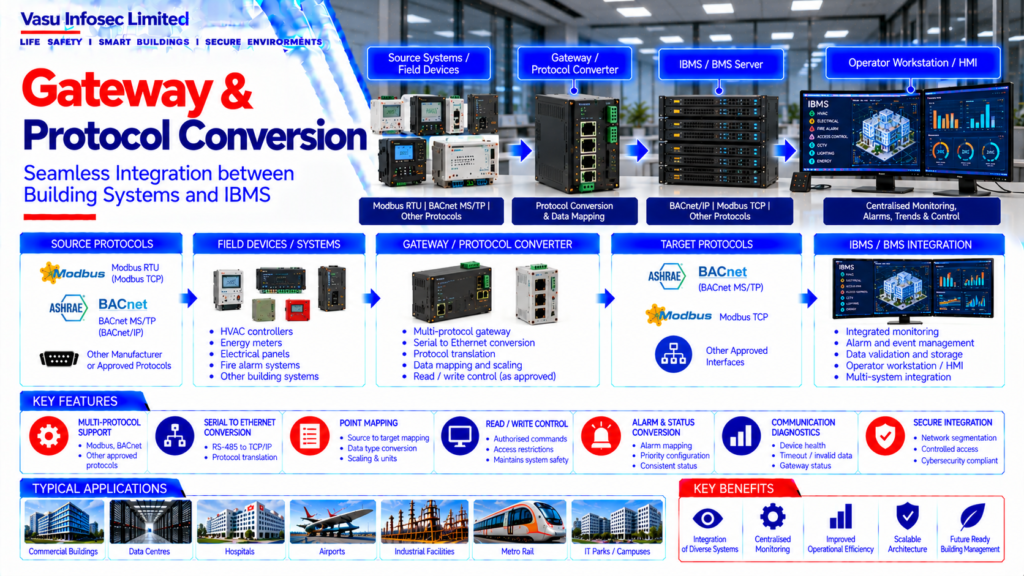
Source System / Field Devices → Native Protocol Network → Gateway / Protocol Converter → Target Protocol Network → IBMS / BMS Server → Database / Historian → Operator Workstation / HMI
3. Gateway Function
A gateway receives data from a source system, interprets the relevant communication objects or registers, converts them into the required target format and exposes the approved points to the receiving system.
4. Protocol Conversion
Protocol conversion may be required between technologies such as Modbus RTU, Modbus TCP, BACnet MS/TP, BACnet/IP and other manufacturer-specific or approved interfaces. The selected gateway should support the required protocols and data exchange functions.
5. Source & Target Definition
Every gateway application should clearly identify the source protocol, source devices, source addresses, target protocol, target network and destination system. This information should be documented before configuration.
6. Point Mapping
Point mapping establishes the relationship between source data and target data. Each point should have a defined source address / object, target point, data type, engineering unit, scaling, status interpretation and read / write permission.
7. Data Type Conversion
Gateways may convert data types where required, such as integer, floating-point, Boolean or multi-state information. Conversion should preserve the intended engineering meaning of the source data.
8. Scaling & Engineering Units
Measured values may require scaling or unit conversion before presentation in IBMS. Scaling factors, offsets, decimal positions and engineering units should be verified against the source equipment documentation.
9. Read & Write Control
The integration matrix should identify which points are read-only and which points may receive commands. Write commands should be restricted to authorised functions and should not bypass dedicated equipment safety or local control logic.
10. Alarm & Status Conversion
Source alarms and statuses should be mapped to appropriate target states. Alarm descriptions, priorities, normal states and abnormal states should be defined consistently in the integration point list.
11. Communication Health
The gateway should provide an appropriate mechanism to identify loss of source communication, target communication failure, device timeout, invalid data or gateway fault. Communication health should be monitored where required.
12. Gateway Network Architecture
Gateways may have serial ports, Ethernet interfaces, fibre interfaces or other approved communication interfaces. Network addressing, routing, segmentation and physical connectivity should follow the approved project architecture.
13. Serial-to-Ethernet Conversion
A gateway may convert a serial protocol such as Modbus RTU or BACnet MS/TP into an Ethernet-based protocol such as Modbus TCP or BACnet/IP. Serial parameters and Ethernet configuration should both be verified.
14. Multi-Protocol Integration
Some gateways support multiple source protocols or multiple target interfaces. The configuration should avoid unnecessary protocol complexity and should expose only the approved data points.
15. Data Refresh & Polling
Polling intervals, update rates and communication loads should be configured according to the source system capabilities and project requirements. Excessive polling should be avoided to maintain stable communication.
16. Gateway Redundancy
Where the application requires high availability, redundant gateways, communication paths or power supplies may be considered. The redundancy arrangement should be defined during detailed design.
17. Cybersecurity
Gateway devices should be incorporated into the approved cybersecurity architecture. Network access, credentials, configuration interfaces, remote access and communication paths should be controlled according to project requirements.
18. Installation Requirements
Installation should verify:
- Correct gateway model
- Correct source protocol
- Correct target protocol
- Correct source addressing
- Correct target addressing
- Correct serial parameters
- Correct IP configuration
- Correct point mapping
- Correct scaling and units
- Correct alarm mapping
- Correct read / write permissions
- Proper network segregation
19. Testing & Commissioning
Gateway commissioning should verify:
- Source device communication
- Target system communication
- Protocol conversion
- Point mapping
- Data types
- Scaling
- Engineering units
- Alarm and status mapping
- Approved commands
- Communication failure indication
- Data refresh performance
- IBMS graphics
20. Troubleshooting
Typical gateway issues may include incorrect protocol selection, duplicate addresses, incorrect register / object mapping, data type mismatch, scaling errors, serial communication faults, IP configuration errors, routing problems, unsupported commands and communication timeouts.
21. Maintenance
Maintenance should include gateway health checks, communication diagnostics, configuration backup, point verification, network checks, firmware / software maintenance where approved and periodic review of critical interfaces.
22. Design Change Control
Changes to source devices, target systems, protocols, gateway configuration, point mapping, network architecture, scaling or command permissions should be reviewed against the approved integration architecture before implementation.
23. Documentation
Gateway and protocol conversion documentation should include, as applicable:
- Integration architecture
- Gateway schedule
- Source / target protocol matrix
- Device schedule
- Point mapping table
- Register / object mapping
- Scaling and units schedule
- Alarm mapping
- Network topology
- Gateway configuration details
- Testing and commissioning records
- As-built drawings
- O&M manual
24. Engineering Objective
The engineering objective is:
Correct Source Interface → Accurate Protocol Interpretation → Controlled Data Conversion → Verified Point Mapping → Correct Scaling & Status → Secure Target Communication → Reliable IBMS Integration → Complete Testing → Maintainable Gateway Architecture
Website Publishing Metadata
| SEO title | Gateway and Protocol Conversion in IBMS | Engineering Guide |
| Meta description | Learn how IBMS gateways convert protocols, map points, validate data and support secure integration between building systems. |
| Suggested URL slug | gateway-protocol-conversion-ibms |
| Primary topic / keywords | IBMS gateway, protocol conversion, Modbus RTU, Modbus TCP, BACnet MS/TP, BACnet/IP, point mapping, building automation integration |
| Image alt text | IBMS gateway and protocol conversion architecture connecting field devices, source and target protocols, and the supervisory server |
Frequently Asked Questions
What is gateway and protocol conversion in IBMS?
It is the controlled exchange of approved data between building systems that use different communication protocols, data structures or network architectures.
Which protocols may be connected through a gateway?
Depending on device and gateway support, examples include Modbus RTU, Modbus TCP, BACnet MS/TP, BACnet/IP and approved manufacturer-specific interfaces.
What should a gateway point map contain?
It should define source and target points, data types, engineering units, scaling, status interpretation and read/write permissions.
Why is data scaling important?
Incorrect scaling or unit conversion can cause displayed values to differ from the source equipment data.
Can IBMS issue commands through a gateway?
Only where commands are explicitly authorised in the approved integration matrix; they must not bypass dedicated equipment safety or local control logic.
What should be tested during gateway commissioning?
Source and target communication, protocol conversion, point mapping, data types, scaling, alarms, authorised commands, communication failure indication and data refresh performance.