
Article
High-Pressure Water Mist: Working Principle
Oct 2026
Direct Answer
A high-pressure water mist system uses an engineered pressure source and specially designed nozzles to convert pressurised water into fine droplets. Depending on the approved hazard application and system design, these droplets can absorb heat and contribute to fire control or suppression.
1. Engineering Overview
A high-pressure water mist system uses water at an engineered high pressure to produce finely divided droplets through specially designed nozzles. The resulting water mist provides fire control, suppression or extinguishing performance depending on the approved application, hazard, nozzle technology and system design.
2. Working Principle Architecture
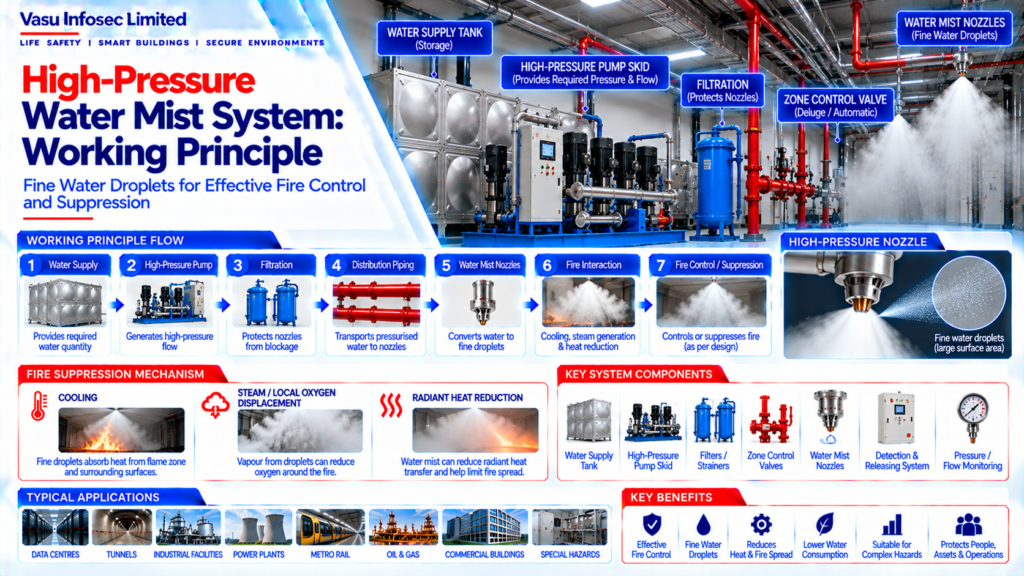
Water Source → High-Pressure Pump / Pressure Source → Filtration → High-Pressure Distribution Piping → High-Pressure Water Mist Nozzles → Fine Droplet Formation → Fire Interaction → Cooling / Oxygen Displacement / Radiant Heat Reduction → Fire Control / Suppression
3. High-Pressure Water Mist Generation
The system generates high-pressure water flow and delivers it to specially engineered nozzles. The nozzle converts the pressurised water into fine droplets through its internal discharge geometry and orifice arrangement.
4. Droplet Formation
Fine water droplets provide a large surface area relative to their volume. When exposed to the heat of a fire, the droplets absorb heat and may vaporise, contributing to cooling and reduction of the energy available to sustain combustion.
5. Fire Cooling Mechanism
One of the primary effects of water mist is cooling. Fine droplets can absorb significant heat from the flame zone and surrounding surfaces, reducing temperatures and helping limit fire development.
6. Steam / Local Oxygen Displacement
When water droplets absorb sufficient heat and vaporise, the resulting steam can contribute locally to displacement of oxygen around the fire. The relative contribution depends on the system design, enclosure conditions and fire scenario.
7. Radiant Heat Reduction
Water mist can reduce radiant heat transfer by interacting with the flame and hot gases. This can help protect surrounding equipment and limit fire spread where the system has been specifically designed and tested for the application.
8. High-Pressure Pump Function
The high-pressure pump or pressure source supplies the flow and pressure required by the water mist system. Pump selection should be based on the approved hydraulic calculation, nozzle requirements, zone demand and system operating conditions.
9. Filtration Function
High-pressure water mist nozzles may contain small flow passages that require protection from contaminants. Appropriate filtration should therefore be provided where specified by the approved system design and manufacturer requirements.
10. Piping Network
The high-pressure distribution network transports water from the pressure source to the water mist nozzles. Pipe material, pressure rating, dimensions, routing, fittings and supports should be compatible with the operating pressure and approved design.
11. Nozzle Function
The nozzle is a critical component that converts the high-pressure water flow into the required mist discharge pattern. Nozzle type, orifice, operating pressure, spray angle, quantity, orientation and spacing should be established from the approved system design.
12. Detection & Release Sequence
A typical automatic sequence is:
Fire Detection → Signal to Releasing / Control Panel → Alarm & Cause-and-Effect Actions → Zone Valve / Pump Activation → Pressurised Water Flow → Nozzle Discharge → Water Mist Formation → Fire Control / Suppression
13. Open Nozzle Arrangement
In an open-nozzle system, the nozzles are normally open and water is released when the associated detection and control sequence operates the zone control or deluge arrangement.
14. Closed / Automatic Nozzle Arrangement
Where closed or automatic nozzles are used, the nozzle operating mechanism responds to the local thermal condition in accordance with the approved nozzle design. The overall system architecture should match the selected nozzle technology.
15. Pressure & Flow Relationship
The required nozzle performance depends on the available operating pressure and flow. The system should therefore be hydraulically calculated to confirm that the design pressure and flow are available at the hydraulically most demanding nozzle or zone.
16. Coverage & Distribution
Nozzle coverage is application-specific and should be established from approved manufacturer design criteria and applicable fire testing / listing. Room geometry, hazard configuration, ceiling height and obstructions should be considered.
17. Application-Specific Performance
High-pressure water mist performance is dependent on the fire hazard, fuel type, enclosure characteristics, nozzle technology, discharge density, pressure and application-specific system testing. A system should not be assumed suitable for a hazard solely because it uses high-pressure water mist.
18. Installation Requirements
Installation should verify:
- Correct high-pressure pump / pressure source
- Correct filtration
- Correct pipe material and pressure rating
- Correct valve arrangement
- Correct nozzle type
- Correct nozzle location and orientation
- Secure pipe supports
- Correct detection and control wiring
19. Testing & Commissioning
Commissioning should verify:
- Pump operation
- Pressure and flow
- Zone valve operation
- Detection sequence
- Release logic
- Alarm indication
- Nozzle installation
- Interface operation
- Drain / test arrangement
- Cause & Effect sequence
20. Documentation
Documentation should include, as applicable:
- Design basis
- System schematic
- Pump datasheet
- Hydraulic calculation
- Piping drawings
- Nozzle datasheet and schedule
- Zone control arrangement
- Detection / Cause and Effect Matrix
- Testing and commissioning records
- As-built drawings
- O&M manual
21. Engineering Objective
The engineering objective is:
Correct Hazard Assessment → High-Pressure Water Generation → Controlled Flow & Filtration → Engineered Piping → Correct Nozzle Atomisation → Fine Droplet Formation → Effective Heat Absorption → Fire Control / Suppression → Verified System Performance
Frequently Asked Questions
How does a high-pressure water mist system work?
A pressure source delivers water to specially engineered nozzles, which form fine droplets. Depending on the application and system design, the droplets absorb heat and contribute to fire control or suppression.
Why are fine droplets used?
Fine droplets provide a large surface area relative to their volume, supporting heat absorption and possible vaporisation when exposed to fire heat.
What does the high-pressure pump do?
It supplies the flow and pressure required by the system; selection should follow the approved hydraulic calculation and nozzle and zone requirements.
Why is filtration important?
Filtration can protect small nozzle flow passages from contaminants where required by the approved system design and manufacturer instructions.
Are all hazards suitable for high-pressure water mist?
No. Suitability depends on the hazard, fuel, enclosure, nozzle technology, operating conditions and application-specific testing. High pressure alone does not establish suitability.
How is nozzle coverage determined?
Coverage is application-specific and should follow approved manufacturer criteria and applicable fire testing/listing, considering room geometry, hazard configuration, ceiling height and obstructions.
SEO & Website Publishing Details
SEO title: High-Pressure Water Mist System: Working Principle and Components
Meta description: Learn how high-pressure water mist systems generate fine droplets and use heat absorption, pressure generation, filtration, nozzles and engineered release logic for fire control.
Suggested URL slug: high-pressure-water-mist-working-principle
Primary keyword: high-pressure water mist working principle
Related keywords: high-pressure water mist system; water mist nozzles; water mist fire suppression; water mist hydraulic calculation; water mist system components
Suggested internal links: Water Mist System: Complete Architecture; Water Mist Nozzle Arrangement and Coverage; Water Mist Hydraulic / Flow Calculation; Fire Detection and Release Logic; Water Mist Testing and Commissioning