
Article
HVAC Integration with IBMS
Oct 2026
Direct Answer
HVAC integration with an Integrated Building Management System (IBMS) connects approved HVAC equipment and local controllers to a central supervisory platform for monitoring, alarms, trending, scheduling and only those control functions defined in the approved integration scope. Dedicated HVAC controllers retain equipment-specific control logic and protection functions.
1. Engineering Overview
HVAC Integration with IBMS establishes the communication and supervisory interface between heating, ventilation and air-conditioning equipment and the central Integrated Building Management System. The integration provides central monitoring, alarm management, trending, scheduling and approved control functions while dedicated HVAC controllers retain equipment-specific control logic.
2. Integration Architecture
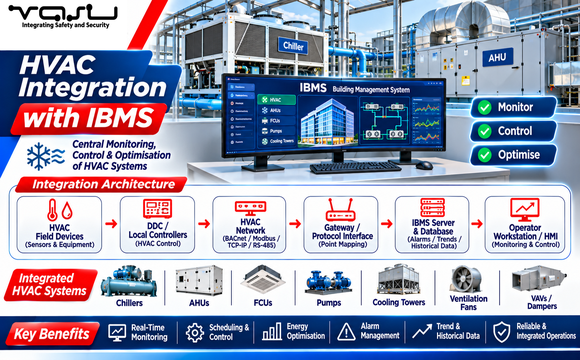
HVAC Field Sensors / Equipment → DDC / Local Controllers → HVAC Network → Gateway / Protocol Interface → IBMS Server → Database → Operator Workstation / HMI
Typical Equipment → Chillers → AHUs → FCUs → Pumps → Cooling Towers → Fans → VAVs / Dampers → Sensors & Actuators
3. Integration Philosophy
The IBMS should provide supervisory monitoring and only those control functions specifically defined in the approved integration scope. Local HVAC controllers should retain the dedicated control sequences necessary for normal equipment operation and protection.
4. HVAC Equipment Integration
Typical HVAC equipment that may be integrated includes chillers, cooling towers, chilled-water pumps, condenser-water pumps, AHUs, FCUs, ventilation fans, VAVs, dampers, valves and associated sensors. Final integration points should follow the approved equipment schedules.
5. Field Sensors
Common HVAC field inputs may include:
- Supply air temperature
- Return air temperature
- Room temperature
- Relative humidity
- Static pressure
- Differential pressure
- Flow
- Equipment run status
- Equipment fault status
- Valve / damper position
6. Actuators & Control Outputs
Approved IBMS control points may include:
- Equipment enable / disable
- Start / stop command
- Temperature setpoint
- Pressure setpoint
- Valve command
- Damper command
- Fan speed command
- Operating mode
7. Chiller Integration
Chiller integration may include operating status, availability, alarm status, leaving / entering water temperatures, load information, setpoints and other approved parameters. Chiller-specific safety and protection functions should remain within the dedicated chiller control system.
8. AHU Integration
AHU integration may include supply / return air temperature, fan status, filter alarm, damper position, valve position, humidity and other approved operating parameters. The IBMS may execute approved scheduling and enable / disable functions.
9. FCU Integration
FCU integration may provide room temperature, fan status, operating mode, setpoint and valve / fan control where supported by the approved design. The level of integration should be defined in the point schedule.
10. Pump Integration
Chilled-water and condenser-water pumps may be monitored for run status, fault status, speed, pressure and other approved parameters. Lead-lag and sequencing functions should follow the approved HVAC control philosophy.
11. Cooling Tower Integration
Cooling tower fans and associated equipment may be integrated for status, speed, temperature and approved control functions. Equipment protection and dedicated operating logic should remain within the local controller.
12. Ventilation System Integration
Ventilation fans may be monitored and controlled for run status, fault status, speed and approved scheduling. Where ventilation is associated with fire or smoke-control functions, the dedicated life-safety control philosophy shall govern.
13. Control Sequences
HVAC control sequences may include scheduling, temperature control, pressure control, lead-lag operation, equipment staging, interlocking, optimum start / stop and other approved functions. Final sequences should be documented and commissioned against the approved design.
14. Communication Protocols
HVAC systems may communicate with IBMS through BACnet, Modbus, TCP/IP, RS-485 or other approved protocols. Protocol selection and interface configuration should follow the equipment manufacturer’s capabilities and approved project architecture.
15. Gateway & Point Mapping
Where a gateway is required, all integrated points should be mapped against the approved point list. Data type, units, scaling, status states, alarm conditions and writable commands should be verified.
16. Alarm Management
HVAC alarms may include equipment faults, high / low temperature, pressure abnormalities, communication failures, filter alarms and other approved conditions. Alarm priorities and operator response should follow the approved alarm philosophy.
17. Trend & Historical Data
IBMS trending may record temperatures, pressures, flow, energy-related parameters, equipment status and other selected HVAC data. Trend intervals and retention periods should follow project requirements.
18. Energy Management
HVAC data can support energy monitoring and optimisation through equipment runtime, temperatures, flow, load and other approved parameters. Any automatic optimisation strategy should remain within the approved HVAC control boundaries.
19. Installation Requirements
Installation should verify:
- Correct HVAC controllers
- Correct field sensors
- Correct actuators
- Correct communication network
- Correct gateway configuration
- Correct point mapping
- Correct units and scaling
- Correct alarm mapping
- Correct graphics
- Proper cable segregation
- Correct equipment identification
20. Testing & Commissioning
HVAC-IBMS commissioning should verify:
- Sensor values
- Equipment status
- Command operation
- Setpoint changes
- Controller communication
- Gateway communication
- Alarm transmission
- Interlocks
- Control sequences
- Graphics
- Trends
- Schedules
21. Communication Failure & Local Operation
Loss of IBMS communication should be detected and indicated through the approved diagnostic mechanism. HVAC equipment should continue its approved local control functions where designed to do so, without dependence on the supervisory IBMS for essential equipment protection.
22. Maintenance
Maintenance should include sensor calibration / verification, controller checks, network diagnostics, gateway checks, server health, point verification, alarm review and configuration backup. Any changes to control sequences should be documented and retested.
23. Design Change Control
Changes to HVAC equipment, controllers, sensors, communication protocols, point lists, control sequences, network architecture or IBMS graphics should be reviewed against the approved integration design before implementation.
24. Documentation
HVAC-IBMS documentation should include, as applicable:
- HVAC integration architecture
- Equipment schedule
- Point list
- I/O schedule
- Control philosophy
- Sequence of operation
- Network topology
- Gateway mapping
- Alarm matrix
- Graphics schedule
- Testing and commissioning records
- As-built drawings
- O&M manual
25. Engineering Objective
The engineering objective is:
Reliable HVAC Field Data → Local Equipment Control → Secure Communication → Accurate IBMS Integration → Central Monitoring → Approved Supervisory Control → Effective Alarms & Trends → Verified Sequences → Complete Commissioning → Reliable HVAC Management
Frequently Asked Questions
What is HVAC integration with IBMS?
It connects approved HVAC equipment and local controllers to IBMS for central monitoring and selected supervisory functions.
Which HVAC equipment may be integrated?
Depending on the approved project scope, equipment may include chillers, cooling towers, pumps, AHUs, FCUs, ventilation fans, VAVs, dampers, valves and associated sensors.
What information can IBMS monitor?
The source lists examples such as temperatures, humidity, pressure, flow, equipment run/fault status, valve/damper position and approved equipment parameters.
Can IBMS start or stop HVAC equipment?
Only where start/stop, enable/disable, setpoint or other commands are included in the approved integration scope and control philosophy.
Which protocols may be used?
The source mentions BACnet, Modbus, TCP/IP and RS-485, or other approved protocols, subject to equipment capabilities and the project architecture.
What should commissioning verify?
The source lists sensor values, equipment status, commands, setpoints, controller/gateway communication, alarms, interlocks, control sequences, graphics, trends and schedules.
SEO & Publishing Details
| SEO title | HVAC Integration with IBMS | Vasu Infosec |
| Meta description | Learn how HVAC equipment integrates with IBMS for central monitoring, alarms, trends and approved supervisory control while local HVAC controllers retain equipment-specific control logic. |
| Primary keyword | HVAC integration with IBMS |
| Secondary keywords | IBMS HVAC monitoring, HVAC building automation, chiller integration, AHU monitoring, HVAC control interface |
| Suggested URL slug | hvac-integration-with-ibms |
| Suggested image alt text | HVAC equipment and local controllers connected through an approved network and gateway to an IBMS server and operator workstation |