
Article
HVAC Pump Selection
Nov 2026
1. Engineering Overview
HVAC Pump Selection establishes the engineering basis for selecting pumps for chilled-water, condenser-water, heating-water and other HVAC hydronic services. Pump selection should satisfy required flow, total dynamic head, operating range, efficiency, control requirements, redundancy, water quality, reliability and maintainability.
2. Complete HVAC Pump Selection Architecture
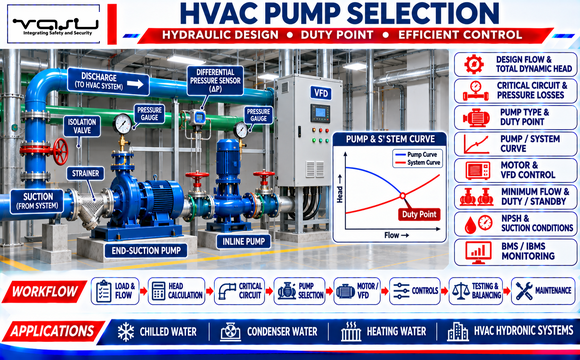
System Load → Design Flow → Circuit Configuration → Pipe Sizing → Static Head → Friction Loss → Equipment Pressure Drop → Control Valve Loss → Required Pump Head → Pump Type → Pump Duty Point → Motor Selection → VFD → Duty / Standby → Controls → BMS / IBMS → Testing & Balancing → Maintenance
3. Design Philosophy
Pumps should be selected close to the required operating point while maintaining adequate margin without excessive oversizing. Selection should consider the complete hydraulic system, variable-flow operation, minimum flow requirements, control strategy and lifecycle energy performance.
4. Pump Application Identification
The application should be identified as chilled-water primary, chilled-water secondary, condenser-water, heating-water, domestic HVAC support or another approved hydronic duty. Each application should have a defined flow, head and operating temperature.
5. Design Flow
Required pump flow should be established from connected equipment loads, design temperature differential and system operating philosophy. Diversity and staging should be considered where applicable.
6. Total Dynamic Head
Pump head should include pipe friction, fittings, valves, strainers, heat exchangers, coils, chillers, cooling towers, control valves and other equipment pressure losses in the critical hydraulic path.
7. Static Head Assessment
Closed-loop HVAC systems generally require consideration of system pressure and component losses rather than simply adding building elevation as pump head. Open systems and pressure-dependent arrangements should be assessed separately.
8. Pipe Friction Loss
Pipe sizing and friction calculations should establish pressure losses at the design flow. Excessive velocity and pressure drop should be avoided to control energy consumption and noise.
9. Fittings & Valve Losses
Elbows, tees, reducers, isolation valves, check valves, balancing valves, strainers and control valves should be included in the hydraulic calculation using appropriate loss coefficients or manufacturer data.
10. Equipment Pressure Drop
Pressure drops through chillers, AHU coils, heat exchangers, cooling towers and other connected equipment should be taken from approved equipment selection data.
11. Critical Circuit
Pump head should be based on the hydraulically critical circuit under the relevant operating condition. The selected pump should provide required flow at the calculated system resistance.
12. Pump Type Selection
End-suction, inline, split-case, vertical turbine or other pump types should be selected according to flow, head, space, temperature, maintenance and system requirements.
13. Pump Duty Point
The selected pump should operate near an efficient region of its performance curve at the design duty point. The pump curve should demonstrate adequate capacity over the expected operating range.
14. Pump Curve & System Curve
Pump selection should be evaluated against the system resistance curve. The intersection of pump and system curves should provide the required operating point without unstable operation.
15. Efficiency
Pump efficiency and motor efficiency should be considered as part of lifecycle energy performance. Selection should avoid excessive throttling or unnecessary head.
16. Motor Selection
Motor rating should be adequate for the selected pump duty and operating range. Motor service conditions, starting requirements, ambient conditions and electrical supply should be considered.
17. Variable Frequency Drive
Variable-frequency drives should be considered for variable-flow HVAC systems. VFD control should maintain required differential pressure or flow while minimising pump energy consumption.
18. Minimum Flow
Minimum allowable pump and equipment flow should be established from manufacturer requirements. Bypass or minimum-flow arrangements should be provided where required.
19. Duty / Standby Arrangement
Critical HVAC systems should use duty / standby or other redundancy arrangements where continuity of service is required. Automatic changeover and failure indication should be defined.
20. Parallel Pump Operation
Where multiple pumps operate in parallel, pump curves, staging, check valves and control logic should be coordinated to ensure stable flow sharing and efficient operation.
21. Series Pump Operation
Where pumps operate in series, total head requirements, pressure ratings, control logic and equipment limits should be assessed to avoid excessive pressure.
22. Pump Materials
Pump casing, impeller, shaft, seals and other wetted components should be compatible with the fluid, temperature, water-treatment regime and operating environment.
23. Mechanical Seals & Bearings
Mechanical seals, bearings and associated components should be suitable for the expected operating conditions and maintenance strategy.
24. Pump Base & Vibration Isolation
Pump installation should provide suitable supports, alignment, flexible connections and vibration isolation to limit transmission of vibration to piping and building structures.
25. Piping Interface
Pump suction and discharge piping should be coordinated to minimise turbulence and avoid adverse hydraulic conditions. Straight-run requirements, reducers, strainers and valves should follow the selected pump arrangement.
26. Suction Conditions
Pump suction conditions should be assessed to prevent cavitation. Net positive suction head requirements, fluid temperature and suction losses should be considered where applicable.
27. Control Valve & Differential Pressure Interface
Pump control should be coordinated with terminal control valves and system differential pressure. Excessive differential pressure should be avoided at low-load conditions.
28. Controls & Automation
Pump controls should include start / stop logic, speed control where applicable, lead / lag sequencing, differential-pressure control, flow monitoring, fault indication and protective interlocks.
29. BMS / IBMS Integration
Pump status, speed, flow, pressure, alarms and energy information should be integrated with BMS / IBMS where required.
30. Electrical Interface
Pump motors, VFDs, starters, protection devices and control panels should be coordinated with electrical distribution and the applicable power-quality requirements.
31. Installation Requirements
HVAC pump installation should verify:
- Correct pump duty
- Correct flow
- Correct head
- Correct pump type
- Correct pump orientation
- Correct motor rating
- Correct VFD / starter
- Correct suction arrangement
- Correct discharge arrangement
- Correct valves
- Correct strainers
- Correct flexible connections
- Correct vibration isolation
- Correct supports
- Correct minimum-flow provision
- Correct redundancy
- Correct controls
- Correct BMS / IBMS interface
- Correct electrical supply
- Correct access for maintenance
32. Testing & Commissioning
Pump commissioning should verify:
- Pump rotation
- Flow rate
- Differential pressure
- Pump head
- Motor current
- VFD operation
- Control response
- Lead / lag sequencing
- Minimum-flow protection
- Valve operation
- Vibration / noise where required
- BMS / IBMS status
- Failure indication
33. Hydraulic Balancing
The hydronic system should be balanced to achieve approved design flows at connected equipment. Pump operating points should be verified after balancing and final system resistance is established.
34. Performance Verification
Actual pump flow, differential pressure, speed, motor load and operating condition should be compared with approved selection data. Any significant deviation should be investigated before final acceptance.
35. Integrated HVAC Testing
Pump operation should be tested with chillers, cooling towers, AHUs, control valves, differential-pressure sensors, BMS / IBMS and associated electrical systems under representative load conditions.
36. Maintenance
Preventive maintenance should include inspection of seals, bearings, couplings, alignment, strainers, valves, motor condition, VFDs, vibration, operating pressures and flow performance.
37. Impairment Management
Any impairment affecting a critical HVAC pump should be formally controlled. Standby equipment or temporary arrangements should be confirmed where required.
38. Failure & Recovery
The system should address pump failure, motor failure, VFD failure, power loss, sensor failure, low-flow conditions and communication loss. Automatic or manual changeover should restore required hydraulic service.
39. Design Change Control
Changes to HVAC loads, pipe sizes, equipment pressure drops, control valves, system configuration or operating temperatures should trigger a review of pump flow, head and selection.
40. Documentation
HVAC pump documentation should include, as applicable:
- Pump selection basis
- Design flow calculations
- Head-loss calculations
- Critical-circuit calculation
- Pump schedule
- Pump curves
- System curves
- Motor schedule
- VFD schedule
- Pipe-sizing calculations
- Valve / strainer schedule
- Equipment pressure-drop data
- Minimum-flow requirements
- Duty / standby philosophy
- Controls philosophy
- BMS / IBMS interface
- Electrical interface
- Equipment datasheets
- Installation records
- Hydraulic balancing reports
- Testing and commissioning records
- Performance verification reports
- Maintenance schedule
- Impairment records
- As-built drawings
- O&M manual
41. Engineering Objective
The engineering objective is:
Establish HVAC Load & Design Flow → Identify Hydraulic Circuit → Calculate Pipe, Fitting & Equipment Losses → Determine Critical Circuit & Required Head → Select Appropriate Pump Type → Verify Pump Curve & Duty Point → Select Motor & VFD → Establish Redundancy & Minimum-Flow Protection → Integrate Controls & BMS / IBMS → Install & Align Equipment → Test, Balance & Verify Performance → Maintain Efficient, Reliable & Maintainable HVAC Pumping
Frequently Asked Questions
What is covered under 1. Engineering Overview?
HVAC Pump Selection establishes the engineering basis for selecting pumps for chilled-water, condenser-water, heating-water and other HVAC hydronic services. Pump selection should satisfy required flow, total dynamic head, operating range, efficiency, control requirements, redundancy, water quality, reliability and maintainability.
What is covered under 2. Complete HVAC Pump Selection Architecture?
System Load → Design Flow → Circuit Configuration → Pipe Sizing → Static Head → Friction Loss → Equipment Pressure Drop → Control Valve Loss → Required Pump Head → Pump Type → Pump Duty Point → Motor Selection → VFD → Duty / Standby → Controls → BMS / IBMS → Testing & Balancing → Maintenance
What is covered under 3. Design Philosophy?
Pumps should be selected close to the required operating point while maintaining adequate margin without excessive oversizing. Selection should consider the complete hydraulic system, variable-flow operation, minimum flow requirements, control strategy and lifecycle energy performance.