
Article
IBMS Server & Workstation Architecture
Oct 2026
Direct Answer
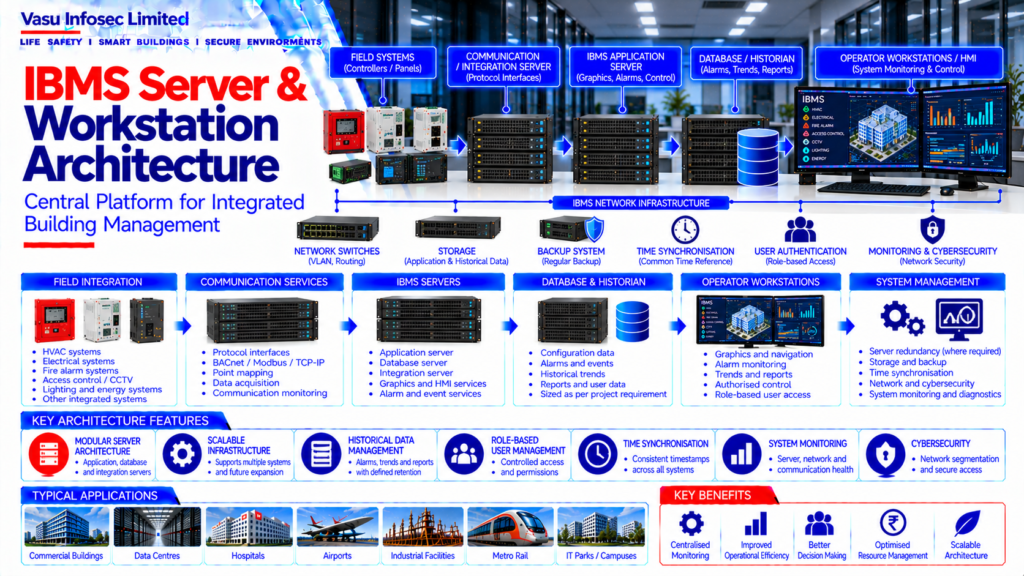
IBMS server and workstation architecture defines the computing infrastructure that hosts the Integrated Building Management System application, databases, communication services, historical data, alarm management, graphics and operator interfaces. It connects field systems and integration services with servers, databases and authorised operator workstations through the approved network architecture.
1. Engineering Overview
IBMS Server & Workstation Architecture defines the central computing infrastructure required to host the Integrated Building Management System application, databases, communication services, historical data, alarm management, graphics and operator interfaces. The architecture establishes the relationship between field systems, integration servers, databases, operator workstations and the approved network infrastructure.
2. Complete Server & Workstation Architecture
Field Controllers / Integrated Systems → Building Automation Network → Communication / Integration Services → IBMS Application Server → Database / Historian → Operator Workstations / HMI
3. Server Architecture
IBMS server architecture may include application servers, database servers, communication / integration servers, web servers and other project-defined services. The final arrangement should be based on system capacity, availability, cybersecurity and project requirements.
4. Application Server
The application server hosts the IBMS supervisory application and associated services required for system monitoring, graphics, alarms, trends, reports and authorised control functions.
5. Database Server
The database server stores system configuration, alarms, events, trends, historical values, user information and other approved application data. Database capacity and retention should be sized according to the project requirements.
6. Communication / Integration Server
Where a dedicated communication server is provided, it manages communication with field controllers, gateways and integrated building systems. Communication services should be configured according to the approved protocol and point-mapping requirements.
7. Server Redundancy
Where high availability is required, redundant servers, clustered services, replicated databases or standby systems may be provided. The redundancy strategy should be defined during detailed design and verified during commissioning.
8. Server Capacity
Server sizing should consider the number of integrated systems, total points, alarm rates, historical data volume, number of concurrent users, graphics requirements, reporting functions and required response times.
9. Storage Architecture
Storage capacity should support application data, historical records, configuration files, event logs and approved backup requirements. Storage utilisation should be monitored to prevent loss of system performance or historical data.
10. Backup Architecture
Backup arrangements should cover IBMS databases, application configuration, graphics, point databases, gateway configurations and other critical system files. Backup frequency, retention and restoration procedures should follow the approved project strategy.
11. Operator Workstations
Operator workstations provide authorised personnel with access to IBMS graphics, alarms, trends, reports and approved control functions. Workstations should be configured according to the approved display, software and network requirements.
12. Workstation Distribution
Workstations may be located in control rooms, facility management offices, security rooms or other approved locations. Each workstation should have appropriate network connectivity and user permissions.
13. User Management
IBMS access should be controlled through authorised user accounts and role-based permissions. Monitoring, acknowledgement, control, configuration and administrative privileges should be separated according to operational responsibilities.
14. HMI & Graphics Services
The server architecture should support the approved HMI and graphics environment. Graphics, navigation, equipment status, alarms and trends should be accessible to authorised workstations through the designated application architecture.
15. Alarm & Event Services
IBMS servers should process and store approved alarm and event information. Alarm priority, acknowledgement, event logging and escalation functions should follow the approved alarm-management philosophy.
16. Historical Data & Trending
Historical data services should collect and store approved trends such as equipment status, temperatures, pressures, energy values and other building parameters. Data retention should be coordinated with available storage and project requirements.
17. Network Architecture
Servers and workstations should connect through the approved IBMS network architecture. Network segmentation, VLANs, routing, firewall rules and communication paths should follow the project IT and cybersecurity requirements.
18. Time Synchronisation
Servers, workstations and integrated systems should use a coordinated time source where required. Consistent timestamps are important for alarms, events, trends and system diagnostics.
19. Cybersecurity
Server and workstation infrastructure should incorporate approved cybersecurity measures, including secure user authentication, access control, endpoint protection, network segmentation, controlled remote access, patch management and configuration control as applicable.
20. Installation Requirements
Installation should verify:
21. Testing & Commissioning
Server and workstation commissioning should verify:
22. Failure & Recovery
The architecture should define the response to server, database, network or workstation failure. Where redundancy is provided, failover and recovery procedures should be tested. Dedicated field systems should retain their approved local operating functions where designed to do so.
23. Maintenance
Maintenance should include server health monitoring, storage checks, database maintenance, backup verification, workstation inspection, application configuration review, network diagnostics and cybersecurity updates according to approved procedures.
24. Design Change Control
Changes to server hardware, virtual machines, operating systems, databases, application versions, network architecture, workstation configuration, user permissions or backup arrangements should be reviewed against the approved IBMS architecture before implementation.
25. Documentation
IBMS server and workstation documentation should include, as applicable:
26. Engineering Objective
The engineering objective is:
Frequently Asked Questions
What is IBMS server and workstation architecture?
It is the arrangement of servers, databases, communication services, networks and operator workstations that supports the IBMS application and its monitoring, alarm, trend and authorised control functions.
What factors affect IBMS server sizing?
Sizing should consider integrated systems, total points, alarm rates, historical data volume, concurrent users, graphics, reporting and required response times.
Why are backups important in IBMS?
Backups support recovery of databases, application configuration, graphics, point databases, gateway configurations and other critical files. Frequency, retention and restoration should follow the approved project strategy.
Is server redundancy always required?
Not necessarily. Redundant servers, clustered services, replicated databases or standby systems may be provided where high availability is required and should be defined during detailed design.
What should commissioning verify?
Checks may include server availability, application and database operation, communication services, gateway connectivity, point acquisition, alarms, historical data, graphics, permissions, backup and restoration, and network-failure behaviour.
How should IBMS servers and workstations be secured?
They should follow the approved cybersecurity architecture, including authentication, access control, endpoint protection, network segmentation, controlled remote access, patch management and configuration control as applicable.
SEO & Publishing Details
SEO title: IBMS Server and Workstation Architecture | Vasu Infosec Limited
Meta description: Understand IBMS server and workstation architecture, application and database servers, integration services, cybersecurity, backups, commissioning and recovery.
Primary keyword: IBMS server and workstation architecture
Secondary keywords: IBMS application server, IBMS database server, operator workstation, IBMS network architecture, IBMS backup and recovery, IBMS cybersecurity
Suggested URL slug: /ibms-server-workstation-architecture/
Suggested image alt text: IBMS server and workstation architecture showing integration services, application server, database, network and operator HMI