
Article
IBMS Testing, Commissioning & Maintenance
Oct 2026
Direct Answer
IBMS Testing, Commissioning & Maintenance establishes the structured process for verifying that the Integrated Building Management System has been installed, configured, integrated and commissioned in accordance with the approved design. The process confirms field devices, controllers, communication networks, gateways, servers, workstations, graphics, alarms, trends and approved control functions.
1. Engineering Overview
IBMS Testing, Commissioning & Maintenance establishes the structured process for verifying that the Integrated Building Management System has been installed, configured, integrated and commissioned in accordance with the approved design. The process confirms field devices, controllers, communication networks, gateways, servers, workstations, graphics, alarms, trends and approved control functions.
2. Testing & Commissioning Architecture
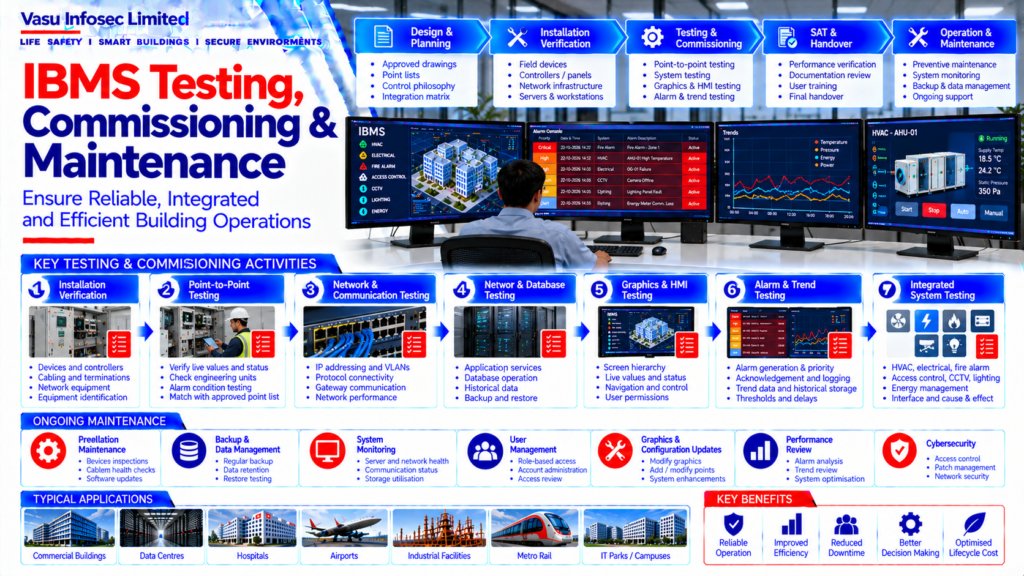
Approved Design & Documentation → Installation Verification → Point-to-Point Testing → Controller Testing → Network Testing → Gateway / Protocol Testing → Server & Database Testing → Graphics / HMI Testing → Alarm & Trend Testing → Integrated Functional Testing → SAT → Handover → Preventive Maintenance
3. Pre-Commissioning Requirements
Before functional commissioning, the following should be verified:
- Approved drawings available
- Equipment schedules available
- Point lists approved
- Control philosophy approved
- Cause and Effect / alarm matrix approved where applicable
- Equipment installed and accessible
- Controllers powered
- Network infrastructure available
- Communication interfaces available
- Software configuration loaded
4. Installation Verification
Installation inspection should verify field devices, controllers, panels, communication cabling, network equipment, gateways, servers, workstations, power supplies, equipment identification, cable termination and physical accessibility against the approved design.
5. Point-to-Point Testing
Each integrated point should be tested from the field device or source equipment through the controller / gateway and into the IBMS. The displayed value, status, alarm condition, engineering unit and point identification should correspond with the approved point list.
6. Sensor Verification
Sensors should be checked for correct identification, installation, signal transmission and displayed engineering value. Where calibration is applicable, readings should be verified against the approved commissioning requirements.
7. Controller Testing
DDC and other local controllers should be tested for power, communication, I/O operation, control logic, interlocks, schedules and approved sequences. Controller operation should remain consistent with the approved control philosophy.
8. Network Testing
Network commissioning should verify physical connectivity, IP addressing, switches, VLANs where applicable, routing, communication paths, protocol connectivity and network performance. Communication failures should be identifiable through approved diagnostics.
9. Gateway & Protocol Testing
Gateways should be tested for source communication, target communication, point mapping, data types, scaling, engineering units, alarm mapping and approved read / write commands.
10. Server & Database Testing
IBMS servers should be tested for application services, database operation, communication services, historical data, alarm processing, user access, backup functions and system performance.
11. Graphics & HMI Testing
Graphics should be verified for hierarchy, equipment identification, live values, status indications, alarms, navigation, trends, commands, setpoints and user permissions. Graphics should correspond with approved drawings and schedules.
12. Alarm Testing
Alarm testing should verify alarm generation, priority, annunciation, acknowledgement, return-to-normal indication, event logging and escalation where applicable. Alarm behaviour should follow the approved alarm philosophy.
13. Trend & Historical Data Testing
Trend testing should verify correct source points, engineering units, sampling intervals, historical storage and graphical presentation. Historical records should accurately represent the source data.
14. Schedule Testing
Approved equipment schedules should be tested for correct start / stop behaviour, operating modes, holidays, overrides and return to normal schedule. Schedule permissions should be verified.
15. Control Sequence Testing
Functional testing should verify approved control sequences including equipment enable / disable, staging, lead-lag operation, interlocks, setpoint control, pressure / temperature control and other project-defined functions.
16. Integrated System Testing
Integrated testing should verify interfaces between IBMS and connected systems such as HVAC, electrical monitoring, energy management, lighting, fire alarm status, access control, CCTV and other approved systems. Each interface should be tested against the approved integration matrix.
17. Communication Failure Testing
Controlled communication-failure tests should verify that loss of a device, gateway, network path or server communication is correctly identified and annunciated. Dedicated local systems should retain their designed local operating functions where applicable.
18. SAT / Functional Acceptance
Site Acceptance Testing should confirm the complete integrated system under representative operating conditions. SAT records should document test results, deviations, corrective actions and final acceptance status.
19. Defect & Punch List Management
Defects identified during commissioning should be recorded in a controlled punch list. Each item should identify the responsible party, required corrective action, status and retest requirement.
20. Retesting & Closure
Corrective actions should be followed by appropriate retesting. A test should be considered closed only after the required functionality has been demonstrated and the result has been documented.
21. Documentation & Handover
Handover documentation should include, as applicable:
- Approved as-built drawings
- Final point list
- Controller schedules
- Network topology
- Gateway / protocol mapping
- Alarm matrix
- Control sequences
- Graphics schedule
- Testing and commissioning records
- SAT records
- Defect closure records
- Software / configuration backup
- O&M manual
22. Preventive Maintenance
Preventive maintenance should include periodic inspection and functional verification of field devices, controllers, network equipment, gateways, servers, workstations, databases, graphics, alarms and communication interfaces.
23. Field Device Maintenance
Sensors, meters, actuators, switches and other field devices should be inspected for physical condition, correct operation, contamination, damage, calibration requirements and communication status.
24. Controller & Panel Maintenance
Controllers and panels should be checked for power supply, indicators, wiring, communication status, controller health, configuration integrity and environmental conditions.
25. Network & Gateway Maintenance
Network switches, gateways and communication interfaces should be checked for communication health, configuration integrity, alarms, cabling condition and approved software / firmware status.
26. Server & Workstation Maintenance
Servers and workstations should be checked for system health, storage capacity, database condition, application services, backups, user access and cybersecurity controls according to the approved maintenance procedure.
27. Backup & Recovery
Current backups of IBMS databases, application configuration, graphics, point databases and gateway configurations should be maintained. Restoration procedures should be periodically verified for critical systems.
28. Alarm Performance Review
Alarm history should be periodically reviewed for nuisance alarms, repeated alarms, communication faults, stale points and inappropriate priorities. Corrective actions should be implemented through controlled change management.
29. Design Change Control
Changes to field devices, controllers, communication protocols, point lists, gateways, server configuration, graphics, alarms or control sequences should be reviewed and documented before implementation.
30. Maintenance Records
Maintenance records should identify the date, system / equipment, activity performed, observations, defects, corrective actions, test results and responsible personnel. Records should be retained according to the approved project or facility requirements.
31. Engineering Objective
The engineering objective is:
Approved Design → Verified Installation → Accurate Point Testing → Reliable Communication → Functional Integration → Complete SAT → Defect Closure → Documented Handover → Preventive Maintenance → Continuous IBMS Availability & Performance
Frequently Asked Questions
What is IBMS testing and commissioning?
It is the structured process of verifying installation, point mapping, controllers, networks, gateways, servers, graphics, alarms, trends and approved control functions against the approved design.
What should be completed before functional commissioning?
Approved drawings, equipment schedules, point lists, control philosophy and applicable cause-and-effect or alarm matrices should be available. Equipment should be installed and accessible, controllers powered, networks and interfaces available, and software configuration loaded.
What is point-to-point testing?
Each integrated point is checked from the field device or source equipment through the controller or gateway into the IBMS. Displayed values, status, alarm condition, engineering units and point identification should match the approved point list.
What should integrated system testing cover?
It should verify interfaces between IBMS and connected systems such as HVAC, electrical monitoring, energy management, lighting, fire alarm status, access control, CCTV and other approved systems against the approved integration matrix.
What is included in SAT records?
Site Acceptance Testing records should document test results, deviations, corrective actions and final acceptance status under representative operating conditions.
What does preventive maintenance include?
It may include periodic inspection and functional verification of field devices, controllers, networks, gateways, servers, workstations, databases, graphics, alarms and communication interfaces, along with backup and recovery checks.
SEO & Publishing Details
SEO title: IBMS Testing, Commissioning & Maintenance | Vasu Infosec Limited
Meta description: Learn about IBMS testing, commissioning, Site Acceptance Testing, point-to-point verification, integrated functional testing, handover and preventive maintenance.
Primary keyword: IBMS testing commissioning and maintenance
Secondary keywords: IBMS commissioning checklist, point-to-point testing, IBMS SAT, integrated system testing, IBMS preventive maintenance, IBMS handover documentation
Suggested URL slug: /ibms-testing-commissioning-maintenance/
Suggested image alt text: IBMS testing and commissioning process showing point testing, network and gateway verification, integrated functional testing and maintenance.