
Article
IG-100 vs IG-541: System Comparison
Oct 2026
Direct Answer
IG-100 and IG-541 are inert-gas fire suppression systems that primarily suppress fire by reducing oxygen concentration within a protected enclosure. IG-100 uses nitrogen, while IG-541 uses a blend of nitrogen, argon, and carbon dioxide. The appropriate system must be selected through a project-specific engineering assessment and approved design calculations; one agent’s design values should not be transferred to the other without verification.
1. Engineering Overview
IG-100 and IG-541 are inert-gas fire suppression agents used in engineered gaseous fire suppression systems. Both systems suppress fire by reducing the oxygen concentration within the protected enclosure to a level at which combustion cannot be sustained. Selection should be based on the hazard, enclosure, design concentration, storage arrangement, project requirements and approved system design.
2. System Architecture Comparison
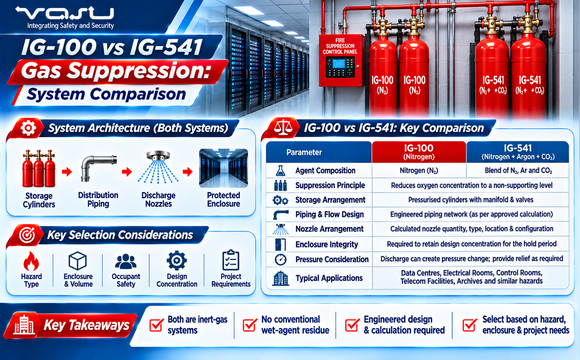
IG-100: Nitrogen-based inert gas agent → Storage cylinders → Manifold/valves → Distribution piping → Discharge nozzles → Protected enclosure.
IG-541: Inert gas blend of nitrogen, argon, and carbon dioxide → Storage cylinders → Manifold/valves → Distribution piping → Discharge nozzles → Protected enclosure.
3. Agent Composition
IG-100 consists of nitrogen as the extinguishing agent. IG-541 is a blend of nitrogen, argon, and carbon dioxide. The specific agent composition, storage pressure, and system characteristics should be verified from the approved manufacturer’s documentation.
4. Fire Suppression Principle
Both systems primarily suppress fire by reducing the oxygen concentration in the protected enclosure. The agent is discharged through engineered nozzles to achieve the required design concentration throughout the protected space.
5. IG-100 System Characteristics
IG-100 uses nitrogen as the extinguishing medium. Nitrogen is naturally present in the atmosphere and does not introduce a chemical clean-agent residue into the protected space. System performance depends on the approved design concentration, cylinder configuration, piping network, nozzle arrangement, and enclosure integrity.
6. IG-541 System Characteristics
IG-541 uses a controlled mixture of nitrogen, argon and carbon dioxide. The combination is engineered to achieve the required fire suppression concentration while supporting the approved life-safety design for the protected occupancy.
7. Storage Arrangement
Both systems use pressurised storage cylinders. Cylinder quantity, capacity, storage pressure, and bank configuration should be determined from the approved agent quantity and flow calculations and the selected manufacturer’s equipment range.
8. Piping & Flow Design
Both IG-100 and IG-541 systems require engineered distribution piping. Pipe sizing, routing, fittings, pressure losses, nozzle configuration, and discharge characteristics should be established using the approved manufacturer’s calculation methodology.
9. Nozzle Arrangement
For both agents, nozzle quantity, type, location, and orifice configuration are determined through the approved system calculation. The arrangement should achieve effective distribution throughout the protected enclosure and account for room geometry and obstructions.
10. Enclosure Integrity
Both systems depend on adequate enclosure integrity to maintain the required extinguishing concentration for the specified hold period. Doors, penetrations, HVAC openings and other leakage paths should be assessed and controlled.
11. Pressure & Discharge Considerations
Discharge of either inert-gas system can create pressure changes within the protected enclosure. The design should evaluate pressure effects and provide suitable pressure relief provisions where required.
12. Design & Calculation Requirements
Agent quantity, design concentration, discharge time, cylinder selection, piping network and nozzle arrangement should be determined using the approved design methodology applicable to the selected system. Values should not be transferred from one agent system to the other without engineering verification.
13. Application Considerations
Both systems can be considered for applications such as data centres, electrical rooms, control rooms, telecommunications facilities, archives and other hazards where gaseous suppression is appropriate. Final suitability depends on the specific hazard and approved project design.
14. Safety Considerations
The protected enclosure should be assessed for occupant safety, warning requirements, release sequence, evacuation arrangements and applicable design criteria. The final design should be based on the selected agent, occupancy and applicable requirements.
15. Environmental & Residue Considerations
Both IG-100 and IG-541 are gaseous inert-agent systems and do not leave conventional wet-agent residue after discharge. Their environmental and operational characteristics should nevertheless be assessed using current manufacturer and project documentation.
16. Engineering Comparison
Key comparison points include:
- Agent composition
- Storage configuration
- Cylinder pressure/capacity
- Agent quantity
- Design concentration
- Piping/flow calculation
- Nozzle arrangement
- Enclosure integrity
- Pressure relief
- Occupancy considerations
- Project specification
- Manufacturer availability
17. Selection Philosophy
Agent selection should not be based solely on a generic comparison. The engineering assessment should consider the actual protected hazard, room volume, occupancy, required concentration, equipment availability, cylinder arrangement, piping constraints, enclosure characteristics, and project requirements.
18. Testing & Commissioning
Both systems require verification of the complete suppression sequence.
Testing may include:
- Detection operation
- Releasing logic
- Pre-discharge warning
- Manual release
- Abort/hold function, where applicable
- Cylinder/valve status
- Interface operation
- Nozzle installation
- Enclosure integrity
- Cause & Effect verification
19. Documentation
Comparison and selection documentation should include, as applicable:
- Agent datasheets
- Design basis
- Agent quantity calculation
- Cylinder schedule
- Piping/flow calculation
- Nozzle schedule
- Enclosure integrity report
- Cause & Effect Matrix
- FAT / SAT records
- Commissioning records
- As-built drawings
- O&M documentation
20. Engineering Objective
The engineering objective is:
Correct Hazard Assessment → Appropriate Agent Selection → Verified Design Concentration → Accurate Agent Quantity → Engineered Cylinder & Piping System → Effective Nozzle Distribution → Adequate Enclosure Integrity → Safe Release Sequence → Verified Testing → Reliable Inert-Gas Fire Suppression Performance
Frequently Asked Questions
What is the main difference between IG-100 and IG-541?
IG-100 uses nitrogen as the extinguishing agent. IG-541 is a blend of nitrogen, argon, and carbon dioxide.
Do IG-100 and IG-541 use the same design calculations?
No design values should be transferred between the systems without engineering verification. Use the approved design methodology and manufacturer calculation procedure for the selected system.
Are enclosure integrity and pressure relief important for both systems?
Yes. Enclosure leakage and pressure effects during discharge should be assessed, with suitable pressure-relief provisions where required by the approved design.
Where may inert-gas suppression systems be considered?
Potential applications include data centres, electrical rooms, control rooms, telecommunications facilities, archives and other hazards where gaseous suppression is appropriate. Suitability must be confirmed for the specific hazard and project.
What should be checked before selecting an agent?
Review the hazard, protected volume, occupancy, design concentration, storage and piping constraints, enclosure characteristics, equipment availability, and project requirements.
SEO and Publication Details
SEO title: IG-100 vs IG-541: Inert Gas Fire Suppression System Comparison
Meta description: Compare IG-100 and IG-541 inert-gas fire suppression systems, including agent composition, design considerations, storage, piping, safety, and selection criteria.
Suggested URL slug: /ig-100-vs-ig-541-system-comparison/
Primary keyword: IG-100 vs IG-541
Related keywords: inert gas fire suppression, nitrogen fire suppression system, IG-541 gas suppression, gas suppression system design
Suggested internal links: Gas Suppression System Design Workflow; Gas Suppression Enclosure Integrity; Gas Suppression System Nozzle Arrangement; Fire Detection and Gas Release Logic