
Article
Integrated Building Management Architecture
Oct 2026
Direct Answer
Integrated Building Management Architecture connects approved building-service systems to a common supervisory platform through defined field devices, local controllers, communication networks, gateways, servers, databases and operator interfaces. The architecture should clearly separate dedicated system responsibilities from central monitoring and any explicitly authorised control functions.
1. Engineering Overview
Integrated Building Management Architecture establishes the technical framework through which multiple building services are connected to a common supervisory management platform. The architecture defines field devices, controllers, communication networks, gateways, servers, databases, operator interfaces and approved system-to-system integrations.
2. Integrated Architecture
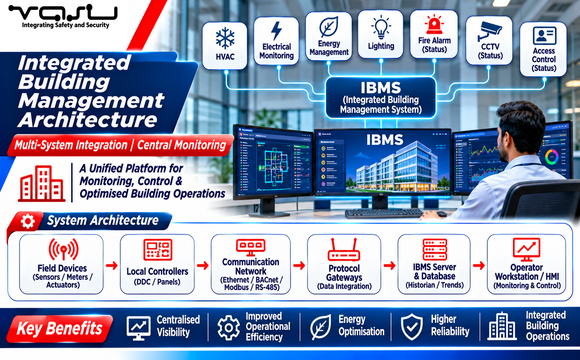
Building Field Devices → Local Controllers / Panels → System Networks → Protocol Gateways → IBMS Integration Layer → Central Server / Database → Operator Workstations / HMI
Integrated Systems → HVAC → Electrical Monitoring → Energy Management → Lighting → Fire Alarm Status → Access Control Status → Other Approved Building Services
3. Integration Philosophy
Integration should be based on clearly defined monitoring and control responsibilities. Each dedicated building system should retain its primary operational and safety functions, while the IBMS provides central supervisory visibility and only those commands expressly permitted by the approved integration scope.
4. Field Device Layer
Sensors, meters, switches, actuators, detectors and equipment status contacts form the field layer. These devices provide real-time operating information to local controllers or dedicated system panels.
5. Local Control Layer
Dedicated controllers and panels process field information and execute system-specific control sequences. Local control functions should remain coordinated with the manufacturer’s equipment logic and approved system design.
6. Communication Layer
The communication layer provides connectivity between building systems and the IBMS. Depending on the approved architecture, communication may use Ethernet / TCP-IP, BACnet, Modbus, RS-485, fibre or other approved technologies.
7. Gateway & Protocol Conversion
Gateways may be deployed where integrated systems use different communication protocols. Gateway configuration should define point mapping, data types, scaling, alarm status, commands and communication health.
8. IBMS Integration Server
The integration server manages communication with connected systems and transfers approved data to the IBMS application. Server capacity should be suitable for the number of connected systems, points, users and required historical data.
9. Database & Historian
The database stores configuration and operational information. Historical data may include alarms, events, trends, energy values and equipment operating parameters in accordance with the approved data-retention requirements.
10. Operator Workstation & HMI
Operator workstations provide central visibility of integrated building services. HMI graphics should provide structured navigation from site level to building, floor, zone, equipment and individual point level.
11. HVAC Integration
HVAC integration may include chillers, AHUs, FCUs, pumps, cooling towers, ventilation systems and associated sensors. Monitoring and control points should be based on the approved equipment schedules and control philosophy.
12. Electrical System Integration
Electrical monitoring may include meters, breakers, distribution boards, UPS systems, generators and other approved electrical equipment. Protection functions should remain within the dedicated electrical protection system unless specifically approved for integration.
13. Energy Management Integration
Energy data from electrical meters and other approved sources can be collected by the IBMS for consumption monitoring, trends, reports and performance analysis. Any automated energy-control function should follow the approved operating strategy.
14. Lighting Integration
Lighting systems may be integrated for status monitoring, schedules, occupancy-based operation and authorised control. Interface responsibilities should be clearly defined between the lighting control system and IBMS.
15. Fire Alarm Integration
Fire alarm integration should provide only the approved status, alarm and supervisory information. Life-safety control functions should remain under the dedicated fire alarm architecture and approved Cause and Effect logic.
16. Access Control Integration
Access control may provide approved door status, access events, alarms and other information to the IBMS. Commands exposed through the IBMS should be limited to those specifically approved.
17. Network Segregation
Network segmentation should be implemented where required to separate building automation traffic, security systems, enterprise IT and other network domains. The architecture should follow the approved IT and cybersecurity requirements.
18. Alarm & Event Management
Integrated alarms should be categorised according to priority and source. The IBMS should provide clear annunciation, acknowledgement, event logging and historical records while preserving the originating system’s alarm responsibilities.
19. Time Synchronisation
Integrated systems should use a coordinated time reference where required so that alarms, events, trends and logs from different systems have consistent timestamps. Time synchronisation should follow the approved network architecture.
20. User & Access Management
IBMS access should be controlled through authorised user accounts and role-based permissions. Monitoring, acknowledgement, configuration and control privileges should be assigned according to approved responsibilities.
21. Installation Requirements
Installation should verify:
- Correct field devices
Correct controllers / panels
• Correct communication cabling
• Correct network equipment
• Correct gateway configuration
• Correct IP / device addressing
• Correct point mapping
• Correct graphics
• Correct alarm mapping
• Correct power supply
• Proper service segregation
22. Testing & Commissioning
Integrated commissioning should verify:
- Field device values
Controller operation
• Network communication
• Gateway communication
• Point mapping
• Alarm transmission
• Status indication
• Authorised commands
• HMI graphics
• Trends and history
• Time synchronisation
• System interfaces
23. Fail-Safe & Communication Failure
Communication failure should be identified through appropriate diagnostics and alarms. Dedicated systems should continue to perform their approved local functions where designed to do so, while the IBMS should indicate loss of communication or stale data.
24. Maintenance & Backup
Maintenance should cover controllers, gateways, network equipment, servers, databases, workstations, software configuration and communication links. Configuration and database backups should be maintained according to the approved maintenance strategy.
25. Design Change Control
Changes to integrated systems, protocols, point lists, gateways, network topology, server configuration, graphics or control sequences should be reviewed against the approved integrated architecture before implementation.
26. Documentation
Integrated building management documentation should include, as applicable:
- System architecture drawings
Integration matrix
• Network topology
• Point lists
• Gateway mapping
• Communication protocol details
• Alarm matrix
• Control sequences
• Graphics philosophy
• User access matrix
• Testing and commissioning records
• As-built drawings
• O&M manual
27. Engineering Objective
The engineering objective is:
Reliable Field Data → Dedicated Local Control → Secure Communication → Controlled System Integration → Centralised IBMS Supervision → Accurate Alarms & Graphics → Authorised Control → Historical Data → Verified Interoperability → Maintainable Integrated Building Management
Frequently Asked Questions
What is integrated building management architecture?
It is the technical framework that connects selected building services to a common supervisory platform using defined devices, controllers, networks, gateways, servers and operator interfaces.
Which systems can be integrated with IBMS?
Depending on the approved project scope, integrations may include HVAC, electrical monitoring, energy management, lighting, fire alarm status, access control status and other building services.
Does IBMS replace dedicated system controllers?
No. The source document states that dedicated systems should retain their primary operational and safety functions. IBMS provides central supervision and only approved commands.
Why are protocol gateways used?
Gateways can provide controlled communication between systems that use different communication protocols or architectures. Their point mapping, data types, scaling, alarms and commands should be defined.
What should integrated commissioning verify?
The source lists field values, controller operation, network and gateway communication, point mapping, alarm transmission, status indication, authorised commands, HMI graphics, trends/history, time synchronisation and system interfaces.
What documentation should be maintained?
As applicable, documentation includes architecture drawings, integration matrix, network topology, point lists, gateway mapping, protocol details, alarm matrix, control sequences, graphics philosophy, user access matrix, test records, as-built drawings and O&M manual.
SEO & Publishing Details
| SEO title | Integrated Building Management Architecture | Vasu Infosec |
| Meta description | Understand integrated building management architecture, including field devices, local controllers, gateways, IBMS servers, approved system interfaces, alarms, cybersecurity and commissioning. |
| Primary keyword | integrated building management architecture |
| Secondary keywords | IBMS architecture, building systems integration, IBMS gateway, building automation network, IBMS commissioning |
| Suggested URL slug | integrated-building-management-architecture |
| Suggested image alt text | Integrated building management architecture showing field devices, local controllers, communication networks, gateways, IBMS server and operator workstation |