
Article
Integrated Fire & Life Safety Testing
Nov 2026
1. Engineering Overview
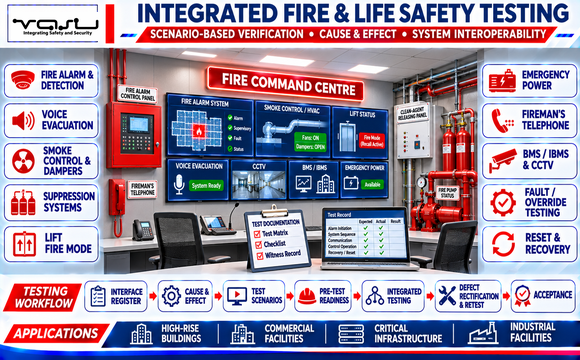
Integrated Fire & Life Safety Testing verifies that individual fire-protection and life-safety systems operate together as an integrated emergency-response architecture. The testing should demonstrate correct initiation, sequencing, communication, control, emergency power, monitoring and recovery across interconnected systems.
2. Complete Integrated Testing Architecture
Approved Fire Strategy → System Interfaces → Cause & Effect Matrix → Test Scenarios → Test Preparation → Individual System Readiness → Integrated System Activation → Sequence Verification → Emergency Power Verification → Monitoring & Communication → Failure Testing → Recovery → Defect Closure → Final Integrated Test Report
3. Testing Philosophy
Integrated testing should be scenario-based, documented, repeatable and traceable to the approved design. Testing should confirm not only individual equipment operation but also the correct interaction between systems during representative emergency conditions.
4. System Interface Identification
All interfaces between fire alarm, detection, suppression, smoke control, emergency lighting, emergency voice evacuation, fireman’s telephone, lifts, access control, CCTV, BMS / IBMS, emergency power and other life-safety systems should be identified before testing.
5. Cause & Effect Verification
The approved cause-and-effect matrix should form the principal reference for integrated testing. Each defined input, output, sequence, delay, priority, feedback and reset condition should be verified.
6. Test Scenario Development
Representative scenarios should be developed for different fire zones, occupancy areas and critical systems. Scenarios should include normal alarm activation, multiple interfaces, system impairment and recovery conditions.
7. Pre-Test Readiness
Before integrated testing, individual systems should be commissioned, available for operation and free from unresolved critical defects. Test equipment, drawings, procedures, personnel and communication arrangements should be confirmed.
8. Fire Detection & Alarm Integration
Testing should verify that detector or manual alarm activation initiates the correct fire alarm zone, notification, evacuation sequence and downstream system responses.
9. Emergency Voice Evacuation Integration
The test should verify correct automatic voice-message selection, zone activation, message priority, emergency microphone operation and alignment with the approved evacuation strategy.
10. Smoke Control Integration
Testing should verify smoke-extraction fans, staircase pressurisation, lobby pressurisation, make-up air, smoke dampers, HVAC shutdown and associated control sequences.
11. Fire & Smoke Damper Integration
Damper commands, actuator operation, position feedback and coordination with HVAC and fire alarm systems should be verified for representative fire scenarios.
12. Suppression System Integration
Sprinkler, hydrant, water-mist, clean-agent or other suppression systems should be tested for alarm, supervisory, release and interface signals applicable to the approved architecture.
13. Clean Agent Integration
For clean-agent systems, integrated testing should verify pre-discharge alarm, warning devices, abort / hold functions where provided, release logic, HVAC shutdown, damper operation and post-discharge status.
14. Fire Pump & Water System Integration
Where applicable, fire pump start signals, pump status, pressure conditions, water-storage monitoring and alarm indications should be coordinated with the fire alarm and command-centre architecture.
15. Lift Fire Mode Integration
Testing should verify fire alarm initiation, lift recall, landing-call cancellation, fire-service / emergency operation where applicable, emergency power and status indication.
16. Emergency Lighting Integration
Loss of normal power and fire conditions should be used to verify emergency lighting operation on designated evacuation routes and critical life-safety areas.
17. Emergency Power Integration
Integrated testing should verify transfer to emergency power and continued operation of critical systems, including fire alarm, emergency communication, smoke control, designated suppression controls, emergency lighting and other approved loads.
18. Fireman’s Telephone Integration
Communication between designated fireman’s telephone points and the fire command centre should be verified during representative emergency scenarios and emergency-power conditions.
19. Fire Command Centre Integration
The fire command centre should receive appropriate alarm, fault and system-status indications and provide designated control functions during integrated scenarios.
20. BMS / IBMS Integration
Where applicable, fire-related status, alarms and equipment feedback should be verified at the BMS / IBMS interface. Life-safety commands should remain consistent with the approved fire-control architecture.
21. Access Control Integration
Emergency release of designated access-controlled doors and gates should be verified where required. The sequence should support evacuation and emergency responder access.
22. CCTV & Incident Monitoring Integration
Where provided, CCTV should support incident verification and monitoring of critical areas. Relevant camera views, recording and event association should be checked where included in the approved scope.
23. Emergency Communication Integration
Emergency communication systems should be verified for correct routing, priority, availability and coordination with the fire command centre and evacuation strategy.
24. Alarm Priority & Sequencing
The test should verify priority between fire alarms, voice messages, emergency controls, routine building systems and manual commands. Defined delays and sequencing should operate correctly.
25. Manual Override Testing
Authorised manual controls should be tested to confirm that emergency operators can initiate or modify designated functions without creating conflict with mandatory life-safety sequences.
26. Failure & Fault Testing
Representative faults should be introduced where safe and approved, including power loss, communication failure, equipment fault, damper failure, fan failure or circuit fault. The expected fault indication and system response should be verified.
27. Recovery & Reset Testing
After each scenario, the system should be returned to a controlled normal condition. Reset logic, equipment recovery, alarm clearing, manual reset requirements and return-to-service procedures should be verified.
28. Test Control & Safety
Integrated testing should be conducted under controlled conditions with defined responsibilities, test permits where required, communication protocols and precautions to prevent unintended emergency response or unsafe operation.
29. Test Records
Every test scenario should record date, location, initiating device / condition, expected response, actual response, observations, measured values where applicable, defects and acceptance status.
30. Defect Management
Any deviation from the approved sequence should be recorded in a controlled defect register. Critical life-safety deficiencies should be prioritised and retested after rectification.
31. Witnessing & Acceptance
Testing should be witnessed by designated stakeholders as required. Acceptance should be based on documented evidence that the tested sequence complies with the approved design and cause-and-effect requirements.
32. Site Verification
Integrated testing should verify, as applicable:
- Fire detection
- Fire alarm
- Emergency voice evacuation
- Smoke extraction
- Staircase pressurisation
- Fire / smoke dampers
- Sprinkler / hydrant systems
- Clean-agent systems
- Fire pumps
- Lift fire mode
- Emergency lighting
- Emergency power
- Fireman’s telephone
- Fire command centre
- BMS / IBMS interface
- Access control
- CCTV
- Emergency communication
- Manual overrides
- Fault monitoring
- Reset / recovery
33. Integrated Scenario Test Matrix
The test matrix should include, as applicable:
- Fire alarm in each representative zone
- Fire alarm affecting protected egress
- Fire alarm affecting HVAC zone
- Clean-agent pre-discharge / release scenario
- Smoke-control activation
- Staircase pressurisation scenario
- Lift recall scenario
- Normal-power failure
- Emergency-power transfer
- Communication fault
- Selected equipment failure
- Manual override
- System reset and recovery
34. Documentation
Integrated fire and life-safety testing documentation should include, as applicable:
- Approved fire strategy
- System architecture drawings
- Interface register
- Cause-and-effect matrix
- Integrated test plan
- Test scenario matrix
- Pre-test readiness checklist
- Individual system commissioning records
- Test procedures
- Test scripts
- Test results
- Measured values
- Witness records
- Fault / defect register
- Corrective-action records
- Retest records
- Emergency-power test records
- Communication test records
- Integrated scenario reports
- Final acceptance certificate / record
- As-built drawings
- O&M manual
35. Engineering Objective
The engineering objective is:
Identify All Life-Safety Interfaces → Establish Approved Cause & Effect → Develop Representative Emergency Scenarios → Confirm Individual System Readiness → Execute Integrated Fire & Life-Safety Tests → Verify Alarm, Evacuation, Smoke Control, Suppression, Lift, Emergency Power & Communication Sequences → Test Faults, Overrides & Recovery → Record Results & Defects → Rectify & Retest → Obtain Integrated Acceptance → Maintain Verified System Interoperability
Frequently Asked Questions
What is the purpose of Integrated Fire & Life Safety Testing?
Integrated Fire & Life Safety Testing verifies that individual fire-protection and life-safety systems operate together as an integrated emergency-response architecture. The testing should demonstrate correct initiation, sequencing, communication, control, emergency power, monitoring and recovery across interconnected systems.
What is the high-level process or architecture covered in Integrated Fire & Life Safety Testing?
Approved Fire Strategy → System Interfaces → Cause & Effect Matrix → Test Scenarios → Test Preparation → Individual System Readiness → Integrated System Activation → Sequence Verification → Emergency Power Verification → Monitoring & Communication → Failure Testing → Recovery → Defect Closure → Final Integrated Test Report