
Article
Lighting Control Integration with IBMS
Oct 2026
Direct Answer
This article describes the supervisory interface between a dedicated lighting control system and an Integrated Building Management System (IBMS). Final functions and interfaces must follow the approved project design and integration scope.
1. Engineering Overview
Lighting Control Integration establishes the interface between the dedicated lighting control system and the Integrated Building Management System. The arrangement enables central monitoring, scheduling and approved supervisory control of lighting systems while dedicated lighting controllers retain their local operating functions.
2. Integration Architecture
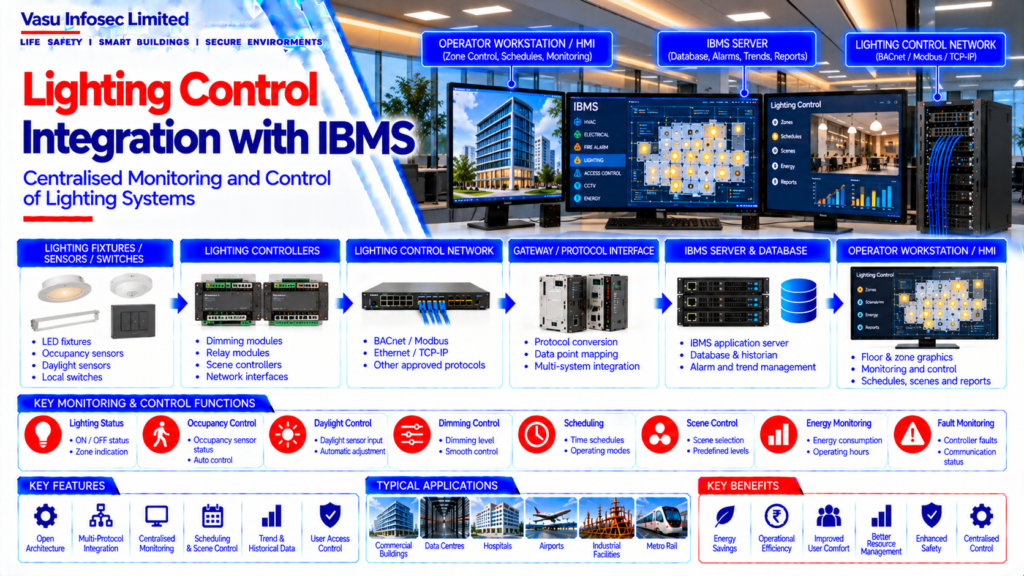
Lighting Fixtures / Sensors / Switches → Lighting Controllers → Lighting Control Network → Gateway / Protocol Interface → IBMS Server → Database → Operator Workstation / HMI
Typical Inputs → Lighting Status → Occupancy → Daylight → Local Switch Status → Fault / Communication Status
Typical Commands → ON / OFF → Dimming → Scene Selection → Schedule → Approved Override
3. Integration Philosophy
The IBMS should provide only the monitoring and control functions defined in the approved integration scope. Local lighting controls, scene logic and equipment-specific functions should remain available through the dedicated lighting control architecture.
4. Lighting Control System
A lighting control system may include lighting controllers, dimming modules, relays, occupancy sensors, daylight sensors, switches, scene controllers and network interfaces. The final arrangement should follow the approved lighting design.
5. Lighting Zones
Lighting should be organised into logical zones based on floor areas, rooms, occupancy, functional use and approved control requirements. Each zone should have a defined control strategy and identification.
6. Local Control
Local switches, occupancy sensors and scene controls may provide direct control of lighting zones. Local control should be coordinated with central schedules and approved override functions.
7. Occupancy-Based Control
Occupancy sensors may be integrated to switch or dim lighting based on detected occupancy. Sensor operation, time delays and control zones should follow the approved lighting control philosophy.
8. Daylight-Based Control
Daylight sensors can support automatic adjustment of lighting levels based on available natural light. Calibration and control thresholds should be established during commissioning.
9. Dimming Control
Where dimmable lighting is provided, the IBMS may monitor and issue approved dimming commands. Dimming range, control resolution and response should be verified against the lighting equipment capabilities.
10. Scheduling
Lighting schedules may be configured for normal operating hours, occupancy periods, cleaning periods, holidays and other approved operating modes. Schedule changes should be restricted to authorised users.
11. Scene Control
Lighting scenes may define predetermined lighting levels for specific activities or operating conditions. Scene selection through IBMS should be limited to approved functions and coordinated with the dedicated lighting control system.
12. Gateway & Protocol Interface
Lighting systems may communicate with IBMS using BACnet, Modbus, TCP/IP or other approved protocols. Where protocol conversion is required, the gateway should map approved status, alarms and commands accurately.
13. Point Mapping
The integration point list should identify lighting zones, status points, control commands, dimming values, occupancy information, faults and communication status. Point names should correspond with approved drawings and graphics.
14. Alarm & Fault Monitoring
Where supported, IBMS may monitor lighting controller faults, communication failures, emergency lighting status or other approved conditions. Alarm priorities should follow the approved alarm philosophy.
15. Emergency Lighting Interface
Emergency lighting systems may be monitored through approved interfaces for status and fault information. Emergency lighting functionality and safety operation should remain under its dedicated system architecture.
16. Graphics & HMI
IBMS graphics should provide clear floor and zone-level representation of lighting status and approved control functions. Zone identification should match the lighting drawings and schedules.
17. Energy Monitoring
Lighting energy information may be collected where meters or controllers provide suitable data. Energy consumption and operating hours can support performance analysis and optimisation.
18. Network Architecture
The lighting control network should be coordinated with the IBMS communication architecture. Network topology, addressing, segmentation and cybersecurity should follow the approved project requirements.
19. Installation Requirements
Installation should verify:
- Correct lighting controllers
- Correct sensors and switches
- Correct communication modules
- Correct network connections
- Correct device addressing
- Correct point mapping
- Correct schedules
- Correct dimming commands
- Correct graphics
- Correct equipment identification
- Proper cable segregation
20. Testing & Commissioning
Lighting-IBMS commissioning should verify:
- Zone status
- ON / OFF commands
- Dimming operation
- Occupancy response
- Daylight response
- Schedule operation
- Scene selection
- Alarm / fault indication
- Gateway communication
- Point mapping
- Graphics
21. Communication Failure
Loss of communication with the lighting control system should be identified through the approved diagnostic mechanism. Local lighting controls should continue to operate according to the designed fallback or local control strategy.
22. Maintenance
Maintenance should include sensor checks, controller inspection, communication diagnostics, gateway checks, schedule verification, point verification, graphics review and configuration backup.
23. Design Change Control
Changes to lighting fixtures, control zones, sensors, controllers, communication protocols, point lists, schedules or IBMS graphics should be reviewed against the approved lighting integration design before implementation.
24. Documentation
Lighting control integration documentation should include, as applicable:
- Lighting control architecture
- Zone schedule
- Controller schedule
- Point list
- Communication protocol details
- Gateway mapping
- Lighting control philosophy
- Schedule matrix
- Graphics schedule
- Testing and commissioning records
- As-built drawings
- O&M manual
25. Engineering Objective
The engineering objective is:
Reliable Lighting Devices → Local Control → Secure Communication → Accurate Zone Integration → Central Monitoring → Approved Scheduling & Control → Energy Visibility → Verified Operation → Complete Commissioning → Reliable Lighting Management
Website SEO & Publishing Details
| SEO title | Lighting Control Integration with IBMS | Engineering Guide |
| Meta description | Learn how lighting control systems integrate with IBMS for zone monitoring, occupancy and daylight control, dimming, scheduling, alarms and energy visibility. |
| Suggested URL slug | /insights/lighting-control-integration-ibms/ |
| Primary keyword | lighting control integration with IBMS |
| Related keywords | IBMS lighting control; lighting automation; occupancy-based lighting; daylight-based lighting control; lighting schedules; lighting gateway integration |
| Suggested image alt text | Lighting control integration architecture showing lighting controllers, sensors, gateway and IBMS operator workstation |
Frequently Asked Questions
What is lighting control integration with IBMS?
It connects a dedicated lighting control system to IBMS so approved lighting status, schedules and supervisory commands can be monitored or managed centrally.
Which lighting points can be monitored in IBMS?
Depending on equipment capability and the approved point list, points may include zone status, occupancy, daylight, local switch status, faults and communication status.
Can IBMS control lighting ON/OFF and dimming?
It may issue ON/OFF, dimming, scene or schedule commands only where the functions are supported and included in the approved integration scope.
Which protocols can be used?
The source document identifies BACnet, Modbus, TCP/IP or other approved protocols. The selected interface must match the lighting system and approved project architecture.
Does IBMS replace local lighting control?
No. The dedicated lighting control architecture should retain local operating functions and equipment-specific logic.
How is the integration tested?
Commissioning should verify zone status, commands, dimming, occupancy/daylight response, schedules, scenes, alarms, gateway communication, point mapping and graphics as applicable.