
Article
Linear Heat Detection in Tunnels
Oct 2026
Direct Answer
Linear Heat Detection (LHD) provides distributed thermal sensing along a defined route and can support continuous detection across long tunnel sections. Technology and alarm settings should follow the approved design.
1. Engineering Overview
Linear Heat Detection (LHD) is a continuous heat-sensing fire detection technology used to monitor extended areas along a defined route. In tunnels, LHD can provide distributed thermal detection across long roadways, cable routes, service areas and other designated zones where conventional point detection may be difficult to maintain or may be affected by airflow and environmental conditions.
2. Complete LHD Architecture
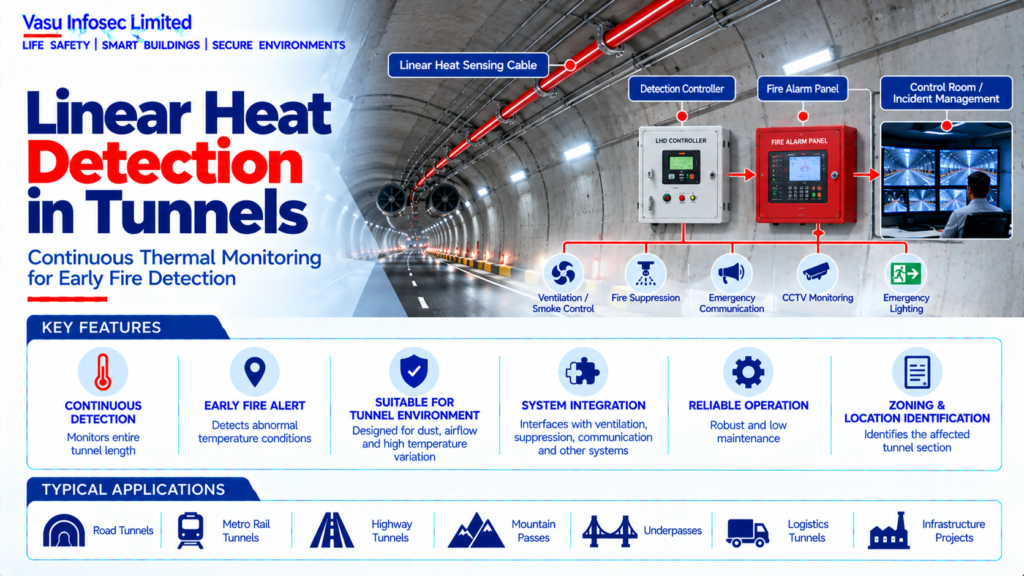
Tunnel Environment → Linear Heat Sensing Cable / Fibre / Approved LHD Device → Detection Controller → Fire Alarm Panel → Alarm Processing → Cause & Effect → Control Room / Incident Management
Interfaces → Ventilation / Smoke Control → Fire Suppression → CCTV → Emergency Communication → Emergency Lighting → Monitoring
Supporting Systems → Power Supply → Battery Backup → Communication Network → Fault Monitoring → Testing & Maintenance
3. LHD Detection Principle
LHD detects abnormal temperature conditions along the monitored route. Depending on the selected technology, detection may be based on a fixed temperature threshold, rate-of-rise behaviour, distributed temperature sensing or another approved sensing principle.
4. Tunnel Application
LHD is particularly useful where a long, continuous detection zone is required. The final application should be established from tunnel geometry, fire risk, airflow, ambient temperature, installation accessibility and the approved detection philosophy.
5. LHD Technology Selection
Possible LHD technologies include digital heat-sensing cable, analogue / resettable sensing cable and fibre-optic distributed temperature sensing. Selection should consider detection characteristics, zoning requirements, environmental conditions, maintenance philosophy and manufacturer capabilities.
6. Digital LHD
Digital LHD cable typically provides an alarm when the temperature at a sensing point reaches the specified threshold. It can provide robust continuous coverage but the exact alarm-location capability depends on the selected system.
7. Analogue / Resettable LHD
Analogue or resettable LHD systems can provide more flexible temperature monitoring and, depending on the technology, may support alarm-location information and adjustable detection characteristics.
8. Fibre-Optic Temperature Detection
Fibre-optic systems can provide distributed temperature measurement over long distances and may offer detailed location information. They can be suitable for demanding environments where electromagnetic immunity and long-distance monitoring are important.
9. Detection Temperature
The alarm temperature should be selected based on the expected ambient temperature, tunnel operating conditions and the required fire-detection response. The selected threshold should avoid unnecessary alarms while providing suitable fire sensitivity.
10. Ambient Temperature Assessment
Tunnel temperature may vary due to weather, traffic, ventilation and equipment operation. The LHD selection should consider the maximum expected normal temperature and transient conditions before establishing alarm thresholds.
11. Installation Location
LHD may be installed along the tunnel ceiling, service zone, cable route or other approved location depending on the fire scenario and detection objective. Final mounting arrangement should be defined by the approved design.
12. Detector Coverage
The sensing route should cover the designated hazard area without unacceptable blind spots. Coverage should be coordinated with tunnel geometry, ventilation airflow, structural obstructions and other services.
13. Zoning
LHD systems should be divided into logical detection zones so that an alarm can identify the affected tunnel section. Zone lengths and boundaries should align with the fire alarm and cause-and-effect architecture.
14. Alarm Location Identification
Where the selected LHD technology supports location identification, the system should provide sufficient resolution to identify the affected section. Location accuracy should be verified during commissioning.
15. Controller Architecture
The LHD controller receives and processes signals from the sensing cable or fibre and communicates alarm and fault information to the fire alarm system. Controller capacity should accommodate the required sensing length, zones and interfaces.
16. Fire Alarm Interface
LHD alarm and fault outputs should be interfaced with the tunnel fire alarm system. The interface should clearly distinguish alarm, fault, communication loss and other system states.
17. Ventilation Interface
An LHD alarm may initiate the approved fire-mode ventilation sequence. The response should be defined in the tunnel cause-and-effect matrix and coordinated with smoke-control requirements.
18. Suppression Interface
Where water mist, sprinkler or another suppression system is installed, LHD alarm signals may initiate or release the approved suppression sequence. Detection and suppression zones should be coordinated.
19. CCTV Interface
An LHD alarm may be used to identify or display relevant CCTV views in the tunnel control room where the integration is provided. The camera-selection logic should be defined in the approved interface matrix.
20. Control Room Monitoring
The control room should receive LHD alarm, zone / location and fault information in a clear format. Operators should be able to identify the affected tunnel section and initiate the approved emergency response.
21. Cable Routing
LHD cable routing should be coordinated with tunnel structure, cable trays, lighting, ventilation equipment, other fire systems and maintenance access. The sensing cable should be protected from mechanical damage.
22. Supports & Fixings
Fixing methods should be compatible with the sensing technology and tunnel environment. Support spacing, attachment methods and mechanical protection should follow the manufacturer’s installation requirements.
23. Environmental Suitability
LHD equipment should be suitable for expected temperature, moisture, dust, vibration, chemical exposure and electromagnetic conditions. The selected system should be appropriate for the tunnel’s environmental classification.
24. Fault Monitoring
The system should detect relevant faults such as open circuit, short circuit, controller fault, communication failure, power failure or other manufacturer-defined abnormal conditions.
25. Power Supply
LHD controllers and associated fire-alarm interfaces should be supplied from the approved fire-safety power arrangement. Required standby battery capacity should be established from the system load and applicable requirements.
26. Installation Requirements
Installation should verify:
- Correct LHD technology
- Correct sensing temperature / characteristics
- Correct sensing coverage
- Correct zone configuration
- Correct mounting location
- Correct supports and protection
- Correct controller capacity
- Correct fire alarm interface
- Correct power supply and standby capacity
- Correct ventilation / suppression / CCTV interfaces
- Correct fault monitoring
- Proper identification and accessibility
27. Testing & Commissioning
LHD commissioning should verify:
- Visual inspection
- Cable / fibre continuity
- Zone identification
- Alarm operation
- Alarm temperature / response characteristics
- Location identification where applicable
- Controller operation
- Fire alarm interface
- Fault monitoring
- Ventilation interface
- Suppression interface
- CCTV / control-room interface
- Standby power operation
28. Integrated Fire Scenario Testing
Representative tunnel fire scenarios should be used to verify the sequence from LHD detection through fire alarm annunciation and the approved cause-and-effect actions. Tests should confirm that alarm location and downstream interfaces operate correctly.
29. Maintenance
Maintenance should include inspection of sensing cable / fibre, fixing points, controller health, alarm history, fault history, connections and interfaces. Testing should follow the approved maintenance programme and manufacturer requirements.
30. Failure & Recovery
The system should be assessed for sensing-cable damage, controller failure, communication loss, power failure, false alarms and loss of detection coverage. Faults should be clearly annunciated and corrected through controlled maintenance.
31. Design Change Control
Changes to tunnel lining, ventilation, cable routes, lighting, structural elements, suppression systems or other services near the LHD route should trigger a review of detection coverage and mounting arrangements.
32. Documentation
LHD documentation should include, as applicable:
- LHD detection philosophy
- Technology / product selection
- Detection layout
- Sensing-cable / fibre schedule
- Zone schedule
- Controller schedule
- Alarm temperature / configuration
- Interface matrix
- Cause-and-effect matrix
- Power / battery calculation
- Testing and commissioning records
- Alarm / fault records
- Maintenance schedule
- As-built drawings
- O&M manual
33. Engineering Objective
The engineering objective is:
Assess Tunnel Fire Risk → Select Suitable LHD Technology → Establish Temperature & Environmental Criteria → Design Continuous Detection Coverage → Define Zones & Alarm Location → Integrate Fire Alarm, Ventilation, Suppression & CCTV → Verify Fault Monitoring & Emergency Power → Test Fire Scenarios → Maintain Reliable Continuous Tunnel Heat Detection
Frequently Asked Questions
What is linear heat detection in tunnels?
The answer depends on the approved tunnel fire-safety strategy, project design basis and specific system configuration. Refer to the relevant technical sections above; do not infer a project-specific value or requirement where it is not stated.
Which LHD technologies may be used?
The answer depends on the approved tunnel fire-safety strategy, project design basis and specific system configuration. Refer to the relevant technical sections above; do not infer a project-specific value or requirement where it is not stated.
What should LHD commissioning verify?
The answer depends on the approved tunnel fire-safety strategy, project design basis and specific system configuration. Refer to the relevant technical sections above; do not infer a project-specific value or requirement where it is not stated.
SEO & Publishing Details
| SEO title | Linear Heat Detection in Tunnels | Vasu Infosec Limited |
| Meta description | Linear Heat Detection (LHD) provides distributed thermal sensing along a defined route and can support continuous detection across long tunnel sections. Technology and alarm settings should follow the approved design. |
| Primary keyword | linear heat detection in tunnels |
| Secondary keywords | LHD cable tunnel, fibre optic temperature detection, tunnel fire detection cable, LHD commissioning |
| Suggested URL slug | linear-heat-detection-in-tunnels |
| Suggested image alt text | Technical architecture and process flow for linear heat detection in tunnels. |