
Article
Low-Pressure vs High-Pressure Water Mist
Oct 2026
Direct Answer
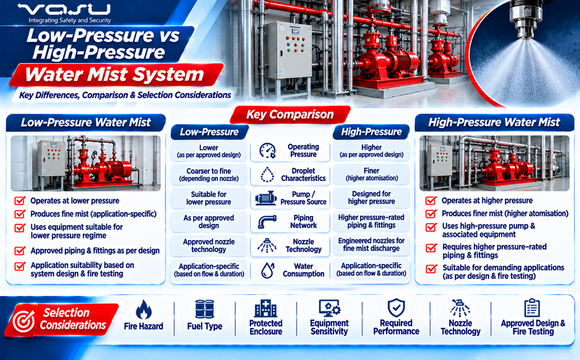
Low-pressure and high-pressure water mist systems differ mainly in their operating pressure regime and the associated pressure source, piping and nozzle technology. The suitable option must be selected for the specific hazard and application using the manufacturer’s approved design and applicable fire testing; pressure alone does not establish performance or suitability.
1. Engineering Overview
Low-pressure and high-pressure water mist systems use engineered water discharge to produce fine droplets for fire control, suppression or extinguishing. The primary distinction is the operating pressure regime and the associated pump, piping, nozzle and droplet-generation technology. Final system selection should be based on the approved application, manufacturer design and fire testing.
2. System Comparison Architecture
Water Source → Pressure Generation → Filtration → Distribution Piping → Water Mist Nozzles → Droplet Formation → Fire Interaction
Low-Pressure System: Lower operating pressure → Larger / coarser mist characteristics depending on nozzle design.
High-Pressure System: Higher operating pressure → Finer atomisation characteristics depending on nozzle design.
3. Pressure Regime
The pressure classification of a water mist system should be taken from the selected manufacturer’s approved system design. Pressure ranges and classifications can vary between technologies and manufacturers; therefore, generic pressure limits should not be assumed without reference to the applicable system documentation.
4. Droplet Generation
Both systems use specially designed nozzles to convert water into a mist. Droplet size and distribution depend on nozzle geometry, water pressure, flow rate and application-specific design. Higher pressure may support finer atomisation, but nozzle design remains a critical factor.
5. Low-Pressure Water Mist
Low-pressure water mist systems operate at a lower pressure than high-pressure technologies while still producing a finely divided water discharge. They may be suitable for applications where the approved nozzle technology and fire testing demonstrate the required performance.
6. High-Pressure Water Mist
High-pressure water mist systems use a higher operating pressure to generate a fine mist through engineered nozzles. The technology can provide high surface-area droplets and may be used for demanding fire protection applications where the system has been specifically designed and tested.
7. Pump & Pressure Source Comparison
Low-pressure systems generally require a pressure source suitable for their approved operating conditions. High-pressure systems require equipment capable of generating and maintaining the higher pressure required by the selected nozzle technology. Pump selection must always follow the approved hydraulic calculation.
8. Piping System Comparison
The piping network must be rated for the operating pressure of the selected system. High-pressure systems may require specialised high-pressure piping, fittings and connections. Low-pressure systems may use a different approved piping arrangement. Material selection should be based on manufacturer requirements.
9. Nozzle Technology
Nozzle design is fundamental to both systems. The nozzle determines spray pattern, droplet characteristics, flow and coverage. Nozzle type, operating pressure, quantity, spacing and orientation should be selected from the approved manufacturer system.
10. Water Consumption Consideration
Water consumption is application-specific and depends on the required flow, nozzle characteristics, number of operating nozzles and duration. A general assumption that one pressure regime always uses less water should not replace the approved hydraulic and application design.
11. Coverage & Spacing
Coverage and nozzle spacing are determined by the approved system design and application-specific testing. Room geometry, ceiling height, hazard configuration and obstructions should be assessed for both pressure regimes.
12. Fire Protection Mechanisms
Both technologies may provide fire protection through cooling, heat absorption, reduction of radiant heat transfer and, where applicable, local steam / oxygen displacement. The relative contribution depends on droplet characteristics, enclosure conditions and the specific fire scenario.
13. Pump Skid Architecture
The pump skid should be selected to provide the required pressure and flow for the hydraulically demanding design condition. High-pressure systems generally require equipment designed specifically for their higher operating pressure, while low-pressure systems use equipment appropriate to their lower pressure regime.
14. Filtration Requirements
Both systems may require filtration to protect nozzle passages from contamination. Filter rating, arrangement and maintenance requirements should follow the selected manufacturer’s design.
15. Application Selection
Selection between low-pressure and high-pressure water mist should consider:
- Fire hazard
- Fuel type
- Protected enclosure
- Equipment sensitivity
- Required suppression performance
- Nozzle technology
- Water availability
- Pump arrangement
- Piping constraints
- Maintenance requirements
- Approved fire testing / listing
16. Installation Considerations
Installation should verify the selected system’s pressure rating throughout the complete installation.
Checks should include:
- Pump / pressure source
- Pipe material and pressure rating
- Valves
- Fittings
- Supports
- Nozzles
- Zone control equipment
- Detection and control interfaces
17. Testing & Commissioning
Testing should verify the complete system under the approved commissioning procedure.
Activities may include:
- Pump operation
- Pressure verification
- Flow verification
- Zone valve operation
- Detection testing
- Release sequence
- Nozzle inspection
- Alarm operation
- Interface testing
18. Engineering Comparison
Key comparison factors include:
- Operating pressure
- Droplet characteristics
- Pump requirements
- Piping requirements
- Nozzle technology
- Water demand
- Coverage
- Application suitability
- Maintenance requirements
- Approved fire testing
19. Documentation
Comparison and design documentation should include, as applicable:
- System datasheets
- Design basis
- Hydraulic calculation
- Pump datasheet
- Piping drawings
- Nozzle schedule
- Zone control arrangement
- Detection / Cause and Effect Matrix
- Testing records
- Commissioning report
- As-built drawings
- O&M manual
20. Engineering Objective
The engineering objective is:
Correct Hazard Assessment → Appropriate Pressure Technology → Suitable Pump & Piping → Correct Nozzle Selection → Verified Flow & Coverage → Application-Specific Fire Performance → Complete Testing & Commissioning → Reliable Water Mist Fire Protection
Frequently Asked Questions
What is the main difference between low-pressure and high-pressure water mist?
The primary difference is the operating pressure regime and the related pressure source, piping and nozzle technology. Actual classification should be taken from the selected manufacturer’s approved system design.
Does high pressure always produce better fire protection?
No universal conclusion should be made from pressure alone. Suitability and performance depend on the hazard, nozzle design, enclosure, system design and application-specific fire testing.
Does a low-pressure system always use more water?
Not necessarily. Water consumption depends on required flow, nozzle characteristics, the number of operating nozzles and discharge duration. The approved hydraulic and application design should be used.
How should pump and piping be selected?
Pump selection should follow the approved hydraulic calculation. Piping, valves, fittings and connections must be suitable for the selected system’s operating pressure and comply with manufacturer requirements.
What determines nozzle coverage and spacing?
Coverage and spacing are established by the approved system design and application-specific testing, considering room geometry, ceiling height, hazard configuration and obstructions.
What should be checked during commissioning?
The approved commissioning procedure may include pump operation, pressure and flow verification, zone valve operation, detection and release sequence, nozzle inspection, alarms and interface testing.
SEO & Website Publishing Details
SEO title: Low-Pressure vs High-Pressure Water Mist Systems: Key Differences
Meta description: Compare low-pressure and high-pressure water mist systems, including pressure regime, droplet generation, pumps, piping, nozzles, water demand and application selection.
Suggested URL slug: low-pressure-vs-high-pressure-water-mist
Primary keyword: low-pressure vs high-pressure water mist
Related keywords: water mist system comparison; low-pressure water mist system; high-pressure water mist system; water mist nozzle technology; water mist pump and piping; water mist hydraulic calculation
Suggested internal links: Water Mist System: Complete Architecture; High-Pressure Water Mist: Working Principle; Water Mist Nozzle Arrangement and Coverage; Water Mist System Design Workflow; Water Mist Testing and Commissioning