
Article
Pre-Action Sprinkler System
Oct 2026
Direct Answer
A pre-action sprinkler system is an automatic fire-protection arrangement in which water admission to the sprinkler distribution piping is controlled by a releasing system in addition to sprinkler operation. A detection event initiates the approved release sequence and allows the pre-action valve to admit water; final discharge occurs when the applicable sprinkler operating condition is met. The system design must coordinate detection and release logic, hydraulic performance, alarm interfaces, testing and restoration.
1. Engineering Overview
A Pre-Action Sprinkler System is an automatic sprinkler arrangement in which water admission to the distribution piping is controlled by a releasing system in addition to the operation of sprinkler heads. The architecture is used where the risk of unintended water discharge requires additional control.
2. System Architecture
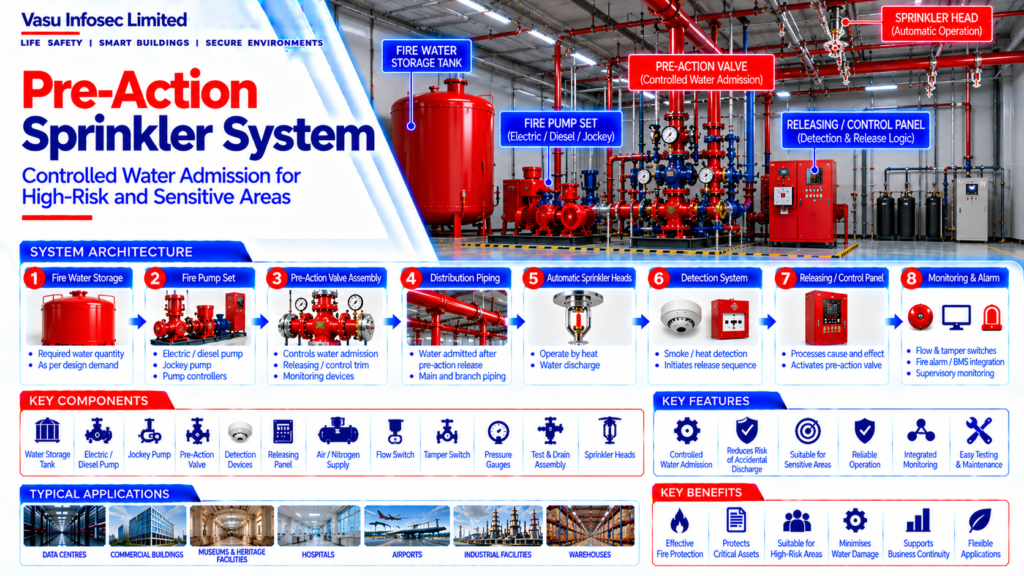
Fire Water Storage → Fire Pump Set → Pre-Action Valve Assembly → Distribution Piping → Automatic Sprinkler Heads
Detection System → Releasing / Control Panel → Pre-Action Valve Activation → Water Admission → Sprinkler Operation → Water Discharge → Alarm & Interface Actions
3. Operating Principle
Under normal standby conditions, the distribution piping is maintained in the approved condition, typically with supervisory air or nitrogen where applicable. A detection event initiates the releasing sequence and allows the pre-action valve to admit water into the sprinkler piping. Final water discharge occurs when the applicable sprinkler operating condition is met.
4. Major Components
A typical pre-action system may include:
- Fire water storage tank
- Electric fire pump
- Diesel fire pump, where applicable
- Jockey pump
- Pre-action valve assembly
- Air / nitrogen supply, where applicable
- Releasing / control panel
- Detection devices
- Main isolation valves
- Flow switch
- Tamper switch
- Pressure gauges
- Test and drain assembly
- Distribution piping
- Automatic sprinkler heads
5. Pre-Action Valve Assembly
The pre-action valve controls water entry into the sprinkler distribution network. Its trim and associated releasing components should be selected and installed according to the approved system design and manufacturer requirements.
6. Detection & Release Logic
The detection system provides the initiating signal for the pre-action sequence. The releasing / control panel processes the approved Cause and Effect logic and operates the pre-action valve when the specified release condition is achieved.
7. Sprinkler Operation
After the pre-action valve has admitted water into the distribution piping, water is discharged through sprinkler heads that operate in response to the applicable thermal condition. The exact operating sequence should follow the approved system configuration.
8. Single-Interlock Arrangement
In a single-interlock configuration, detection operation can initiate water admission into the sprinkler piping while sprinkler operation provides the final discharge path. The exact sequence should follow the approved manufacturer and project design.
9. Double-Interlock Arrangement
In a double-interlock configuration, both the detection condition and sprinkler operation are required to initiate the complete water release sequence. The arrangement is intended to provide additional protection against unintended water admission.
10. Air / Nitrogen Supervision
Where supervisory gas is used, the system should maintain the specified pressure within the sprinkler piping. Pressure monitoring should identify abnormal pressure loss and generate the appropriate supervisory or fault indication.
11. Hydraulic Design
The hydraulic calculation should verify the required flow and pressure at the design sprinklers. Pipe friction losses, fitting losses, elevation, sprinkler characteristics, water supply and the selected pre-action arrangement should be considered.
12. Fire Pump & Water Supply
The fire pump and water supply should provide the required pressure and flow for the approved design condition. Pump operation should be coordinated with the pre-action release sequence.
13. Alarm & Monitoring
Pre-action activation may initiate fire alarm, supervisory, waterflow and equipment interface signals. Flow switches, tamper switches, pressure monitoring and releasing panel signals should be integrated according to the approved Cause and Effect Matrix.
14. Test & Drain Arrangement
The pre-action system should have suitable test and drain facilities to verify valve operation, detection / releasing functions, waterflow alarm and system restoration. Testing should be performed under controlled conditions.
15. Application Considerations
Pre-action systems may be considered for areas where accidental water discharge could cause significant damage or operational disruption, subject to the approved fire protection strategy. Application suitability should be established during system design.
16. Installation Requirements
Installation should verify:
- Correct pre-action valve and trim
- Correct detection system
- Correct releasing panel
- Correct air / nitrogen arrangement, where applicable
- Correct sprinkler type and temperature rating
- Correct piping and supports
- Correct flow and tamper switches
- Accessible test and drain connections
17. Testing & Commissioning
Commissioning should verify:
- Detection operation
- Releasing panel logic
- Pre-action valve operation
- Air / nitrogen pressure, where applicable
- Pump operation
- Flow switch operation
- Tamper switch operation
- Alarm interfaces
- Test and drain operation
- Cause and Effect sequence
18. System Restoration
Following testing or system activation, the pre-action system should be restored according to the approved procedure. The valve, detection system, supervisory pressure and monitoring devices should be returned to the normal standby condition before the system is considered available.
19. Inspection & Maintenance
Periodic inspection should cover the pre-action valve, trim, detection devices, releasing panel, air / nitrogen system, sprinkler heads, piping, valves, monitoring devices and water supply. Defects or abnormal conditions should be rectified and affected functions retested.
20. Design Change Control
Changes to protected occupancy, detection layout, sprinkler locations, piping configuration, air / nitrogen pressure, valve arrangement or water supply should be reviewed against the approved hydraulic and release design.
21. Documentation
Pre-action system documentation should include, as applicable:
- Design basis
- Hydraulic calculation
- Pre-action valve datasheet
- Valve trim details
- Detection layout
- Releasing panel details
- Cause and Effect Matrix
- Sprinkler layout
- Air / nitrogen system details
- Testing and commissioning records
- As-built drawings
- O&M manual
22. Engineering Objective
The engineering objective is:
Reliable Detection → Controlled Pre-Action Release → Verified Water Admission → Correct Sprinkler Operation → Controlled Water Discharge → Alarm & Interface Verification → Complete Testing → Proper Restoration → Reliable Pre-Action Fire Protection
Frequently Asked Questions
What is a pre-action sprinkler system?
It is an automatic sprinkler arrangement in which a releasing system controls water admission to the distribution piping in addition to sprinkler operation.
How does the release sequence work?
The detection system initiates the approved releasing logic, which operates the pre-action valve when the specified release condition is achieved. Water discharge then depends on the applicable sprinkler operating condition and approved configuration.
What is the difference between single-interlock and double-interlock arrangements?
In the source description, a single-interlock arrangement allows detection operation to initiate water admission, while sprinkler operation provides the final discharge path. A double-interlock arrangement requires both the detection condition and sprinkler operation for the complete water-release sequence.
Where might a pre-action system be considered?
It may be considered where accidental water discharge could cause significant damage or operational disruption, subject to the approved fire protection strategy and system design.
What should be tested during commissioning?
The source lists detection operation, releasing panel logic, pre-action valve operation, supervisory gas pressure where applicable, pump and switch operation, alarm interfaces, test/drain functions and the Cause and Effect sequence.
What documents should be retained?
As applicable, the source lists the design basis, hydraulic calculation, valve datasheet and trim details, detection layout, releasing panel details, Cause and Effect Matrix, sprinkler layout, air/nitrogen system details, commissioning records, as-built drawings and O&M manual.
SEO and Website Publishing Details
| Field | Suggested content |
| SEO title | Pre-Action Sprinkler System: Operation, Types and Design |
| Meta description | Understand pre-action sprinkler system operation, detection and release logic, single- and double-interlock arrangements, hydraulic design, alarms and commissioning. |
| Suggested URL slug | /pre-action-sprinkler-system/ |
| Primary keyword | pre-action sprinkler system |
| Secondary keywords | pre-action valve; single-interlock sprinkler system; double-interlock sprinkler system; releasing panel; sprinkler Cause and Effect Matrix |
| Suggested internal links | Wet Pipe Sprinkler System; Dry Pipe Sprinkler System; Sprinkler Head Types and Selection; Automatic Sprinkler System Architecture |