
Article
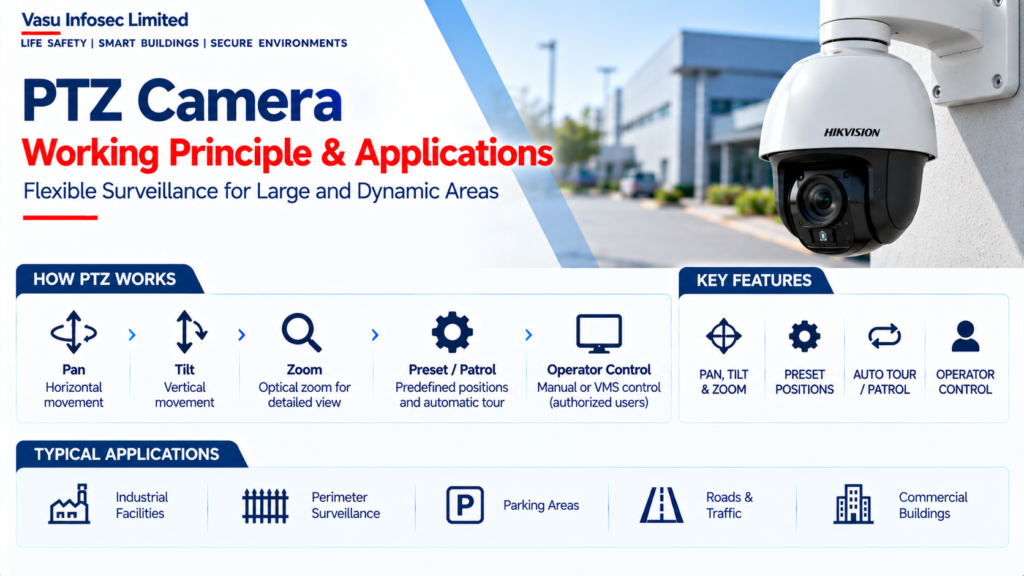
PTZ Camera: Working Principle & Applications
Oct 2026
Direct Answer
A Pan-Tilt-Zoom (PTZ) camera is a remotely controllable CCTV camera that changes viewing direction through horizontal pan and vertical tilt movements and adjusts magnification through optical zoom. It is useful for active surveillance, wide-area coverage, long-range observation and programmed patrols. PTZ selection and configuration should account for the surveillance objective, pan/tilt range, optical zoom, lighting, mounting, environmental conditions, network and power requirements, VMS integration and the need for continuous fixed-camera coverage in critical areas.
1. Engineering Overview
A Pan-Tilt-Zoom (PTZ) camera is a remotely controllable CCTV camera capable of changing its viewing direction through pan and tilt movements and changing magnification through optical zoom. PTZ cameras are used where active surveillance, wide-area coverage, long-range observation or programmed patrol functions are required.
2. PTZ Camera Architecture
PTZ Camera → PoE / Network Switch → CCTV Network → NVR / VMS → Storage → Operator Workstation / Video Wall
Control Path → Operator / VMS → Network → PTZ Camera → Pan / Tilt / Zoom Mechanism
Supporting Infrastructure → UPS → Network Management → Time Synchronisation → Cybersecurity
3. Working Principle
The camera captures video through its imaging sensor and lens while motorised mechanisms control horizontal rotation, vertical movement and optical zoom. Commands from an authorised operator or programmed VMS function are transmitted to the camera through the approved communication network.
4. Pan Function
Pan provides horizontal movement of the camera around its mounting axis. The available pan range depends on the selected PTZ model and mechanical design. Pan limits and operating speed should be configured according to the installation requirements.
5. Tilt Function
Tilt provides vertical movement of the camera. Tilt range determines how effectively the camera can observe areas above and below its normal horizontal viewing position. Mounting geometry should be considered when defining the required tilt range.
6. Optical Zoom
Optical zoom changes the effective focal length of the lens while maintaining the optical image path. Optical zoom is preferred where detailed observation of distant targets is required. Digital zoom enlarges an existing image and does not provide the same optical detail.
7. Preset Positions
Preset positions allow the PTZ camera to store defined pan, tilt and zoom settings. Operators can recall presets to rapidly direct the camera toward important surveillance areas.
8. Preset Tours
A preset tour automatically moves the PTZ camera through a programmed sequence of preset positions. Tour dwell time, movement sequence and operating schedule should be defined according to the approved surveillance philosophy.
9. Auto Scan / Patrol
Where supported, PTZ cameras may execute programmed patrol or scan functions. The configuration should ensure that critical surveillance areas receive appropriate viewing time and that automated movement does not compromise required coverage.
10. Manual Operator Control
Authorised operators may control pan, tilt, zoom, focus and other supported camera functions through the VMS or approved controller. User permissions should restrict PTZ control to authorised personnel.
11. PTZ Speed & Control
PTZ movement speed should be appropriate for the surveillance application. High-speed movement may support rapid response, while controlled low-speed movement can improve observation of critical areas.
12. Auto Focus & Image Control
PTZ cameras may provide automatic or manual focus and other image-processing functions. Focus behaviour should be verified during commissioning across the intended operating range.
13. Wide-Area Surveillance
PTZ cameras are suitable for large yards, campuses, parking areas, roads, industrial sites and other locations where one camera can actively observe multiple zones.
14. Perimeter Surveillance
PTZ cameras can support perimeter monitoring by providing long-range observation and operator-controlled verification of detected events. Fixed cameras or other detection systems may be required to maintain continuous coverage of the full perimeter.
15. Traffic & Road Monitoring
PTZ cameras may be used for road, intersection, parking and traffic observation where active viewing and zoom capability are beneficial. Mounting height, viewing angle and lighting should be assessed carefully.
16. Industrial Applications
Industrial facilities may use PTZ cameras for yards, process areas, storage areas, loading zones and other large operational spaces. Environmental protection and suitable mounting should be selected for the operating conditions.
17. Data Centre Applications
PTZ cameras may be used for external yards, loading areas, entrances and other large spaces around data-centre facilities. Critical internal security zones may require fixed cameras to maintain continuous coverage.
18. PTZ vs Fixed Camera
PTZ cameras provide flexible active viewing but their direction changes over time. Fixed cameras provide continuous observation of a defined field of view. For critical areas, PTZ cameras should generally complement rather than replace required fixed coverage.
19. Camera Selection Criteria
PTZ selection should consider:
- Required surveillance range
- Pan range
- Tilt range
- Optical zoom ratio
- Minimum illumination
- Resolution
- Pixel density at target distance
- WDR capability
- IR / low-light capability
- Preset capacity
- Patrol / tour functions
- Environmental protection
- Mounting arrangement
- Network interface
- PoE / power requirements
- VMS compatibility
- Analytics capability
20. Network & Power Requirements
IP PTZ cameras require suitable network connectivity and adequate power. High-performance PTZ cameras may require power levels beyond standard PoE configurations, so switch and power budgets should be verified against the manufacturer’s requirements.
21. Mounting Arrangement
PTZ mounting should provide adequate structural support, vibration control, viewing height and access for maintenance. Pole, wall, ceiling or pendant mounting should be selected according to the application and approved structural arrangement.
22. Environmental Protection
Outdoor PTZ cameras should have suitable ingress protection, temperature range, impact resistance and corrosion protection where required. Environmental characteristics should match the installation conditions.
23. Integration with VMS
The PTZ camera should be compatible with the approved VMS / NVR and support the required live viewing, recording, PTZ control, presets and other approved functions. Integration should be verified during commissioning.
24. Installation Requirements
Installation should verify:
- Correct PTZ model
- Correct mounting arrangement
- Correct pan / tilt orientation
- Correct lens / zoom capability
- Correct network connectivity
- Correct power supply
- Correct IP addressing
- Correct VMS integration
- Correct preset configuration
- Correct patrol / tour configuration
- Proper cable routing and segregation
25. Testing & Commissioning
PTZ commissioning should verify:
- Live video
- Image quality
- Pan operation
- Tilt operation
- Optical zoom
- Focus
- Preset positions
- Preset tours
- Manual operator control
- Day / night operation
- IR operation, where applicable
- Recording
- Playback
- Communication failure indication
26. Maintenance
Maintenance should include lens and housing cleaning, mechanical movement verification, preset verification, image-quality checks, network connectivity, power checks, firmware / configuration review and inspection of mounting hardware.
27. Design Change Control
Changes to PTZ model, optical zoom, mounting position, preset configuration, patrol routes, network configuration or VMS integration should be reviewed because they can affect surveillance coverage, operational response, bandwidth, storage and system performance.
28. Documentation
PTZ camera documentation should include, as applicable:
- PTZ camera schedule
- Camera model and specifications
- Pan / tilt range
- Optical zoom specification
- Preset schedule
- Patrol / tour schedule
- Mounting details
- Network and power requirements
- VMS integration details
- Camera layout drawings
- Testing and commissioning records
- As-built drawings
- O&M manual
29. Engineering Objective
The engineering objective is:
Define Wide-Area Surveillance Requirement → Select Suitable PTZ → Validate Pan / Tilt / Optical Zoom → Confirm Mounting & Environmental Conditions → Configure Presets & Patrols → Verify Network, Power & VMS → Complete Testing → Establish Reliable Active Surveillance
Frequently Asked Questions
What does PTZ mean?
PTZ stands for Pan-Tilt-Zoom: horizontal movement, vertical movement and optical zoom.
What is the difference between optical and digital zoom?
Optical zoom changes the lens’s effective focal length through the optical image path. Digital zoom enlarges an existing image and does not provide the same optical detail.
Can PTZ cameras replace fixed cameras around a perimeter?
Not necessarily. PTZ cameras change direction over time, so fixed cameras or other detection systems may be needed to maintain continuous coverage of the full perimeter.
What are presets and preset tours?
Presets store defined pan, tilt and zoom settings. Preset tours move the camera through a programmed sequence of those positions.
What should be checked during PTZ commissioning?
Verify live video, image quality, pan, tilt, optical zoom, focus, presets, tours, operator control, day/night operation, applicable IR, recording, playback and communication-failure indication.
SEO & Publishing Details
| SEO title | PTZ Camera Working Principle and Applications | Vasu Infosec Limited |
| Meta description | Learn how PTZ CCTV cameras use pan, tilt, optical zoom, presets and patrols for wide-area surveillance, with selection, integration and commissioning considerations. |
| Primary keyword | PTZ camera working principle |
| Secondary keywords | PTZ CCTV camera, pan tilt zoom camera, PTZ camera applications, optical zoom CCTV, PTZ preset tour, perimeter surveillance camera, PTZ commissioning |
| Suggested URL slug | ptz-camera-working-principle-applications |
| Suggested image alt text | PTZ CCTV camera with pan, tilt and optical zoom functions for wide-area surveillance |