
Article
Room Integrity / Enclosure Integrity Testing
Oct 2026
Direct Answer
Room integrity testing evaluates whether a protected enclosure has leakage characteristics that can support the required extinguishing-agent retention period. The assessment should use the approved test procedure, applicable requirements and the design criteria for the selected gas suppression system.
1. Engineering Overview
Room Integrity / Enclosure Integrity Testing verifies whether a protected enclosure has sufficient leakage characteristics to retain the extinguishing agent for the required hold period. The test supports validation of the engineered gas suppression system and should be performed using the approved test procedure and applicable requirements.
2. Integrity Testing Architecture
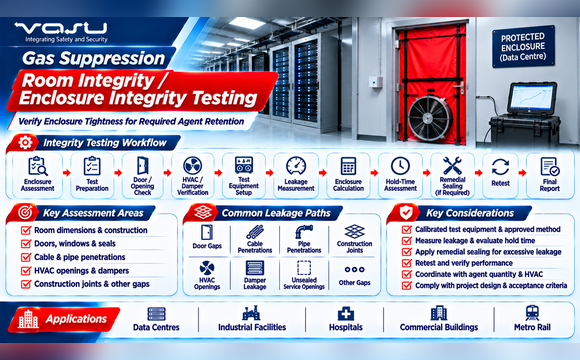
Protected Enclosure Assessment → Test Preparation → Door / Opening Check → HVAC / Damper Verification → Test Equipment Setup → Leakage Measurement → Enclosure Calculation → Hold-Time Assessment → Remedial Sealing, if Required → Retest → Final Report
3. Purpose of Integrity Testing
The purpose of the test is to determine whether unintended leakage from the protected enclosure could adversely affect the required agent concentration and hold period after discharge.
4. Protected Enclosure Assessment
Before testing, the actual protected enclosure should be reviewed against approved drawings and system documentation.
The assessment may include:
- Room dimensions
- Walls and partitions
- Ceiling construction
- Floor construction
- Doors
- Windows / glazing
- Cable penetrations
- Pipe penetrations
- HVAC openings
- Dampers
- Other openings
5. Test Preparation
The enclosure should be prepared in accordance with the approved test procedure.
Preparation may include:
- Closing doors
- Confirming HVAC condition
- Confirming damper position
- Checking permanent penetrations
- Identifying temporary openings
- Confirming room configuration
- Ensuring test access and safety
6. Leakage Path Identification
Potential leakage paths should be identified before or during testing.
Typical leakage paths include:
- Door gaps
- Cable penetrations
- Pipe penetrations
- Construction joints
- HVAC openings
- Damper leakage
- Unsealed service openings
- Other building envelope gaps
7. Test Equipment
Integrity testing should use suitable calibrated test equipment capable of measuring the enclosure leakage characteristics required by the approved test methodology. Equipment setup and operation should follow the manufacturer’s instructions and approved test procedure.
8. Test Methodology
The test procedure should establish the enclosure’s leakage characteristics under controlled conditions. Measurements should be taken in accordance with the approved methodology and used to determine the expected agent retention performance.
9. Pressure Measurement
The test may involve establishing controlled pressure differences across the enclosure and measuring the resulting airflow. The measured data provides the basis for evaluating the enclosure leakage characteristics.
10. Hold-Time Assessment
The test results should be assessed against the required agent hold period established by the approved suppression design. The assessment should consider the actual enclosure condition and the applicable calculation methodology.
11. Acceptance Criteria
Acceptance should be based on the approved project design, applicable requirements and the test methodology used for the selected gas suppression system. The final result should demonstrate that the enclosure can support the required suppression performance.
12. Excessive Leakage
If excessive leakage is identified, the affected leakage paths should be investigated and corrected before final acceptance.
Corrective measures may include:
- Sealing cable penetrations
- Sealing pipe penetrations
- Adjusting door seals
- Treating construction joints
- Correcting damper leakage
- Closing unintended openings
13. Remedial Sealing
Sealing materials and methods should be compatible with the enclosure construction and approved fire protection requirements. Remedial work should not adversely affect doors, dampers, fire-rated construction or other building services.
14. Retesting
After corrective action, the enclosure should be retested where required. The retest should verify the actual as-built condition and confirm that the revised enclosure performance satisfies the approved integrity requirements.
15. Coordination with Agent Quantity
Room integrity is directly related to agent retention. Any significant change to room leakage, volume, openings or enclosure configuration should be reviewed against the approved agent quantity calculation and overall suppression design.
16. Coordination with HVAC & Dampers
HVAC equipment and dampers should be checked as part of the enclosure integrity assessment where they form part of the protected enclosure boundary. Their operating position during the test should correspond with the approved suppression sequence.
17. Testing & Commissioning
Integrity testing should be coordinated with final suppression commissioning.
Verification may include:
- Actual room configuration
- Door condition
- Penetration sealing
- HVAC / damper condition
- Test result review
- Hold-time assessment
- Corrective action closure
- Final system acceptance
18. Common Engineering Considerations
Engineering review should verify:
- Correct protected enclosure
- Accurate room volume
- Complete leakage-path assessment
- Test equipment suitability
- Approved test methodology
- Correct pressure measurements
- Hold-time assessment
- Remedial sealing
- Retesting
- Final report
19. Documentation
Room integrity documentation should include, as applicable:
- Protected room details
- Room volume information
- Test procedure
- Test equipment details
- Calibration information
- Test measurements
- Leakage assessment
- Hold-time calculation / result
- Remedial action records
- Retest report
- Final acceptance documentation
20. Engineering Objective
The engineering objective is:
Complete Enclosure Assessment → Accurate Test Preparation → Controlled Leakage Measurement → Valid Hold-Time Assessment → Effective Remedial Sealing → Verified Retest → Confirmed Agent Retention → Complete Documentation → Reliable Gas Suppression System Performance
Frequently Asked Questions
What is room integrity testing?
It is an assessment of enclosure leakage characteristics to evaluate whether the protected room can retain the extinguishing agent for the required hold period.
Why is enclosure integrity important for gas suppression?
Unintended leakage may adversely affect agent concentration and retention after discharge.
Which areas should be checked before testing?
The source document identifies room boundaries and dimensions, walls, ceiling and floor construction, doors, glazing, cable and pipe penetrations, HVAC openings, dampers and other openings.
What happens if excessive leakage is found?
Investigate and correct affected leakage paths. Retesting should be performed where required to verify the as-built condition against approved integrity requirements.
Can acceptance criteria be assumed to be the same for every system?
No. Acceptance should be based on the approved project design, applicable requirements and the test methodology used for the selected gas suppression system.
What records should be retained?
As applicable, retain room details and volume information, test procedure, test equipment and calibration information, measurements, leakage and hold-time assessment, remedial action records, retest report and final acceptance documentation.
SEO & Website Publishing Details
SEO title: Room Integrity Testing for Gas Suppression Systems
Meta description: Learn how room integrity testing evaluates enclosure leakage, agent hold time, HVAC openings, remedial sealing, retesting and documentation for gas suppression systems.
Suggested URL slug: /engineering/room-integrity-testing-gas-suppression/
Primary keyword: room integrity testing
Related keywords: enclosure integrity testing, gas suppression room leakage, agent hold time assessment, protected enclosure leakage, gas suppression commissioning
Suggested internal links: Gas Suppression System Design Workflow; Gas Suppression Enclosure Integrity; Gas Suppression Agent Quantity Calculation; Gas Suppression Testing and Commissioning.