
Article
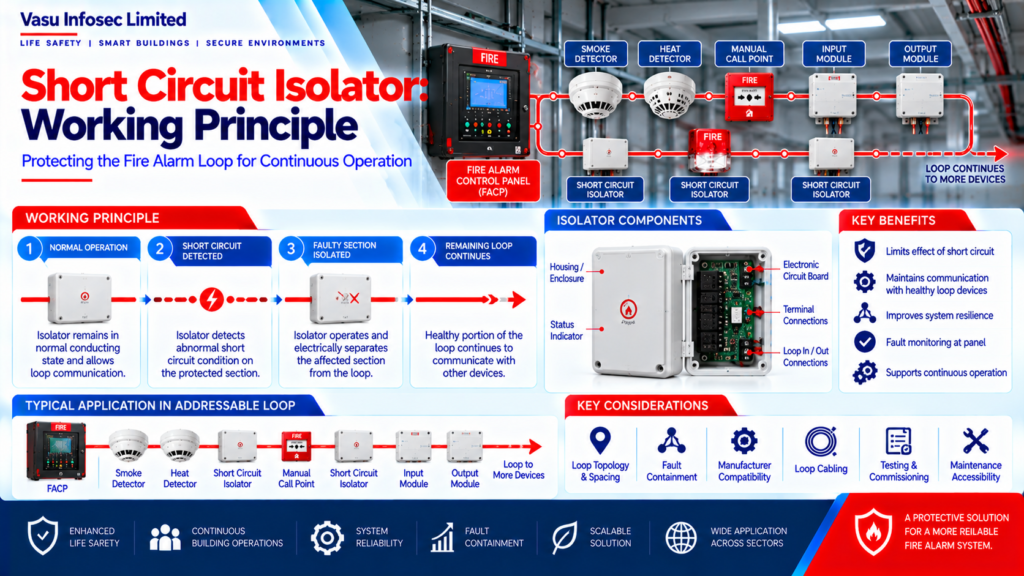
Short Circuit Isolator: Working Principle
Oct 2026
Direct Answer
A short circuit isolator is a protective device used in an addressable fire alarm loop. When it detects a short circuit in its protected section, it electrically isolates the affected section so that unaffected parts of the loop may continue communicating, subject to the approved system architecture and the manufacturer’s requirements.
1. Engineering Overview
A Short Circuit Isolator is a protective device used in an addressable fire alarm loop to limit the effect of a short circuit on the communication path. It detects an abnormal short circuit condition and isolates the affected section so that the remaining healthy portion of the loop can continue to communicate, subject to the approved system architecture and manufacturer requirements.
2. Short Circuit Isolation Architecture
Addressable Loop → Short Circuit Isolator → Protected Loop Section → Field Devices → Short Circuit Condition → Isolator Operates → Faulty Section Isolated → Remaining Loop Devices Continue Communication
3. Working Principle
Under normal conditions, the isolator remains in its normal conducting state and permits communication between the fire alarm control panel and connected field devices. When a short circuit is detected on the protected section, the isolator operates and electrically separates the affected section from the healthy portion of the loop.
4. Purpose of Isolation
The primary purpose of the isolator is to limit the extent of loop impairment caused by a short circuit. This helps maintain communication with unaffected devices and supports system resilience.
5. Normal Operating Condition
During normal operation, the isolator allows the addressable loop communication path to remain continuous. The device monitors the circuit for abnormal electrical conditions while remaining transparent to normal system communication.
6. Short Circuit Condition
When a short circuit occurs on the protected section, the isolator detects the abnormal condition and changes its electrical state. The affected section is isolated to prevent the short circuit from impairing the wider loop.
7. Restoration Principle
After the short circuit is removed and the circuit returns to an acceptable condition, the isolator may restore the protected section automatically or according to the selected manufacturer’s operating logic. The Fire Alarm Control Panel should confirm the restoration and clear the corresponding fault when appropriate.
8. Isolator Location & Arrangement
Isolators should be positioned according to the approved loop architecture and manufacturer requirements.
Engineering considerations include:
- Loop topology
Protected circuit sections
• Device distribution
• Fault containment
• Accessibility
• Maintenance requirements
• Physical protection
9. Isolator Spacing Philosophy
The number and location of isolators should be determined from the approved design and the selected system’s requirements. The arrangement should ensure that a single short circuit does not unnecessarily affect a large portion of the protected fire alarm system.
10. Compatibility
The isolator should be compatible with the selected Fire Alarm Control Panel, addressable loop protocol, field devices and system architecture. Manufacturer compatibility requirements should be verified before installation.
11. Fault Monitoring
The Fire Alarm Control Panel should indicate the resulting loop fault or isolated condition according to the selected system architecture. The indication should assist maintenance personnel in identifying and rectifying the affected section.
12. Testing & Commissioning
Testing should verify correct isolator operation and system resilience.
Testing may include:
- Normal communication test
Controlled short circuit simulation
• Isolator operation verification
• Healthy loop device communication
• Fault indication at panel
• Restoration after fault removal
• Event recording
13. Inspection & Maintenance
Short circuit isolators should be inspected as part of the fire alarm system maintenance programme.
Activities may include:
- Visual inspection
Physical condition check
• Wiring / termination inspection
• Fault history review
• Functional testing
• Verification of connected loop sections
14. Common Engineering Considerations
Engineering review should verify:
- Correct isolator type
Manufacturer compatibility
• Loop architecture
• Protected section arrangement
• Fault containment
• Device distribution
• Accessibility
• Correct panel indication
• Testing requirements
• Maintenance provisions
15. Documentation
Isolator documentation should include, as applicable:
- Isolator datasheet
Loop architecture
• Loop drawings
• Device schedule
• Isolator location schedule
• Cable schedule
• Cause & Effect Matrix, where applicable
• Testing records
• Commissioning records
• As-built documentation
16. Engineering Objective
The engineering objective is:
Reliable Loop Supervision → Rapid Short Circuit Detection → Effective Section Isolation → Protection of Healthy Loop Devices → Clear Fault Indication → Controlled Restoration → Verified Testing → Maintainable Fire Alarm Loop Resilience
Frequently Asked Questions
What does a short circuit isolator do?
It isolates the affected section of an addressable fire alarm loop when a short circuit is detected, helping limit the effect on unaffected devices.
Will all devices continue operating during a short circuit?
Not necessarily. The outcome depends on the loop architecture, isolator arrangement, fault location and manufacturer-specific system behaviour.
Where should short circuit isolators be installed?
Locations and spacing should follow the approved loop architecture, protected-section design and the selected manufacturer’s requirements.
Does an isolator reset automatically?
Restoration behaviour varies by manufacturer and system. The source document notes that restoration may be automatic or follow the selected manufacturer’s operating logic after the short circuit is removed.
What should be verified during commissioning?
The source identifies normal communication, controlled short-circuit simulation, isolator operation, communication with healthy devices, panel fault indication, restoration and event recording as possible test items.
SEO and CMS Recommendations
| SEO title | Short Circuit Isolator: Working Principle in Fire Alarm Loops | Vasu Infosec |
| Meta description | Learn how a short circuit isolator detects and isolates a faulted section of an addressable fire alarm loop, including placement, compatibility, testing and restoration. |
| Suggested URL slug | /short-circuit-isolator-working-principle/ |
| Primary keyword | short circuit isolator working principle |
| Related keywords | fire alarm loop isolator, addressable fire alarm loop, short circuit fault isolation, fire alarm loop testing |
| Suggested internal links | Fire Alarm Loop Architecture; Addressable Fire Alarm Systems; Fire Alarm Testing & Commissioning |
Technical Review and Pre-Publication Checklist
- Confirm the selected isolator is compatible with the fire alarm control panel, loop protocol and connected devices.
- Verify loop topology, protected sections and isolator locations against approved drawings and manufacturer documentation.
- Confirm the approved commissioning method and safe, controlled approach for short-circuit simulation.
- Check that restoration behaviour and panel fault indications match the selected system documentation.
- Confirm applicable project standards, editions and requirements before publication; none are specified by name in the source document.
- Ensure project-specific obligations are described only where supported by approved contract and project documents.