
Article
Sprinkler Head Types & Selection
Oct 2026
Direct Answer
Sprinkler head selection determines how water is discharged, the sprinkler’s operating temperature and response characteristics, and its suitability for the protected hazard. Selection should follow the approved sprinkler design, hazard classification, ceiling configuration, hydraulic calculation and applicable manufacturer requirements.
1. Engineering Overview
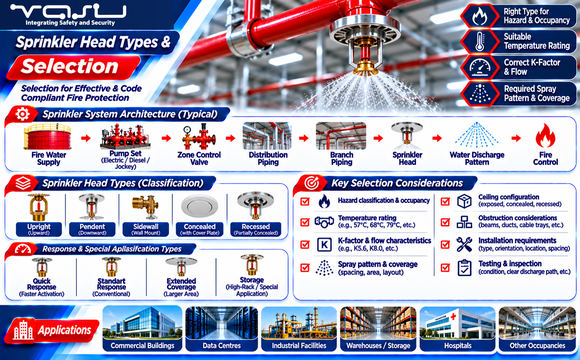
Sprinkler heads are the final discharge devices of an automatic sprinkler system. Their selection determines discharge characteristics, operating temperature, spray distribution and suitability for the protected hazard. Selection should be based on the approved sprinkler design, hazard classification, ceiling configuration and applicable manufacturer requirements.
2. Sprinkler Head Architecture
Fire Water Supply → Pump Set → Zone Control Valve → Distribution Piping → Branch Piping → Sprinkler Head → Water Discharge Pattern → Fire Control
3. Sprinkler Head Classification
Sprinkler heads may be classified according to mounting orientation, discharge pattern, operating temperature, response characteristics and application. The selected type should correspond with the approved system design.
4. Upright Sprinkler Heads
Upright sprinklers are installed with the deflector positioned above the sprinkler frame. They may be suitable for exposed piping arrangements where the approved design requires an upward-oriented sprinkler configuration.
5. Pendent Sprinkler Heads
Pendent sprinklers are installed below the piping with the deflector positioned beneath the sprinkler frame. They are commonly used below ceilings and in areas where the approved design requires downward water distribution.
6. Sidewall Sprinkler Heads
Sidewall sprinklers are arranged adjacent to walls and discharge water across the protected area. Their application should follow the manufacturer’s approved spacing and coverage criteria.
7. Concealed Sprinkler Heads
Concealed sprinklers are installed behind an approved cover plate or concealed arrangement. The selected product should be compatible with the ceiling construction and approved installation requirements.
8. Recessed Sprinkler Heads
Recessed sprinklers are installed partially within the ceiling or mounting surface. The recess arrangement should comply with the manufacturer’s installation requirements so that the sprinkler operates and distributes water correctly.
9. Quick Response Sprinklers
Quick response sprinklers are designed with a faster thermal response characteristic than standard response types. Selection should be based on the approved hazard classification and applicable design criteria.
10. Standard Response Sprinklers
Standard response sprinklers provide the thermal response characteristics defined by their approved listing and manufacturer data. Their use should correspond with the approved design basis.
11. Extended Coverage Sprinklers
Extended coverage sprinklers are designed for larger approved coverage areas than conventional sprinklers. Their use requires compliance with the specific manufacturer’s coverage, pressure and spacing limitations.
12. Storage Sprinklers
Storage applications may require specialised sprinkler types based on storage commodity, storage arrangement, rack configuration, storage height and ceiling height. The selected sprinkler should be approved for the intended storage application.
13. Temperature Rating
Sprinkler temperature rating should be selected based on the maximum expected ambient or ceiling temperature and the applicable design requirements. The rating should be suitable for the installation environment.
14. K-Factor & Flow Characteristics
The sprinkler K-factor establishes the relationship between discharge flow and operating pressure. The selected K-factor should be compatible with the approved hydraulic calculation and required design density.
15. Spray Pattern & Coverage
Sprinkler discharge pattern and coverage should match the intended hazard and layout. Spacing, distance from walls, ceiling configuration and obstructions should be considered during selection.
16. Hazard Classification Coordination
Sprinkler head selection should be coordinated with the applicable hazard classification. Occupancy, fire load, combustible materials, storage arrangement and ceiling conditions should be assessed before final selection.
17. Obstruction Considerations
Beams, ducts, cable trays, lighting fixtures, structural members and other obstructions can affect sprinkler discharge. The selected sprinkler type and layout should maintain the required water distribution.
18. Installation Requirements
Installation should verify:
- Correct sprinkler type
Correct temperature rating
• Correct K-factor
• Correct orientation
• Correct location
• Correct spacing
• Correct elevation
• Correct fitting / connection
• Protection from physical damage
19. Testing & Inspection
Sprinkler head inspection should verify physical condition, correct installation, clear discharge path and absence of contamination or obstruction. Testing and maintenance should follow the approved inspection procedure and manufacturer requirements.
20. Documentation
Sprinkler selection documentation should include, as applicable:
- Sprinkler datasheets
Sprinkler schedule
• Approved layout drawings
• Hydraulic calculation
• Hazard classification
• Temperature rating details
• K-factor details
• Manufacturer approvals / listings
• Inspection records
• Testing and commissioning records
21. Engineering Objective
The engineering objective is:
Hazard Assessment → Correct Sprinkler Classification → Suitable Mounting Type → Correct Temperature Rating → Appropriate K-Factor → Verified Coverage → Obstruction Coordination → Hydraulic Validation → Accurate Installation → Reliable Fire Protection
Frequently Asked Questions
What factors determine sprinkler head selection?
The source identifies the approved design, hazard classification, ceiling configuration, manufacturer requirements, temperature rating, K-factor, spray pattern, coverage, spacing and obstructions as relevant considerations.
What is the difference between upright and pendent sprinklers?
Upright sprinklers have the deflector above the sprinkler frame; pendent sprinklers are installed below the piping with the deflector beneath the frame.
When may sidewall sprinklers be used?
The source describes sidewall sprinklers as arranged adjacent to walls to discharge water across the protected area; application must follow the manufacturer’s approved spacing and coverage criteria.
What should be considered for storage sprinklers?
Selection may depend on storage commodity, storage arrangement, rack configuration, storage height and ceiling height. The sprinkler should be approved for the intended storage application.
What is the sprinkler K-factor?
The source states that K-factor establishes the relationship between discharge flow and operating pressure; the selected value should align with the approved hydraulic calculation and required design density.
What should be checked during installation and inspection?
Verify sprinkler type, temperature rating, K-factor, orientation, location, spacing, elevation, fitting/connection and protection from physical damage; inspection should also check condition, clear discharge path, contamination and obstruction.
SEO and Website Publishing Details
| SEO title | Sprinkler Head Types and Selection Guide | Vasu Infosec Limited |
| Meta description | Understand sprinkler head types and selection factors, including upright, pendent, sidewall, concealed, recessed, quick response, extended coverage and storage sprinklers. |
| Suggested URL slug | /sprinkler-head-types-selection/ |
| Primary keyword | sprinkler head types and selection |
| Secondary keywords | upright sprinkler head; pendent sprinkler head; sidewall sprinkler; quick response sprinkler; sprinkler K-factor; storage sprinkler selection |
| Suggested internal links | Automatic Sprinkler System Architecture; Sprinkler Hydraulic Design; Fire Pump System; Fire Alarm System Integration |